Stretch V. Where it goes
What an aerobic system needs from you
What does an aerobic septic system need from you?
Chapter 25 of 34. Sources checked .
It needs someone responsible for it, always. A two-year service policy comes first; after that you keep a licensed provider on contract or, where local rules allow, maintain it yourself, though opening lids stays with a licensed provider. It needs the right chlorine, working power, grass over the spray field and lids that stay shut.
25-1 The contract comes with the system
Chapter 24 explained why a place on clay may end up with a pumped system. If yours is an aerobic unit with spray heads, like the one in Figure 25-1, it comes with duties that a conventional tank never had.
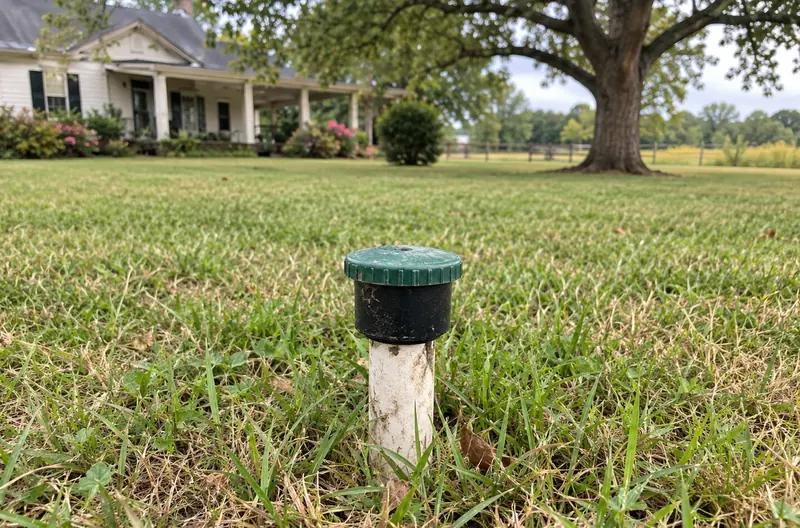
The first duty runs itself for a while: "The initial two-year service policy shall be effective for two years from the date the OSSF is first used."1 After that: "the owner of an OSSF for a single family residence shall either maintain the system personally or obtain a new maintenance contract."1 That choice applies only to a single-family house. It is not for "commercial, speculative residential, or multifamily property."1
The choice is less free than it sounds. TCEQ says: "Some permitting authorities have adopted more stringent requirements, which may require homeowner training or even a prohibition against homeowner maintenance."2 State law adds a further step: an owner "in a county with a population of at least 40,000" who self-maintains and violates the rules has 10 days after notice to correct it or sign a contract, and a second violation before the third anniversary means a contract.3 This book did not check county populations, so ask your authorized agent whether that sentence applies to you.
This book does not teach self-maintenance. It would take you to tanks and chlorinators, and it needs training and your local authority's yes. Most of what follows assumes a licensed provider, and the provider must be one: "The contract must be with a 'licensed' maintenance provider. A maintenance provider is an individual person."2
25-2 What a contract should say
TCEQ tells you what to look for: the items covered, the time to respond to a complaint, the named person, how often they maintain, test and report, and "who is responsible for maintaining the disinfection unit."2
| Item | Figure | Note |
|---|---|---|
| Reports | "at least once every four months" | May drop to six months with electronic monitoring; due "within 14 days after the test is performed" |
| Surface application testing | At least every four months | "0.1 mg/l Residual in Pump Tank or Fecal Coliform Not To Exceed 200 MPN/100 ml" |
| Self-maintaining owner | "not subject to testing and reporting requirements" | Still bound by everything else |
| Tag | Weather-resistant, marked at each check | Names provider, phone and start date |
| Pumping | "depends on the depth of sludge and manufacturer's recommendations" | Your provider's call; pumpers must be registered with TCEQ |
| Inspection | "at any time" | "An authorized agent or the commission may inspect" |
Those rule figures are from the 2017 compilation, and Section 285.7 was among those amended in 2023, so confirm with your agent.1 4 The maker must also "make available to the homeowner all replacement parts," which helps when a provider quits or moves away.1
25-3 Chlorine, and the mistake to avoid
TCEQ's warning is in capitals for a reason: "WARNING: DO NOT use swimming pool chlorine tablets in your disinfection system." Pool tablets are trichloroisocyanuric acid, and "there is a danger of explosion." They are "not approved by EPA for wastewater effluent disinfection." The right tablet is "made from calcium hypochlorite and is certified for wastewater disinfection by EPA."2
Storage matters as well. "Chlorine tablets release chlorine gas. Do not store chlorine tablets in the house, garage or storage areas with metal tools."5 Ask your provider who supplies them and where to store them on your place.
25-4 The spray field and the lids
What comes out of the heads is not clean water. AgriLife says "the water exiting the spray heads may still contain potentially harmful pathogens," and tells you to keep a healthy grass cover.6 Its bulletin says residents and pets should avoid contact, and Texas rules prohibit applying effluent to vegetable gardens.5 Keep the children's play and the garden out of that area. Never connect a hose or sprinkler of your own to it.
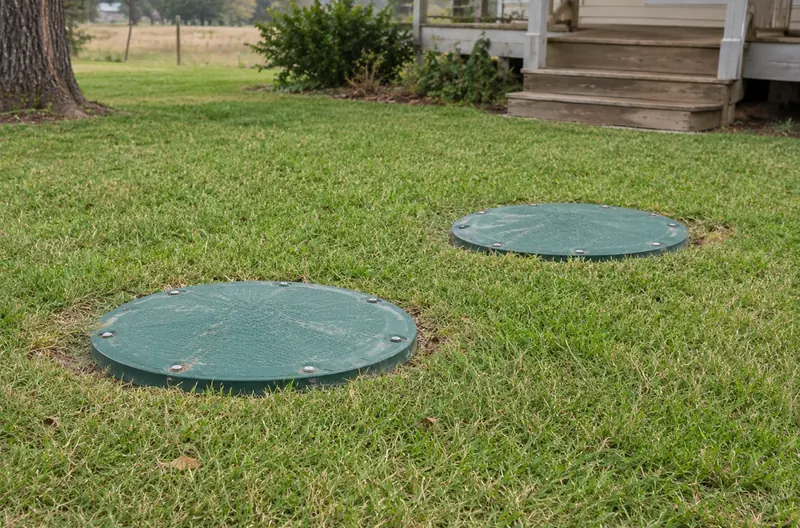
Figure 25-2 shows the lids you are likely to see. They stay closed. Hazards in these systems include "poisonous or explosive gases... and confined space entry," in AgriLife's words.5 Never open a tank or riser yourself, and never lean into one. Its bulletin lists the safety measures: "installing fencing for components, risers with heavy concrete lids, lighter lids with safety screws, lighter lids with locking mechanisms."5 The 2017 rule requires "a secondary plug, cap, or other suitable restraint system" below a riser cap.1 If a lid is cracked or loose, keep children and pets away from it and call your provider that day.
25-5 Alarms, outages and rain
Aerobic units depend on electricity, and rural power goes out. AgriLife's outage sheet gives the arithmetic. Systems that need power must hold a reserve of one-third of a day's design flow, so a three-bedroom system rated for 240 gallons a day holds about 80 gallons.7 One 10-minute shower uses about 25.
During an outage, "Limit your water usage to essentials such as toilet flushing and hand washing." Then: "Stop all water use if the electrical outage is extended or the plumbing begins to drain slowly."7 After power returns, ease back in. Limit laundry and dishwashing, and if the outage ran longer than a day, stop those for a day and limit showers. The high-water alarm may sound. "You can silence the alarm if it has a silence switch option. Contact your service provider if the alarm remains activated for more than 24 hours."7 After a long outage, the spray water may not be up to normal, so make sure your provider checks the disinfection unit, and "limit activity in the distribution area."7
Rain is the other tell. Rainwater may be getting in if there is "an unexplained number of dosing cycles" or spraying during a shower.5 If you are away for a while, the bacteria drop off too, so increase water use gradually on return.5
Who decides this
- Is a contract required after two years?
- State rule plus your local authority; ask the authorized agent
- Is the county over the 40,000 line?
- Ask the authorized agent
- Who may service the unit?
- A TCEQ-licensed maintenance provider, by name
- Who opens the lids?
- Your licensed provider; you stay off and out
- Alarm still on after 24 hours
- Your service provider
On your own place
- Check your contract's end date and named provider against the tag on the unit.
- Read the tag, and see whether the last visit was marked.
- Look at each spray head from a few feet away, with the system idle, for damage or blocked heads.
- Check the lids by eye for cracks, and that they sit closed and secure, without lifting them.
- Check any chlorine tablet label for calcium hypochlorite, and move storage away from the house, garage and metal tools.
- Note where the breaker and alarm are, and write down your provider's name beside them.
Notes
- TCEQ, On-Site Sewage Facility Rules Compilation RG-472, May 2017: 30 TAC 285.7, 285.38(c), 285.91(4). tceq.texas.gov (read November 4, 2026) ↩
- TCEQ, OSSF Maintenance. tceq.texas.gov (read November 4, 2026) ↩
- Texas Health and Safety Code ch. 366, section 366.0515(g). tcss.legis.texas.gov (read November 4, 2026) ↩
- TCEQ, adoption order, Project 2021-030-285-CE. tceq.texas.gov (read November 4, 2026) ↩
- Texas A&M AgriLife, B-6234, Living with an Aerobic Treatment Unit and Spray Field. ossf.tamu.edu (read November 4, 2026) ↩
- Texas A&M AgriLife, OSSF Frequently Asked Questions. ossf.tamu.edu (read November 4, 2026) ↩
- Texas A&M AgriLife, L-5475, Responding to Power Outages and Floods. ossf.tamu.edu (read November 4, 2026) ↩