Stretch V. Where it goes
Getting a septic permit, step by step
How do you get a septic permit, and from whom?
Chapter 23 of 34. Sources checked .
You get it from the authorized agent for your county, or TCEQ's regional office where none covers you. A licensed site evaluator or engineer studies the land, you file the application with planning materials and fee, the authority answers within 30 days, and the work is inspected before use.
23-1 Start at the right office
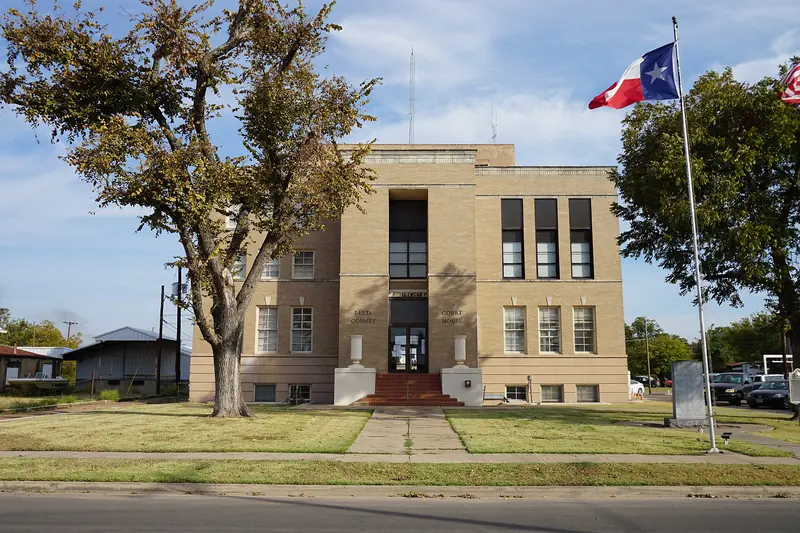
Chapter 22 named the authorized agent for each county. In Lamar County that is the county's agent, for "unincorporated County + City of Paris; administered by Paris Lamar County Health District."1 In Delta County, which Figure 23-1 shows, the listing says "entire County."1 Start by calling or visiting that office and asking for its form, its fee and its local order. This book did not read those local orders, and TCEQ warns they can be stricter than the state's.2
23-2 The order of the work
The rules set the sequence, and most of it runs on licensed people.
| Step | What the rule says | Who |
|---|---|---|
| Site evaluation | "shall be performed by either a site evaluator or a professional engineer on every tract of land where an OSSF will be installed" | Licensed evaluator or engineer |
| Soil work | "either drill two soil borings or excavate two backhoe pits at opposite ends of the proposed disposal area" | The same; 811 first |
| Application | Authority's form, planning materials, "the results of a site evaluation" and "the appropriate fee" | You, with your designer |
| Affidavit | Systems needing continuous maintenance "must record an affidavit in the county deed records" before authorization | You |
| Decision | "shall either approve or deny an application within 30 days"; denial reasons in writing | Permitting authority |
| Authorization | "valid for one calendar year from the date of its issuance" | Permitting authority |
| Inspection | Installer gives notice "at least five working days" before ready; written approval within seven calendar days of passing | Installer and authority |
The citations for those lines are all in the same compilation of the rules.3 Remember that it dates from May 2017 and that some sections were amended in 2023, so check any deadline with your agent.4
If you are denied, "You may appeal this decision to the permitting authority's supervisory authority (e.g., Commissioners' Court, City Council, River Authority Board, Public Health District Board, etc.)."2
Those borings and pits are digging. Call 811 before any digging, every time, and read Chapter 13 on why your own water line will not be marked.
23-3 Distances from everything else
Where the system may go is set by a table of separation distances. A few of them are below. These figures come from the 2017 compilation of Table X in 30 TAC 285.91, and that section was amended in 2023; confirm the current table with the authorized agent before anyone stakes out a line. The table has other lines too, including a different one for some wells.3
| From | Tank | Soil absorption | Spray area edge |
|---|---|---|---|
| Public water well | 50 | 150 | 150 |
| Private well or underground cistern | 50 | 100 | 100 |
| Public water supply line | 10 | 10 | 10 |
| Private water line | 10 | 10 | No separation listed |
| Stream, pond, lake or creek | 50 | 75 | 50 |
| Foundation, building or property line | 5 | 5 | Property line 20 |
Setback rules matter on a small tract with a well and a long line. Lay your well from Chapter 6 and your line from Chapter 12 on a sketch, and take it to the first meeting. The spray figure for property lines "may be reduced to 10 feet when sprinkler operation is controlled by commercial timer," and drip lines "may not be placed under foundations."3
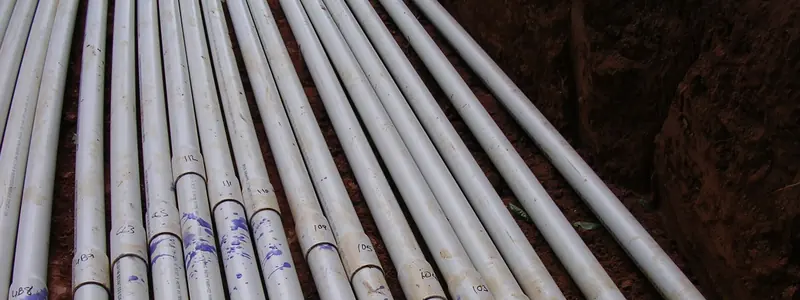
Figure 23-2 shows new pipe in a clay trench, the part of the system the inspector sees and you will never see again.
23-4 Who may install it
For pay, a license is the rule. A person who "constructs, installs, alters, extends, services, maintains, or repairs" a system "for compensation must hold a license or registration."5 Anyone doing "preconstruction site evaluations" must hold a TCEQ license unless licensed as an engineer.5
The owner's own install is narrower than the talk at the feed store. Under 30 TAC 30.244, persons who "own a single-family dwelling are not required to be a licensed installer in order to install or repair an on-site sewage facility (OSSF) on the individual's property." Then the conditions: "This provision does not apply to property that is to be developed for sale or lease." If you pay anyone to build any part, that person "shall be a licensed installer." You still "meet all permitting, construction, and maintenance requirements," and the site evaluation still takes a licensed evaluator or engineer.3
TCEQ adds: "This depends on whether the permitting authority allows this in their local requirements." So local rules may forbid it. It also says some systems "a homeowner can't buy because they must be installed by a factory representative." Anyone helping, "(e.g., having someone do backhoe work or trenching, etc.)," must be a licensed installer, with exceptions for a licensed electrician and for someone who delivers and sets a tank.2 In practice, ask first. Even on an owner install, nobody enters a tank or pit: gases in them can kill quickly.
23-5 Repairs need a permit too
A replacement is not a loophole. "The replacement of tanks or drainfields is considered a repair and requires a permit for the entire OSSF system."3 An alteration includes "an increase in the volume of permitted flow," so adding bedrooms or a guest house is a question for the agent before you build.3
The emergency exception is real and small. It applies "for the abatement of an immediate, serious and dangerous health hazard," for items such as "replacing tank lids" and "repairing solid lines," with written notice "within 72 hours after starting."3 Leave that to licensed people as well.
Who decides this
- Who issues the permit?
- The authorized agent listed for your county in Chapter 22
- Who evaluates the soil?
- A TCEQ-licensed site evaluator or a licensed engineer
- May an owner install it?
- 30 TAC 30.244 and your local authority; ask before you buy anything
- Who checks an installer's license?
- TCEQ's licensed OSSF professional search
- What follows a denial?
- The authority's supervisory body, such as commissioners court
On your own place
- Call the agent's office and ask for the form, fee list and local order.
- Sketch your tract: house, well, water line, ponds, creeks, property lines.
- Call 811 before any borings or pits, every time, and mark your own lines from your own records.
- Find licensed evaluators on TCEQ's search, and check any name you are given there.
- Keep a folder for the permit, approved plan, inspection notice and affidavit.
- Note the date your authorization expires, one calendar year from issue.
Notes
- TCEQ, OARS Find a Local Contact, one query per county. www6.tceq.texas.gov (read November 4, 2026) ↩
- TCEQ, OSSF Permits. tceq.texas.gov (read November 4, 2026) ↩
- TCEQ, On-Site Sewage Facility Rules Compilation RG-472, May 2017: 30 TAC 285.2, 285.3, 285.30, 285.35, 285.91(10), and 30.244. tceq.texas.gov (read November 4, 2026) ↩
- TCEQ, adoption order, Project 2021-030-285-CE. tceq.texas.gov (read November 4, 2026) ↩
- Texas Health and Safety Code ch. 366, section 366.071. tcss.legis.texas.gov (read November 4, 2026) ↩
- TCEQ, advice for OSSF owners. tceq.texas.gov (read November 4, 2026) ↩