Stretch V. Where it goes
Why clay decides your septic system
Why does clay soil decide what septic system you get?
Chapter 24 of 34. Sources checked .
Because clay takes in water very slowly, and a standard drain field depends on soil to take it in. Texas rules treat clay as Soil Class IV, unsuitable for standard absorption. On this ground you are usually choosing among pumped systems, each of which asks more of you afterward.
24-1 What the rules call your soil
Chapter 23 called for two borings or pits at opposite ends of the proposed field. This chapter is about what they tend to find here.
The rule states it in one line: "Soil Class IV. This class includes silty clay and clay soils."1 Table V then lists Class IV along the sidewall, or within two feet below the bottom, as Unsuitable "(Except for pumped effluent and ET)."1 AgriLife says it more simply: "Sand transmits water faster than silt, which is faster than clay." And: "A standard drain field cannot be used in a clay soil."2
The local soil survey agrees. The 1979 survey of Lamar and Delta counties says: "Very clayey or wet soils are poorly suited to septic tank absorption fields."3 The USDA's description of Houston Black, the first-named soil of the survey's largest unit, calls it "very slowly permeable."4 Other soils in the survey have a loamy top over a clayey subsoil.3 On those, what lies down at trench depth is what counts, which is why the evaluator digs instead of glancing at the surface. The survey covers Lamar and Delta only, so do not stretch it to your county.
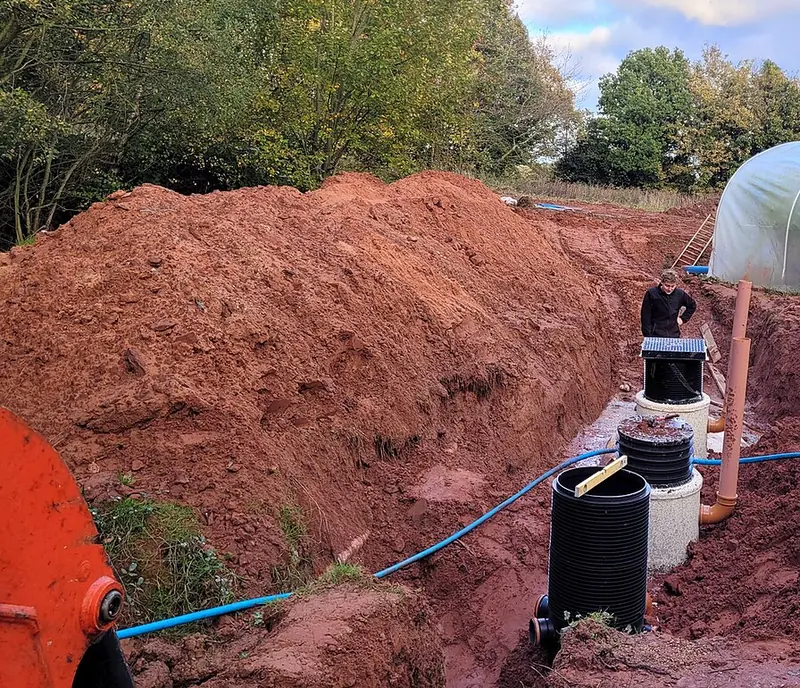
Figure 24-1 shows an installation in red ground. The look of it, a long open trench and a big spoil heap, gives a fair idea of the scale of work.
24-2 Dry cracks and wet months
Clay here behaves in two different ways at two times of year. Houston Black, when dry, "has cracks ranging from 1.25 to 10 cm (0.5 to 4 in) wide," and the same description says: "Water enters the soil rapidly when it is dry and cracked, and very slowly when it is moist."4 So a dry summer may flatter a piece of ground. A field that seems to swallow water in August may be a different field in a wet spring. That is this book's inference from the soil description, not an agency finding. It is one more reason to rely on the classification in the rule and not on how the pasture looks today.
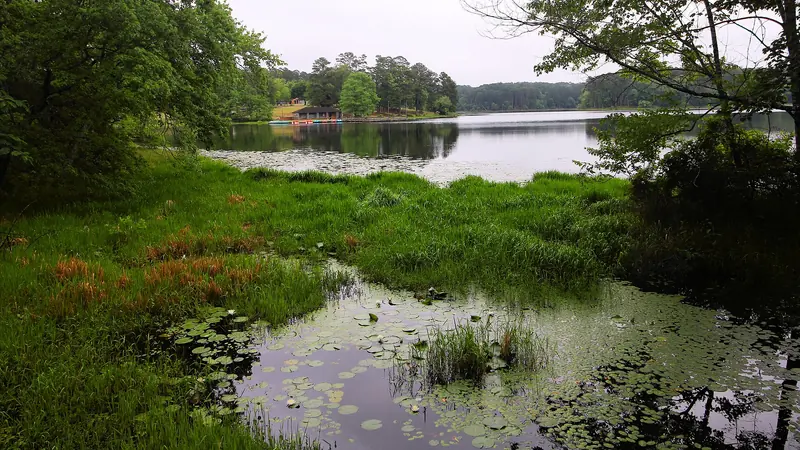
And rain counts. AgriLife says: "Fields that are saturated with rainwater are unable to accept wastewater," and that roof and concrete runoff "should be drained around the soil absorption field."5 Figure 24-2 shows a Morris County wetland edge. Most land here is not that wet, yet it stands for the same point: ground that stays wet has little room for anything else.
24-3 What the rules allow on Class IV
The rule leaves real options. "Drip irrigation systems using secondary treatment may be used in all soil classes including Class IV soils."1 AgriLife names the group: "Low pressure, subsurface drip, and spray distribution systems are designed to function in difficult areas." Then the catch: "These advantages, however, increase the operation and maintenance requirements."6
| Option | What the sources say | What it asks of you |
|---|---|---|
| Standard gravity drain field | "cannot be used in a clay soil" (AgriLife); Class IV listed as Unsuitable | Not an option where Class IV governs |
| Evapotranspiration (ET) | The table's exception names ET | Ask your designer whether it suits your site |
| Low-pressure dosing | Designed for difficult areas; "pumped effluent" exception | A pump and its upkeep |
| Subsurface drip | Allowed "in all soil classes," with secondary treatment | Treatment unit plus drip upkeep; not under foundations |
| Spray distribution | Designed for difficult areas | Treatment unit, disinfection, upkeep; see Chapter 25 |
Who picks? Your designer proposes and your authorized agent approves, on the site evaluation, and those decisions are not made from a chart in a book. Your part is to ask the right questions: who services this, how often, what it needs in power, and what happens to it if the place sits empty. AgriLife's warning is worth reading before you sign: "If you select the wrong system or design, or install, operate or maintain the system improperly, it can fail, which could result in pollution of your property and your neighbors. You could also be fined."7
24-4 Where this meets the rest of the place
A spray field and drip lines need room, and they keep the distances in Chapter 23, so confirm the current table with the authorized agent before you plan around them. The clay also moves, as Chapter 14 described for water lines. No agency statement was found on what shrink-swell does to septic pipe or tanks in particular, so treat any strong claim on that point with care, including from people selling a system.
If you soften your water, read the rule in Chapter 20 first. AgriLife warns that added salinity "may damage the soils in a septic leach field," and a non-standard system has its own connection rule.8
And one point on working around all this. Stay off a system's tanks and lids even when the ground is wet and something seems off. Do not open them. The next chapters cover what to do instead.
Who decides this
- Is the soil Class IV?
- A licensed site evaluator or engineer, from borings or pits
- Which system fits?
- Your designer proposes; the authorized agent approves
- May the old field serve a bigger house?
- Your authorized agent; added flow counts as an alteration
- What does the county add?
- The county's OSSF order, from the agent's office
On your own place
- Watch where water stands on your place after heavy rain, and take dated photographs.
- Note where roof gutters and concrete drains send their water, and whether that heads for the field.
- Walk the likely field area after a dry spell and look for cracks in the ground.
- Keep vehicles and livestock off any existing field or tank.
- Before any new digging, call 811, and have your own lines plotted from your own records.
- Write down your questions on service, power and upkeep for the designer.
Notes
- TCEQ, On-Site Sewage Facility Rules Compilation RG-472, May 2017: 30 TAC 285.30(b)(1)(A)(v), 285.33, 285.91(5). tceq.texas.gov (read November 4, 2026) ↩
- Texas A&M AgriLife, L-5227, Septic Tank/Soil Absorption Field. ossf.tamu.edu (read November 4, 2026) ↩
- USDA Soil Conservation Service, Soil Survey of Lamar and Delta Counties, Texas, 1979, machine-read Internet Archive scan, not the agency's site. archive.org (read November 4, 2026) ↩
- USDA, Official Series Description, Houston Black. soilseries.sc.egov.usda.gov (read November 4, 2026) ↩
- Texas A&M AgriLife, L-5227, on rainwater and runoff. ossf.tamu.edu (read November 4, 2026) ↩
- Texas A&M AgriLife, Final Treatment and Disposal. ossf.tamu.edu (read November 4, 2026) ↩
- Texas A&M AgriLife, Selecting and Permitting. ossf.tamu.edu (read November 4, 2026) ↩
- Texas Well Owner Network, Well Owner's Guide to Water Supply, and Cornell LII copy of 30 TAC 285.37. twon.tamu.edu and law.cornell.edu (read November 4, 2026) ↩