Stretch V. Where it goes
When a septic system starts to fail
How do you know a septic system is failing?
Chapter 26 of 34. Sources checked .
The clearest signs are sewage surfacing in the yard or backing up into the house. Earlier ones include slow drains, a soggy patch and unusually green grass over a tank or line. Stay out of the tank, cut water use and call a licensed provider; the law sets a repair clock once you have notice.
26-1 Two lines first
Before the signs, the safety. Never open a septic tank, and never lean into or climb into a tank or pit. Gases in them can kill quickly. NIOSH lists septic tanks among confined spaces that "may contain toxic gases, may not have oxygen, or may be explosive."1 Its instruction, written for a wildfire cleanup but sound here: "Never enter a confined space without proper training and equipment, not even to rescue a fellow worker. Contact the local fire department for help."1 If a person is down in a tank, call 911 and do not go in after them.
AgriLife names "poisonous or explosive gases... and confined space entry" among the hazards.2 EPA said after a 2005 hurricane: "Only trained specialists should clean or repair septic tanks because tanks may contain dangerous gases."3 So everything below is looking from above ground and calling someone.
26-2 The signs
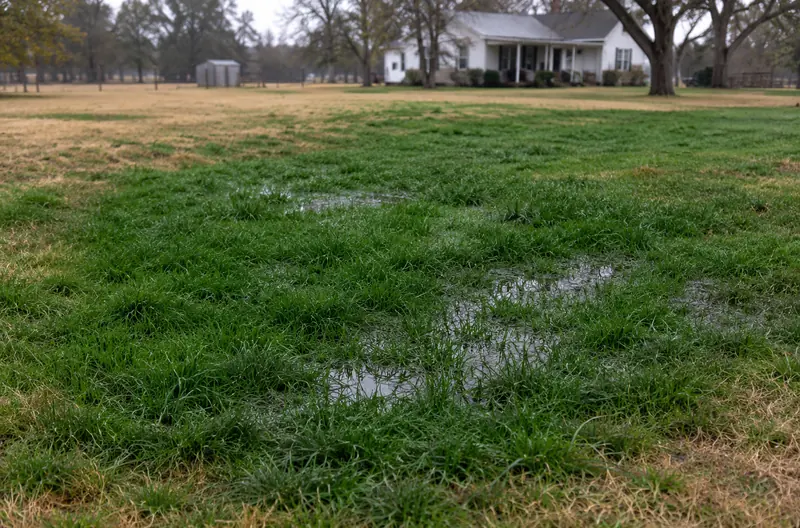
AgriLife describes the end stage: "Sewage will then surface or back up into the house through the plumbing fixtures."4 The earlier signs are subtler. Figure 26-1 shows one of them, a patch greener and wetter than the rest of the yard. On aerobic systems AgriLife says: "Excessive growth and darker green color than the other grass in the yard indicates that the tank or piping is broken."2
| What you notice | What it may mean | Who to call |
|---|---|---|
| Sewage on the ground | Overflow, which the rules count as a nuisance | Licensed provider or installer now; keep people and pets off |
| Backup in fixtures | System full, line blocked or field saturated | Cut water use; licensed provider or plumber |
| Toilets slow in heavy rain only | Saturated field; AgriLife's FAQ covers this | Reduce use until it drains; tell your provider |
| Green soggy strip in dry weather | Broken pipe or tank, or effluent surfacing | Licensed provider |
| Spray running in a shower, or many extra cycles | Rain getting in | Your maintenance provider |
| Alarm over 24 hours | See Chapter 25 | Your maintenance provider |
Clay makes the middle rows harder to read. "Fields that are saturated with rainwater are unable to accept wastewater," AgriLife says, and on this ground saturation can last.5 One wet week may not mean a failed system. A wet patch in a dry month means more. That second point is this book's reading of the sources, not an agency test, and your provider has the last word.
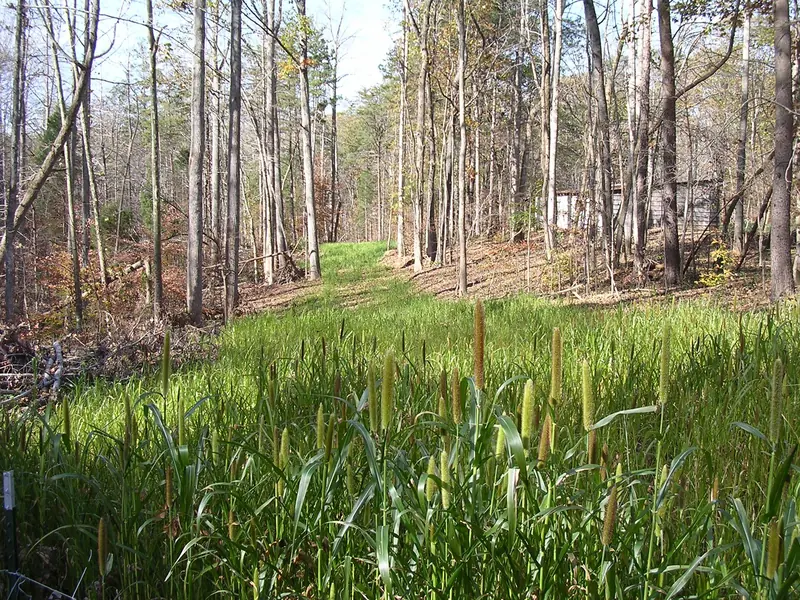
Figure 26-2 shows a drainfield strip in woodland: nothing to see but grass, which is how a sound field should look.
26-3 What the law calls failure, and the clock
A "Malfunctioning OSSF" is one "causing a nuisance or is not operating in compliance," and nuisance includes "an overflow from a septic tank or similar device, including surface discharge from or groundwater contamination."6 Once you are given notice, the rule compiled in 2017 gives you 30 days to repair, 20 if you were notified once in the preceding 12 months and 10 if at least twice. Meanwhile, "The property owner must take adequate measures as soon as practicable to abate an immediate health hazard."6 Check the current wording with your authorized agent, since the compilation is dated and some sections have changed.
A tank or field replacement needs a permit: "The replacement of tanks or drainfields is considered a repair and requires a permit for the entire OSSF system."6 Chapter 23 has the path. The small emergency exception is there too.
26-4 Pumping, and the things that do not help
Pumping is upkeep, not a cure, and it is not yours to do yourself: "Only people registered with the Texas Commission on Environmental Quality may pump and transport septic tank sludge."4 AgriLife says "about every 3 to 5 years" in general, and its table runs shorter for a busy house.4
| Tank | 2 people | 4 people | 6 people |
|---|---|---|---|
| 1,000 gallons | 5.9 | 2.6 | 1.5 |
| 750 gallons | not given | 1.8 | not given |
AgriLife adds: "More frequent pumping needed if a garbage disposal is used."5 Aerobic units follow their own rule; see Chapter 25.
Do not pump a tank in saturated ground. EPA's flood advice: "If the ground area around your septic system is saturated, it is recommended that you do not pump the tank... pumping it out could cause the tank to try to float out of the ground."3 After a flood, AgriLife says not to use the system "until the floodwater has receded from all components," then to look for damaged lids or exposed parts, and to call a service provider if components are full of floodwater.7
As for additives, "it is not necessary to pour additives, yeast or any other materials down the drains."4 And the rule on what goes above: "Owners shall not allow driveways, storage buildings, or other structures to be constructed over the treatment or disposal systems."6 Keep "vehicles, equipment and livestock off" as well.4
26-5 Finding help, and thinking of the well
TCEQ runs a search for licensed OSSF professionals, a list of court judgments against them and a page on filing a complaint.8 Use them. Chapter 34 sets out the wider method, and any digging starts with a call to 811, every time. If sewage has surfaced near your well, treat the water as suspect until a test says otherwise, and read Chapter 7 before you drink from it (ordinary caution; no agency sets that distance).
Who decides this
- Who takes the call when sewage is on the ground?
- A licensed provider or installer; the authorized agent for what the rule requires
- Who may pump the tank?
- A TCEQ-registered transporter
- A neighbor's system is surfacing onto your land
- Your authorized agent; TCEQ takes OSSF complaints
- Someone is down in a tank
- 911 and the fire department; do not enter
- Is a permit needed for the fix?
- The authorized agent; replacing tanks or fields requires one
On your own place
- Walk the system's line from the house on a dry day and note any wet or unusually green strip.
- Write down when the tank was last pumped, and by whom, and work out your interval from the table.
- Check that no vehicle track, shed or pen sits on the tank or field.
- Look at each lid by eye, without lifting it, and report any crack or loose fit.
- Note how drains behave after a hard rain, and keep the notes for your provider.
- Teach everyone in the house that nobody opens a lid, and that a person in trouble in a tank means 911.
Notes
- NIOSH, confined spaces guidance, wildfire cleanup context. stacks.cdc.gov (read November 4, 2026) ↩
- Texas A&M AgriLife, B-6234, Living with an Aerobic Treatment Unit and Spray Field. ossf.tamu.edu (read November 4, 2026) ↩
- U.S. EPA, archived 2005 news release on septic systems after flooding. epa.gov (read November 4, 2026) ↩
- Texas A&M AgriLife, OSSF Frequently Asked Questions. ossf.tamu.edu (read November 4, 2026) ↩
- Texas A&M AgriLife, L-5227, Septic Tank/Soil Absorption Field, and TCEQ owner advice for the pumping table. ossf.tamu.edu and tceq.texas.gov (read November 4, 2026) ↩
- TCEQ, On-Site Sewage Facility Rules Compilation RG-472, May 2017: 30 TAC 285.2, 285.36, 285.39(c), 285.70, and Health and Safety Code 366.017 as compiled. tceq.texas.gov (read November 4, 2026) ↩
- Texas A&M AgriLife, L-5475, Responding to Power Outages and Floods. ossf.tamu.edu (read November 4, 2026) ↩
- TCEQ, OSSF information for homeowners. tceq.texas.gov (read November 4, 2026) ↩