Stretch V. Where it goes
The Texas rules on septic systems
What are the septic rules in Texas?
Chapter 22 of 34. Sources checked .
In Texas you need a permit and an approved plan to build, alter, repair, extend or run a septic system, and the rules sit in 30 TAC Chapter 285. A local authorized agent usually issues the permit. All nine counties in this book list one, and exceptions are narrow.
22-1 The rule and who holds it
The water has crossed the place, gone through the house and now has to leave. On most rural places here, it leaves through an on-site sewage facility, which the rules call an OSSF and everyone else calls a septic system.
The statute is short: "A person must hold a permit and an approved plan to construct, alter, repair, extend, or operate an on-site sewage disposal system."1 It goes on: "If the on-site sewage disposal system is located in the jurisdiction of an authorized agent, the permit is issued by the authorized agent; otherwise, the permit is issued by the commission."1 An authorized agent is a local government body TCEQ has delegated to run the program.2 Where none exists, "The TCEQ regional office will be the permitting authority."3
TCEQ's lookup shows an agent in each of the nine counties this book covers.4 Names below are as TCEQ publishes them. For the office itself, use that lookup; Appendix A goes county by county.
| County | Authorized agent | Area served, as published | TCEQ region |
|---|---|---|---|
| Lamar | Lamar County | "unincorporated County + City of Paris; administered by Paris Lamar County Health District" | 5, Tyler |
| Red River | Red River County | "entire County" | 5, Tyler |
| Fannin | Fannin County | "unincorporated County + City of Bonham" | 4, DFW |
| Delta | Delta County | "entire County" | 5, Tyler |
| Hopkins | Hopkins County; Sabine River Authority | County except near Lake Fork; SRA "w/in 2,000 ft of the project boundary" of the lake | 5, Tyler |
| Franklin | Franklin County | "entire County" | 5, Tyler |
| Titus | Titus County | "entire County" | 5, Tyler |
| Bowie | Bowie County; City of Texarkana | County except the city; city limits | 5, Tyler |
| Morris | Morris County | "unincorporated County + Daingerfield, Lone Star" | 5, Tyler |
A gap sits in that table. Lamar, Fannin and Morris list named cities, and do not say who handles the other towns in the county. TCEQ's lookup says: "If the city is not listed, contact the county."4
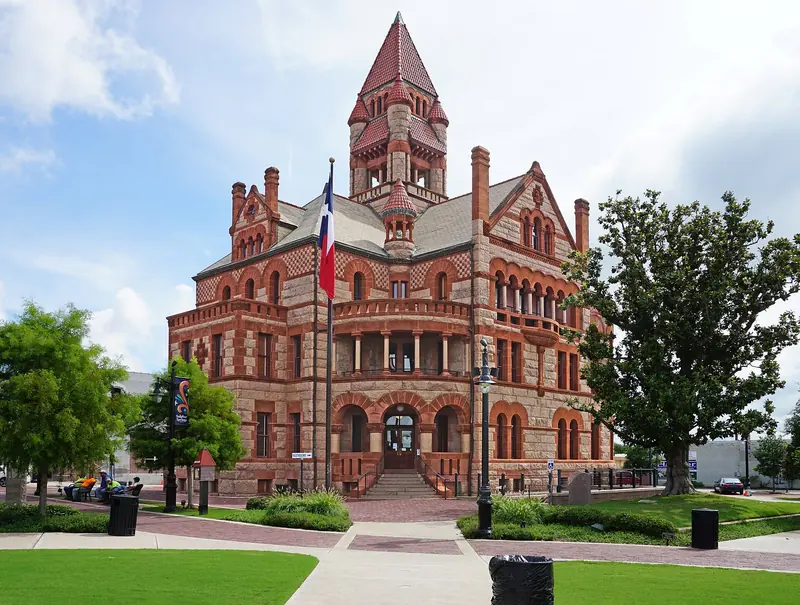
Figure 22-1 is the Hopkins County courthouse, a useful reminder that septic authority here is mostly a county matter and not one you settle in Austin, though in Hopkins County a place near Lake Fork answers to the river authority instead.
22-2 Lot size, read carefully
Lot size trips up a lot of buyers, so here is the wording. "Subdivisions of single family dwellings platted or created after the effective date of this section, served by a public water supply and using individual OSSFs for sewage disposal, shall have lots of at least 1/2 acre." Without a public water supply, "lots of at least one acre."5
Three things follow. The rule is about subdivisions created after the section took effect. Its test is whether the lots are "served by a public water supply," not whether you own a well. And older small lots have their own line: those "subdivided before January 1, 1988," or with a site-specific plan approved between that date and the effective date, "are allowed to use OSSFs, but the OSSFs must comply with the requirements set forth in this Chapter."5
A family split gets narrower relief than people say. A tract divided into four or fewer parts, each five acres or larger, each transferred to a relative within the third degree, "is exempt from submitting planning materials required in this section."5 That is the planning materials. The standards still apply.
22-3 Ten acres and grandfathered systems
The ten-acre rule is real, and it has conditions. "No planning materials, permit, and inspections are required for an OSSF for a single family dwelling located on a tract of land that is ten acres or larger provided the OSSF complies with all other requirements of Chapter 285, Subchapter D: Planning, Construction, and Installation Standards for OSSFs," and meets four conditions.6 The system must not cause a nuisance or pollute groundwater, all of it must sit at least 100 feet from the property line, effluent must stay on the property, and the house must be the only dwelling on the tract.6 TCEQ adds that the property "receives a site evaluation conducted by a TCEQ licensed Site Evaluator or a Professional Engineer (PE)."3 Then: "Always check with your local permitting authority. Local permitting programs can be more stringent than State minimums."3
A second house on the tract ends the exception by its wording.
Grandfathering works much the same. A system "installed before September 1, 1989" and "not creating a nuisance" may carry on, "provided the system has not been altered, and is not in need of repair."6 TCEQ's own summary is cautious: "you MIGHT not need a permit. Confirm with your local permitting authority."3
22-4 What is banned, and what may change
"Boreholes, cesspools, and seepage pits are prohibited for installation or use."2 If you find one on old land, it has to be closed under the rules, and that is a job for licensed people. Treat any old pit or tank as dangerous and stay well back. Keep lids secure, and do not open or lean over any tank or pit. Gases in them can kill quickly, as Chapter 26 explains.
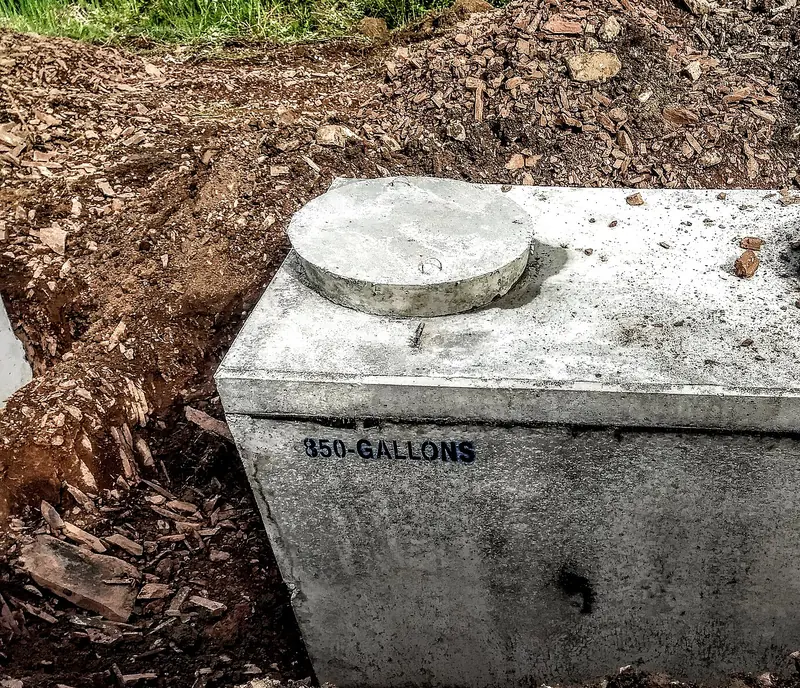
Figure 22-2 shows an ordinary concrete tank during installation. It is a picture of what the rules are written around; the place is not stated and it is not known to be Texas. The same chapter of rules sets the size limits: systems over "5,000 gallons of sewage per day on one piece of property," and any system discharging "into or adjacent to waters in the state," fall outside Chapter 285 altogether.2
Now the caution about this whole chapter. Most quoted text here comes from TCEQ's May 2017 compilation of the rules, and some sections were amended in 2023.7 TCEQ is also running a rule project on Chapter 285 to "Modernize requirements," with a first draft to "be proposed at an upcoming TCEQ commissioners meeting."8 Your authorized agent has the current wording. Local orders may be stricter, and this book did not read any county's order. On an unclear point such as an old lot or an old system, get the agent's answer in writing.
Who decides this
- Who issues the permit?
- The authorized agent in the table, or the TCEQ regional office if none covers you
- Does an old system need a permit?
- Your authorized agent; TCEQ says "confirm"
- Does the ten-acre rule fit the tract?
- Your authorized agent, after a site evaluation
- Is the lot big enough?
- The authorized agent; older lots may fall under the 1988 line
- What did the county order add?
- The county's own OSSF order, from the agent's office
On your own place
- Look up your county on TCEQ's Find a Local Contact page and write down the agent.
- Check whether your place sits inside city limits, or near Lake Fork in Hopkins County.
- Ask the agent's office whether a permit and plan exist for your address, and get a copy.
- Find your deed and plat, and note acreage, plat date and how many dwellings stand on the tract.
- Walk the tract and note any old pit or tank, from a safe distance, and tell the agent.
Notes
- Texas Health and Safety Code ch. 366, section 366.051. tcss.legis.texas.gov (read November 4, 2026) ↩
- TCEQ, On-Site Sewage Facility Rules Compilation RG-472, May 2017: 30 TAC 285.2(6), 285.3(a)(3), (g), (i). tceq.texas.gov (read November 4, 2026) ↩
- TCEQ, OSSF Permits. tceq.texas.gov (read November 4, 2026) ↩
- TCEQ, OARS Find a Local Contact, one query per county. www6.tceq.texas.gov (read November 4, 2026) ↩
- Cornell LII copy of 30 TAC 285.4, matching the wording in RG-472. law.cornell.edu (read November 4, 2026) ↩
- Cornell LII copy of 30 TAC 285.3(f), with conditions as worded in RG-472. law.cornell.edu (read November 4, 2026) ↩
- TCEQ, adoption order, Project 2021-030-285-CE. tceq.texas.gov (read November 4, 2026) ↩
- TCEQ, Chapter 285 Rule Changes Project. tceq.texas.gov (read November 4, 2026) ↩