Stretch VII. Rules and people
When you smell gas or propane
What do you do when you smell gas or propane?
Chapter 33 of 34. Sources checked .
Leave the building first, and take everyone with you. Do not touch light switches, phones or flames inside. From well outside, call 911 and your gas utility or propane supplier. Do not go back in until the responders or technician say it is safe.
33-1 The first minute
This chapter has one job, so its steps come first. If you smell gas or propane in or around a building:
Get everyone out. Do it now, before anything else on this page. Do not stop to look for where it is coming from.
Touch nothing on the way. The Railroad Commission of Texas says to move away "without using any electric switches, appliances, thermostats, or telephones."1 No lighting anything, and no pilot lights: "Never light a pilot if you smell gas."1
Call from outside, well away from the building. For natural gas, the Commission says "leave the area immediately then call 911 and your natural gas service provider."2 For propane, call 911 and your propane supplier. Use a cell phone once you are well away, or a neighbor's phone.
Stay out. "Even if you do not continue to smell propane, do not open or turn on the propane supply valve." "Do not re-enter the building, vehicle or area." Return "only when the service or emergency technician indicates it is safe."1
That is all of it. The rest of this chapter is background to read on a calm day.
33-2 Why the smell is enough
"Propane (sometimes called LPG or LP-gas) is a colorless and odorless gas," the Commission says, and "it is intentionally odorized so leaks can be detected. The odor is similar to rotten eggs."1 The smell is a warning that was added on purpose, so take it as one.
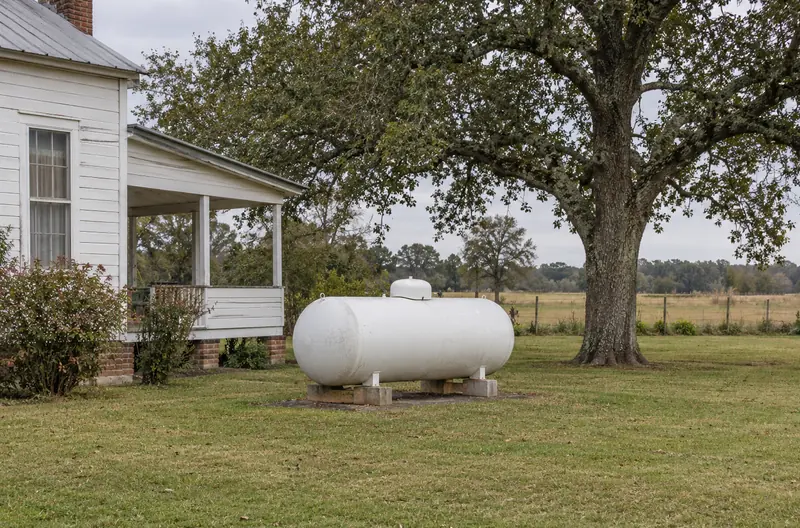
It is tempting to explain a smell away. The Commission addresses the commonest excuse: "Treat all propane gas odors seriously." "Never assume that propane odor is only the result of your tank being near empty."1 It also warns "Never place your head near or directly over the valves on your storage tank."1 A tank like the one in Figure 33-1 sits out in the open and looks harmless. Keep your distance if you suspect it.
Propane also behaves differently from what you may expect. "Propane vapors are heavier than air and may accumulate in low-lying areas such as basements and ditches or along floors."1 So on a still day, it can gather low. That matters under a pier-and-beam house, in a low spot in the yard and in a ditch. Standing up and catching no smell at head height tells you nothing useful, and that is another reason not to linger and sniff around.
33-3 Signs outside
A gas line under the ground can give itself away by more than smell. The Commission's public education sample lists "A blowing or hissing sound", "Dust or dirt may blow into the air", and "May cause bubbles in low areas containing water."3 Its own label on that sample is "Use only as a guide." If you see or hear any of those, get well away and call 911 and the gas company from a safe distance. Do not go closer to check.
The same goes if a line is hit while digging. Utilities Code chapter 251 says the excavator "shall immediately contact the underground facility operator", should "keep sources of ignition away", and that "Only the operator or a person authorized by the operator may perform repairs."4 On a gas line, the people come first: move them away, then call. Chapter 13 is about avoiding that day altogether. It also explains that a line serving only you, on your land, is outside that chapter's locating system. Your buried line from your own tank will not be marked through 811, so keep a sketch of it.
33-4 Carbon monoxide is a different alarm
Carbon monoxide is a separate danger with the same first move. If a CO alarm sounds, everyone goes outside first, and you call 911 from outside. The Consumer Product Safety Commission says not to try to find the source, and not to go back in until responders give permission.5
Texas has its own hard record of this. In the 2021 storm, the state counted nineteen carbon monoxide deaths, from "inappropriate use of generators, grills, heaters, vehicles running in enclosed spaces, and ice obstructing vents in gas powered heating equipment."6 Chapter 27 has the wider record. Ready.gov says "Only use generators and grills outdoors and away from windows and never heat your home with a gas stovetop or oven."7
33-5 Who works on gas
Once a smell has been dealt with, the repair is not a homeowner job. Gas piping is inside the state's definition of plumbing, as Chapter 31 quotes it. For LP gas, the Railroad Commission has adopted safety rules under Natural Resources Code chapter 113 and 16 TAC chapter 9, and has taken in NFPA 58 and NFPA 54 by reference.8 A licensed LP gas installer may install an LPG system without a plumbing license. A licensed plumber works on gas piping.9
| Situation | Call first, from outside | Who does the work afterward |
|---|---|---|
| Gas smell, utility line | 911 and your natural gas provider | The provider on its side; a licensed plumber on yours |
| Propane smell | 911 and your propane supplier | The supplier or a licensed LP gas installer |
| Hissing or bubbling at a buried line | 911 and the gas provider | The line's operator |
| CO alarm | 911 | A qualified technician checks the fuel-burning equipment |
Who decides this
- Is it safe to go back in?
- The emergency responders or the service technician
- Who regulates propane in Texas?
- The Railroad Commission of Texas
- Who may install or repair a propane system?
- A licensed LP gas installer, or a licensed plumber on gas piping
- A buried gas line was hit while digging: who gets the call?
- 911 and the line's operator, from a safe distance
On your own place
- Put your propane supplier's or gas utility's number in every cell phone in the household, today.
- Walk the way out with everyone, including at night, and pick a place to meet well away from the house.
- Make sure everyone in the house knows the rotten-egg smell described above and what it means.
- See where your tank sits and which low spots and crawl spaces lie downhill of it, from a distance.
- Fit carbon monoxide alarms and check them, following the maker's instructions.
- Sketch the buried line from tank to house if you know where it runs, and keep it with your deed.
Notes
- Railroad Commission of Texas, Home Safe Home, propane safety. The sheet disclaims warranties and calls its text suggestions. rrc.texas.gov (read November 4, 2026) ↩
- Railroad Commission of Texas, announcement of February 15, 2021. rrc.texas.gov (read November 4, 2026) ↩
- Railroad Commission of Texas, gas leaks public education sample. rrc.texas.gov (read November 4, 2026) ↩
- Texas Utilities Code, Chapter 251, Sec. 251.159. tcss.legis.texas.gov (read November 4, 2026) ↩
- US Consumer Product Safety Commission, carbon monoxide safety guide. cpsc.gov (read November 4, 2026) ↩
- Texas Department of State Health Services, February 2021 winter storm mortality surveillance report, December 31, 2021. dshs.texas.gov (read November 4, 2026) ↩
- Ready.gov, Winter Weather. ready.gov (read November 4, 2026) ↩
- Railroad Commission of Texas, alternative fuels regulations. rrc.texas.gov (read November 4, 2026) ↩
- Texas Occupations Code, Chapter 1301, Secs. 1301.002 and 1301.055. tcss.legis.texas.gov (read November 4, 2026) ↩