Stretch VI. Weather
The February 2021 freeze
What did the February 2021 freeze teach Northeast Texas?
Chapter 27 of 34. Sources checked .
It taught that cold, power and water fail together, and that a house, a well and a public system lean on each other more than anyone notices in a mild year. The records show how wide the damage ran across Texas, though they say little about Paris by name.
27-1 Eleven days in February
The chapters before this followed the water out of the house and into the ground. The next four are about weather, and they start with the storm most people here still measure others against. The federal disaster, FEMA-DR-4586, was declared on February 19, 2021. Its incident period ran from February 11 to February 21, and it covered all 254 Texas counties.1 NOAA records that every county in the state "as far south as the Rio Grande River" went under a Winter Storm Warning.2
The National Weather Service office at Shreveport covers the eastern counties in this book. It reports that places in southwestern Arkansas and northeast Texas had "as much as 18-22 inches of snow from the two events combined." One report from Daingerfield, in Morris County, gave 9.0 inches on February 17.3 Its preliminary list has Texarkana's airport at -1 F on the morning of February 16; that airport is listed under Miller County, Arkansas.3 To the west, the Fort Worth office gives -2 F at DFW on the same date and 139 hours at or below freezing, from the evening of February 13 to noon on February 19.4
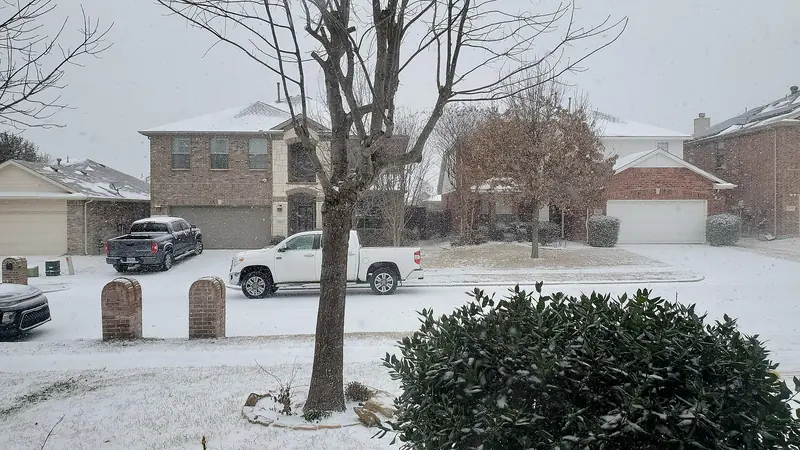
Neither office's storm page gives a reading for Paris or Sulphur Springs, so this book prints none. Figure 27-1 shows what that week looked like in a brick subdivision at McKinney, a good way west of Lamar County.
27-2 Power went, then water
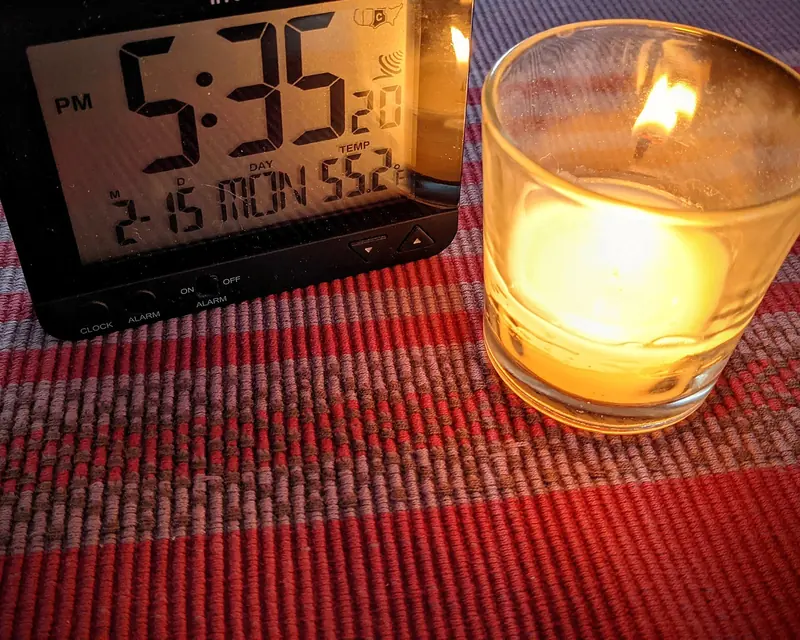
NOAA says that at the peak "nearly 10 million people were in the dark."2 The clock and candle in Figure 27-2 come from one of those houses, in Irving. A University of Houston survey, cited by the Texas Comptroller, found that 69 percent of Texans lost power, for an average of 42 hours. It found that 49 percent lost running water, for an average of 52 hours, and 31 percent had water damage.5
Those water losses had more than one cause. The Shreveport office writes that the cold "led to widespread water main breaks and major pipe bursts from southwestern Arkansas to northwestern Louisiana and westward into East Texas and Deep East Texas," with "water shortages across much of the area."3 An NPR report from February 17 described treatment plants without power. It quoted the head of TCEQ, the state's environmental agency, saying that as of noon there were "332 local water systems reporting impacts in 110 counties across the state, 276 issued boil water notices."6 Those are press figures quoting TCEQ, at one hour on one day. No official final count was found, and they do not say which systems were in this book's counties.
Then came the bills. The Texas Department of Insurance counted 510,772 claims and about $11.2 billion in insured Texas losses as of March 31, 2022. Its figures cover the whole storm, and they include property damage caused by freezing pipes.7 A pipe that burst is only part of that total, and uninsured losses are not in it at all.
27-3 What the death record says
The state's mortality report is the hardest reading in this chapter, and the one that matters most for what you do next time. As of October 27, 2021, the Department of State Health Services had confirmed 246 storm-related deaths across 77 counties, from February 11 to June 4.8
| Cause | Deaths |
|---|---|
| Extreme cold exposure | 161 |
| Pre-existing illness | 25 |
| Motor vehicle | 22 |
| Carbon monoxide | 19 |
| Fire | 10 |
| Falls and other trauma | 9 |
The county table lists Lamar with one death and Hopkins with one. Red River, Fannin, Delta, Franklin, Titus, Bowie and Morris are not listed. That is not the same as saying nobody died there. The table counts only medically certified storm deaths, by the county where the death occurred.8
Two lines in that report bear directly on this book. Risk factors for hypothermia included "engaging in outdoor repair activity during the storm," and deaths during recovery involved "repair of damaged homes."8 A burst line is a real problem. It is a smaller one than you out in the cold with a wrench.
27-4 What this book takes from it
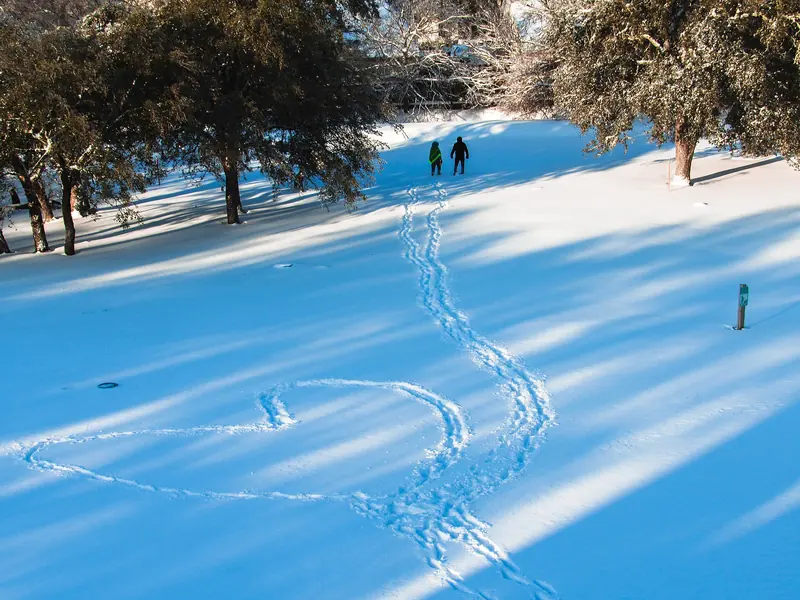
No agency has written a lesson plan for Northeast Texas. What follows is this book's reading of the record, offered as that. Figure 27-3 is Austin under the same storm, a reminder of how far south the cold reached and of how few places were ready for it.
Plan for cold and no power at the same time. A well pump runs on electricity, so a place on its own well can expect to lose water when it loses power (ordinary observation). Chapter 10 covers the parts involved.
Plan for the public system to struggle too. Low pressure, outages and line breaks are all listed reasons for a boil-water notice, and Chapter 30 takes those up.
Keep the worst risks in view. Carbon monoxide and fire killed people trying to stay warm. Hard freezes bring their own sequence of work, in order: Chapter 28 before the cold, and Chapter 29 once a pipe has frozen.
Who decides this
- Was your county in the 2021 disaster declaration?
- Yes; TDEM's page says all 254 counties were
- Why did your water go off that week?
- Your water supplier, which Chapter 2 helps you identify
- What does a claim for frozen pipes cover?
- Your own policy and insurer; this book has no answer for your case
- Where is the official count of deaths by county?
- The DSHS mortality report, Table 1
On your own place
- Write down what failed on your place in 2021, if you owned it then: which taps, which outbuildings, and for how long.
- Ask anyone who lived here that week what froze first, and mark those spots on a sketch of the place.
- Find out from your supplier how it tells customers about a notice or an outage.
- List what on your place needs electricity to deliver water.
- Check that your carbon monoxide alarms work, and agree that everyone goes outside first if one sounds.
Notes
- Texas Division of Emergency Management, Winter Storm Uri, FEMA-DR-4586. tdem.texas.gov (read November 4, 2026) ↩
- NOAA National Centers for Environmental Information, The Great Texas Freeze: February 11-20, 2021. ncei.noaa.gov (read November 4, 2026) ↩
- National Weather Service Shreveport, Arctic Outbreak 2021. Temperatures on the preliminary list are preliminary. weather.gov (read November 4, 2026) ↩
- National Weather Service Fort Worth, February 2021 Winter Event. weather.gov (read November 4, 2026) ↩
- Texas Comptroller, Fiscal Notes, Winter Storm Uri impact, citing a University of Houston survey. comptroller.texas.gov (read November 4, 2026) ↩
- NPR report by Vanessa Romo, February 17, 2021, as carried by KPBS, quoting TCEQ's Toby Baker. A press figure, not a TCEQ document. kpbs.org (read November 4, 2026) ↩
- Texas Department of Insurance, February 2021 Texas winter weather summary, March 2022. tdi.texas.gov (read November 4, 2026) ↩
- Texas Department of State Health Services, February 2021 winter storm mortality surveillance report, December 31, 2021. dshs.texas.gov (read November 4, 2026) ↩