Stretch VII. Rules and people
Who may do plumbing work
Who may do plumbing work in rural Texas?
Chapter 31 of 34. Sources checked .
As a rule, a person needs a Texas plumbing license and licensed supervision. Occupations Code chapter 1301 then has exemptions with exact conditions, including one for your own homestead. Being in the country is not by itself an exemption, and part of the rural wording is unsettled, so read it and ask the state board.
31-1 The general rule
Weather has had its say. The last four chapters of this book are about rules and people, and they start with the broadest rule. Occupations Code section 1301.351(a) says: "A person, other than a responsible master plumber, may not engage in plumbing unless: (1) the person holds the proper license, registration, or endorsement required by this chapter; and (2) the person's work is supervised and controlled by a person licensed under this chapter."1
The word plumbing reaches further than most people expect. The definition covers "a fixture, appurtenance, appliance, or piping, including a disposal system, used to: (i) supply, distribute, circulate, or recirculate water, other liquid, or gas; or (ii) eliminate sewage for a personal or domestic purpose." It also covers pipe "used outside a building to connect the building to" a supply on the premises, and pipe to "a disposal or septic terminal."1 So the long line from Chapter 16 and the gas line both sit inside that word. A license from this board is good statewide: "valid throughout this state."1
31-2 Your own homestead
The first exemption is one sentence. "A property owner is not required to be licensed under this chapter to perform plumbing in the property owner's homestead." That is section 1301.051, and it states no other condition.1 Read it for what it says and no further:
It speaks of a property owner and of that owner's homestead. The section does not define homestead. By its words it does not cover a rental house, a second place or a house you are fixing to sell. It frees you from the license. It does not say anything about permits, inspections, or your supplier's rules, and Chapter 32 and Chapter 12 take those up. If your place is anything other than clearly your own home, ask TSBPE before relying on it.
31-3 The country exemption, as written
Here is the section people cite when they say no license is needed in the country. It does not quite say that, so here is all of it.
"A person is not required to be licensed under this chapter to perform plumbing, other than plumbing performed in conjunction with new construction, repair, or remodeling, on a property that is: (1) located in a subdivision or on a tract of land that is not required to be platted under Section 232.0015, Local Government Code; (2) not connected to a public water system and is located outside a municipality; (3) located outside a municipality and connected to a public water system that does not require a license to perform plumbing; or (4) located inside a municipality that is within a county that has fewer than 50,000 inhabitants and that: (A) has fewer than 5,000 inhabitants; and (B) by municipal ordinance has authorized a person who is not licensed under this chapter to perform plumbing."1
The opening words take away new construction, repair and remodeling. Those are most of what anyone hires a plumber for. What is left is not explained in the statute, and no TSBPE page was found that interprets it. That is the unsettled part. Do not rely on this section for a repair on the strength of this book, or of anyone's say-so at the feed store. Nothing here is legal advice. Ask TSBPE in writing, and keep the answer.
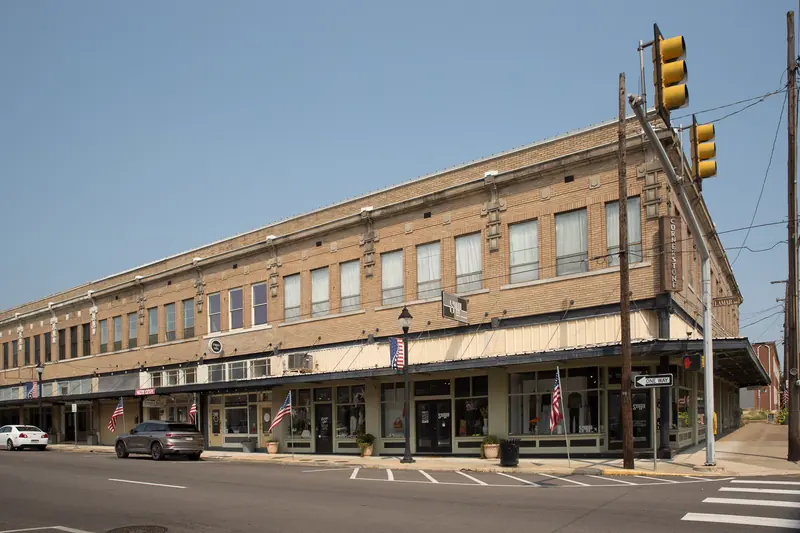
Clause (4) also turns on population, and clause (3) on your water system's own rule. Ask the city and the water system; this book does not say which towns or counties pass those lines. Paris is the seat of Lamar County, and Figure 31-1 and Figure 31-2 show its downtown, where municipal rules apply whatever the rural exemptions say. Chapter 32 picks that up.

31-4 Other carve-outs, and what they leave out
| Section | Who | The limit |
|---|---|---|
| 1301.053 | Maintenance staff who do not plumb for the public; appliance dealers connecting to existing openings; water treatment installations | Subject to inspection. Dealers: "other than installation and service work on water heaters." Water treatment: other than rainwater treatment |
| 1301.054 | Licensed irrigators and licensed water well pump installers | Holds the named license |
| 1301.055 | Licensed LP gas installers doing LPG system installation | Licensed under Natural Resources Code ch. 113 |
| 1301.059 | Mains on private property up to five feet from a building | "does not apply to plumbing work performed on private property designated for use as a one-family or two-family dwelling" |
The self-help section, 1301.057, applies only near the international border, so it does not reach these counties.1 A board rule adds that plumbing by a maintenance man "does not include cutting into fuel gas plumbing systems and the installation of gas fueled water heaters."2
Gas gets its own line in this book, whatever the exemptions might be argued to allow. Gas lines go to a licensed plumber, or for an LP gas system to a licensed LP gas installer, on any property.4 A mistake there is measured in lives rather than in leaks. Chapter 33 has what to do if you smell it. Septic work has its own licensing under a different law, set out in Chapter 23, and well pumps in Chapter 10.
Breaking the rule has a cost. Unlicensed plumbing can be a Class C misdemeanor, with a civil penalty of "not less than $50 or more than $1,000", and administrative penalties can run up to $5,000 per violation.1
31-5 How a plumber's license reads
TSBPE's consumer sheet says "Licensed or Registered plumbers in Texas are required to carry their license cards with them while on a job site." It describes a level that "Must work under a Master Plumber's supervision" and one "Limited to residential repairs and installations." The sheet's labels are pictures, so tying those lines to journeyman and tradesman is this book's reading.3 Chapter 34 shows how to check one.
Who decides this
- Does the homestead exemption fit this house?
- The words of section 1301.051, then TSBPE if your case is not clear
- What does section 1301.052 leave once repairs are excluded?
- Unsettled; ask TSBPE in writing
- May an unlicensed person work on gas piping?
- This book's answer is no: a licensed plumber or licensed LP gas installer
- Does the local water system require a license?
- That water system
- Is a town's ordinance on the books?
- That town's city hall
On your own place
- Write down in a few words what your place is: homestead, rental, second place, or a place being built.
- Note whether it is inside a city limit, and whether it is on a public water system.
- Ask your water system whether it requires a licensed plumber for work on your side of the meter.
- Read section 1301.052 in the statute yourself, once, slowly.
- List your gas and propane lines separately from your water lines, and mark them as licensed work.
- Put your question to TSBPE in writing if your case is anything but clear.
Notes
- Texas Occupations Code, Chapter 1301, Secs. 1301.002, 1301.051-.059, 1301.351, 1301.359, 1301.507, 1301.508, 1301.702. tcss.legis.texas.gov (read November 4, 2026) ↩
- Texas State Board of Plumbing Examiners, Administrative Rules, March 2026. tsbpe.texas.gov (read November 4, 2026) ↩
- TSBPE, Always Hire a Licensed Plumber, consumer sheet. tsbpe.texas.gov (read November 4, 2026) ↩
- Railroad Commission of Texas, alternative fuels regulations, on the LP-gas rules. rrc.texas.gov (read November 4, 2026) ↩