Stretch III. The long line
Finding a buried line before you dig
How do you find a buried line before you dig?
Chapter 13 of 34. Sources checked .
Call 811 first, every time, so other people's lines get marked. Then find your own, because the pipe you own past the meter will not be marked. That part comes from your paperwork, your valves, a walk between the known ends, and if needed a paid locator or licensed plumber.
13-1 What the call does and does not do
Chapter 12 settled who owns the line. Now you need to know where it runs, usually because something is about to be dug. Two different jobs are tangled together here. The call deals with lines that belong to other people. Yours you have to find another way.
Texas's law on this is Utilities Code chapter 251. It speaks of "a notification center", not of a number. Texas811's own site could not be reached when checked, and 811 is the dial code in common use.
You must notify the center "not earlier than the 14th day before the date the excavation is to begin or later than the 48th hour before the time the excavation is to begin, excluding Saturdays, Sundays, and legal holidays."1 So plan ahead. Because weekends and legal holidays do not count, a Friday afternoon call for Monday morning's work falls short, and a call more than 14 days out is too soon.
Read closely, the definition does not seem to catch a person with a shovel, and there is a farming exception too. Section 251.151 does not apply to "activities performed on private property in connection with agricultural operations." Neither one is a reason to skip the call. A fiber line or a buried power line does not care what the statute calls your work. Call 811 before digging, every time.
13-2 Why your own line stays unmarked
Your own line will not be marked. The chapter does not cover a facility "that serves only the owner of the underground facility or the owner's tenant and that is located solely on the owner's property."1 A tank and its connected piping on the same tract are left out as well. No agency page was found saying so in those words, but that is the practical result. Read it as covering the buried pipe from your own propane tank too, and treat that line as unmarked. Call your supplier about it.
There is a second gap. The center "shall advise the excavator that water, slurry, and sewage underground facilities in the area of the proposed excavation may not receive information."1 So even your water supplier's main may not get a mark from your call. Call the supplier directly as well.
Marking is also the operator's judgment. An operator marks "if the operator believes that marking the location is necessary", and if it decides not to, it should tell you.
| Line | Likely result of the call | What else to do |
|---|---|---|
| Power, telephone, fiber, pipeline operators | Marked or notice given, as the operator judges | Wait for the marks or the notice |
| Your water supplier's main | May not receive notice | Call the supplier's office |
| Your line past the meter | Not marked | Trace it yourself or pay someone |
| Line to a barn, trough or second building | Not marked | Same |
| Septic lines on your land | Not marked | Your permit file and the local authorized agent |
| Line from your own fuel tank | Not marked, as this book reads it | Your propane supplier |
13-3 Finding what you own
What follows is ordinary practice, and the order is mostly about spending no money first.
Start with paper. Permit files, a survey, the sellers' memory, and the old service agreement may help. Your well log from Chapter 6 is one more record, since the driller owes the owner a copy, and Chapter 5 has the state's well report viewers.3 A septic permit, if there is one, comes from your local authorized agent or TCEQ, and its file may show lines near the tank.4
Then walk it. You know two ends, the meter and the point where the pipe enters the house. Look for valve boxes like those in Figure 13-1, yard hydrants, sunken strips, and a line of greener grass in a dry spell. Those are clues, not proof. Do not assume a straight run. Old lines tend to follow fences, old driveways, or whatever was easy for the person who laid them.
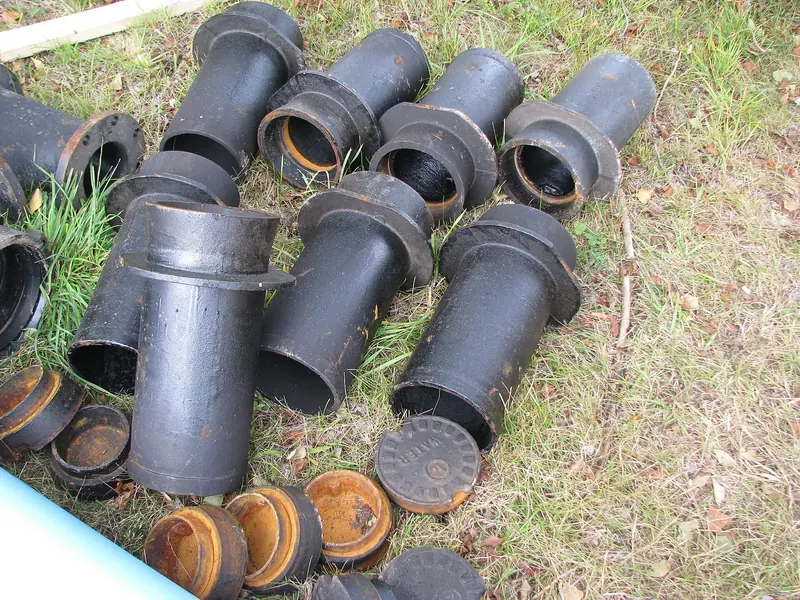
If you need certainty, pay for it. A licensed plumber may be able to trace a line, and private locating services exist that do not depend on the 811 call. Ask what they use and what happens if the pipe is plastic with no tracer wire. This book names no firm, and you may want to confirm what they can do on a long rural run before they come out.
Standards help with one thing. Lamar County WSD's construction section sets water and wastewater lines at least 3 feet apart horizontally, so that where one is found the other might be near.2 That is what the rule asks, and an old line may not follow it. Treat nothing as confirmed until it is exposed by careful hand work, after the call. Chapter 16 has more on those standards, including septic distances.
13-4 When a machine hits something
Figure 13-2 shows what a yard looks like with its old pipes opened up. Once a trench is that deep, a mistake costs a lot.
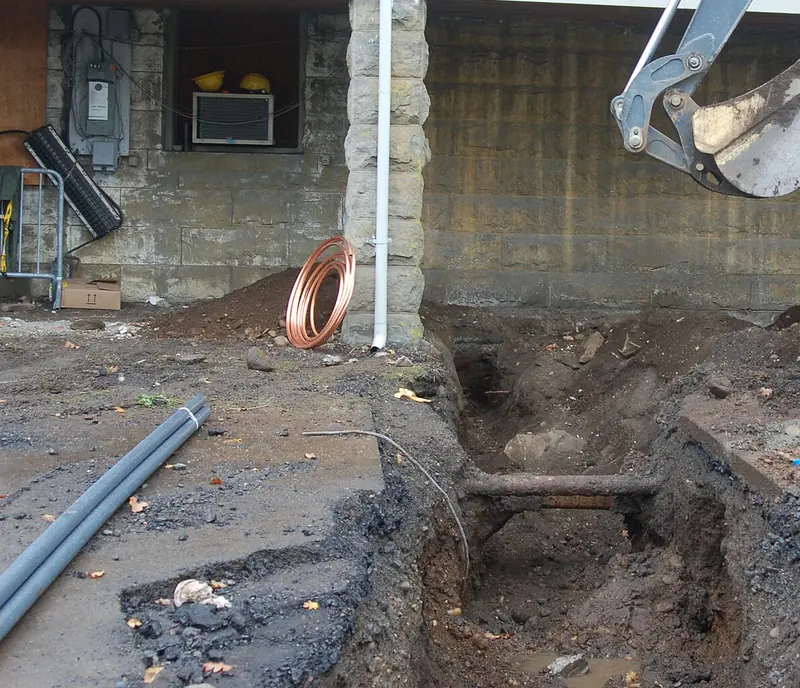
If you damage someone else's line, "the excavator shall immediately contact the underground facility operator". The statute adds that "Only the operator or a person authorized by the operator may perform repairs", tells you to delay backfilling, and says to "keep sources of ignition away."1 A violation carries a penalty of "not less than $500 or more than $1,000." Emergencies may begin at once, with "reasonable care" and notice "as promptly as practicably possible."
If you smell gas or propane, or hit anything that might carry it, leave the area first. No flames. Get well clear, then call 911 and the gas utility or propane supplier from there. Do not go back. Chapter 33 covers this in full.
If a bucket hits an electrical line, keep everyone away from the machine and the trench, and call 911 and the electric provider from a safe distance. Water and live wire in a trench are beyond a homeowner's job.
Who decides this
- Who marks lines?
- Each operator, after the notification center tells it; marking is the operator's judgment
- Who marks a privately owned line?
- Nobody through 811; you, a licensed plumber or a private locator
- Does the law reach a person with a shovel?
- It reads as powered or mechanized digging, 16 inches or deeper; call anyway
- Is farm work exempt?
- Section 251.156 has an agricultural exception; ask a lawyer before relying on it, and call regardless
- Who repairs a damaged line?
- The operator or someone it authorizes; yours only if it is yours
On your own place
- Call 811 before any digging, no sooner than 14 days ahead and no later than 48 hours, weekends and holidays excluded.
- Call your water supplier and ask about any main near the digging.
- Walk from the meter to the house, and flag every lid, hydrant and sunken strip.
- Find your own cut-off valve from Chapter 12 and mark it on a sketch.
- Draw the sketch to scale with distances from fixed corners, and keep it with your deed.
- Ask the seller or an older neighbor what they remember, and write down who said it.
Notes
- Texas Utilities Code ch. 251, sections 251.002, 251.003, 251.151, 251.153, 251.155, 251.156, 251.157, 251.159 and 251.201. tcss.legis.texas.gov (read November 4, 2026) ↩
- Lamar County Water Supply District, District Service Rules and Regulations, section E.22, machine-read scan. lamarcountywatersupply.myruralwater.com (read November 4, 2026) ↩
- Texas Occupations Code 1901.251, on the driller's copy of the well log to the owner. tcss.legis.texas.gov (read November 4, 2026) ↩
- Texas Health and Safety Code 366.051. tcss.legis.texas.gov (read November 4, 2026) ↩