Stretch VII. Rules and people
Plumbing permits, in town and out
Do you need a plumbing permit inside and outside city limits?
Chapter 32 of 34. Sources checked .
Inside a city, usually yes: cities over 5,000 must regulate plumbing, and state law lists only a few repairs as exceptions. Outside city limits, no statute was found giving counties a general plumbing permit power, though that is not proof none exists, and septic and well rules still apply.
32-1 Inside city limits
Chapter 31 asked who may do the work. A permit is a separate question, and a license does not answer it. State law says "A municipality with more than 5,000 inhabitants shall regulate by ordinance or bylaw the material, construction, alteration, and inspection of any pipe, faucet, tank, valve, water heater, or other fixture by or through which a supply of water, gas, or sewage is used or carried." It adds that "Any other municipality may regulate."1 So smaller towns may or may not, and you have to ask each one.
The same section lists what does not need a permit: "other than the repairing of leaks, the replacement of lavatory or kitchen faucets, the replacement of ballcocks or water control valves, the replacement of garbage disposals, or the replacement of water closets."1 Water heaters are not on that list, and neither are new lines. Where a territory overlaps, "only the affected municipality may perform a plumbing inspection and collect a permit fee."1
32-2 What towns here have published
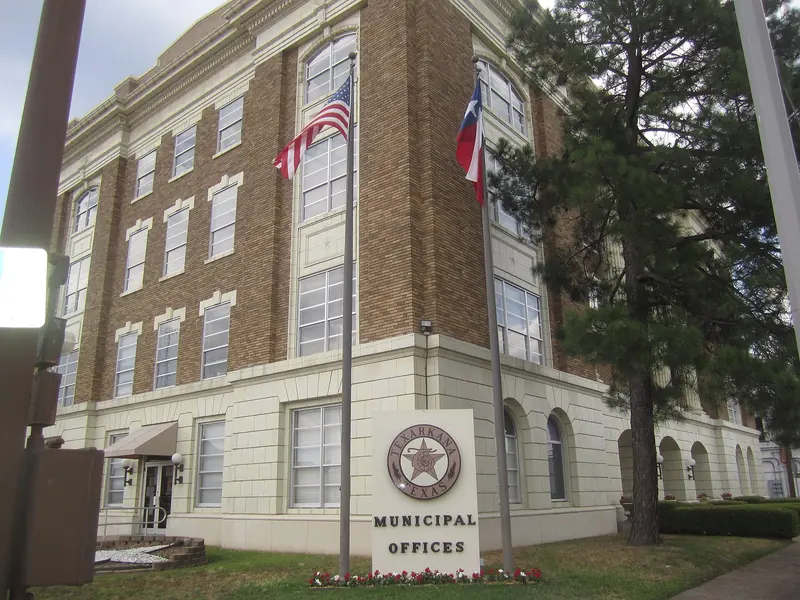
Not every town's own pages opened, and Figure 32-1 stands for one that did not.
| Place | What was found | How sure |
|---|---|---|
| Paris | City sheets describe a "Permit Validation System" listing plumbing subcontractors on the building permit; an undated city document says its inspection staff inspect plumbing in city limits | Not confirmed; city site down when checked8 |
| Sulphur Springs | A July 2025 application asks for "Electrical and plumbing plans" and registered subcontractors, and lists items for "the plumbing rough inspection" | City's own form2 |
| Mount Pleasant | Building department lists the "International Plumbing Code", "2024 Edition" and the International Gas Code, same edition; contractors register there to pull permits | City's own page |
| Texarkana, Texas | The city's FAQ says homeowners who own and occupy may apply, except a Texas licensed plumber must make the sewer tap at the street | Not confirmed; city site down when checked8 |
| Bonham, Clarksville, Reno | Nothing usable found | No city page opened |
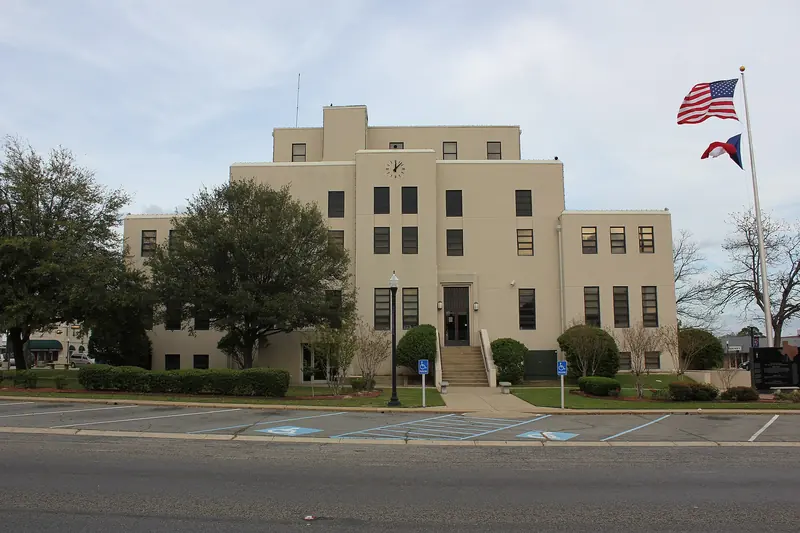
Treat the Paris and Texarkana rows as leads. Before you buy materials, call the city office and ask the two things that matter: does this job need a permit, and may you pull it yourself. The courthouse in Figure 32-2 stands in Mount Pleasant, whose building department is a city office, a reminder that city and county are separate governments with separate counters.3
32-3 Outside city limits
No statute was found giving Texas counties a general power to issue plumbing permits. That absence is not proof, so ask your county. Lamar County's site shows a culvert permit page and no plumbing or septic permit page that could be found.4
Counties do have one narrower tool. Local Government Code chapter 233, subchapter F, applies "only to a county that has adopted a resolution or order." In such a county, new single-family or duplex construction "shall conform to the version of the International Residential Code", with three inspections, and the county may not "require prior approval by the county before the beginning of new residential construction."5 Whether Lamar County or its neighbors have adopted an order was not confirmed. Ask the county before you build.
No permit does not mean no rules. A licensed plumber working "in an area not otherwise subject to regulation under this chapter" must still install "in accordance with a plumbing code adopted by the board", and that plumbing "must be inspected by a plumbing inspector."1 Which editions the board now uses, and how a rural job gets its inspector, were not settled here; ask TSBPE. A municipality or the owner of a public water system may also amend the code for local concerns, so your water system may have its own say.1
32-4 Other paperwork that may apply
A rural job can still meet several other offices. They are not plumbing permits, and most of them run whether a city is involved or not.
| Job | Paperwork | Where it is covered |
|---|---|---|
| Septic system built, altered or repaired | "A person must hold a permit and an approved plan" from the authorized agent or TCEQ6 | Chapter 23 |
| New or changed private water lines on a public system | A customer service inspection certificate7 | Chapter 17 |
| Digging | A call to 811 first, every time | Chapter 13 |
| New meter or moved meter | Your water system's tariff | Chapter 3 |
| New well | License rules, and groundwater district rules where a district exists | Chapter 6 |
A customer service inspection "is not a plumbing inspection." It is "limited to the identification and prevention of cross-connections, potential contaminant hazards, and illegal lead materials."7 Passing one tells you nothing about whether the plumbing code was met. The two can both apply to the same job.
Who decides this
- Does this job need a city permit?
- That city's building or inspection office
- May a homeowner pull the permit?
- That city; Texarkana's FAQ, not confirmed, is reported to allow owner-occupiers to apply
- Does the county issue plumbing permits?
- The county; none was found in Lamar County's published pages
- Which plumbing code applies out here?
- TSBPE, and your water system for local amendments
- Who inspects a septic job?
- The local authorized agent or TCEQ's regional office
On your own place
- Ask the city whether your place is inside its limits. A mailing address is not proof.
- Call the city or county office, and write down the name of the office and the answer you got.
- Ask your water system whether your planned work triggers a customer service inspection.
- Keep any permits and inspection papers in one folder with the deed.
- Call 811 before anyone digs, and remember that your own line will not be marked.
Notes
- Texas Occupations Code, Chapter 1301, Secs. 1301.255, 1301.551, 1301.553. tcss.legis.texas.gov (read November 4, 2026) ↩
- City of Sulphur Springs, Building Permit Application, July 2025. cms2.revize.com (read November 4, 2026) ↩
- City of Mount Pleasant, Building and Development. mpcity.net (read November 4, 2026) ↩
- Lamar County, Texas, county website home page. co.lamar.tx.us (read November 4, 2026) ↩
- Texas Local Government Code, Chapter 233, Subchapter F, Secs. 233.152-233.154. tcss.legis.texas.gov (read November 4, 2026) ↩
- Texas Health and Safety Code, Chapter 366, Sec. 366.051. tcss.legis.texas.gov (read November 4, 2026) ↩
- Cornell LII copy of 30 TAC 290.46(j). law.cornell.edu (read November 4, 2026) ↩
- City of Paris and City of Texarkana: their websites could not be reached on November 4, 2026. The table's rows for them rest on search listings of the city pages, not the pages themselves. paristexas.gov and texarkanatexas.gov (not reached) ↩