Stretch III. The long line
Clay soil and broken lines
Why does clay soil keep breaking water lines?
Chapter 14 of 34. Sources checked .
The likely answer is movement. Much of the ground around Paris shrinks and cracks when dry and swells when wet, and a buried pipe sits in that. The soil science is solid. The link to broken lines is ordinary observation, because no Texas agency was found stating it.
14-1 What the ground is doing
Chapter 13 was about where your line runs. This chapter is about what it runs through.
The USDA's soil survey of Lamar and Delta Counties was published in 1979, and these figures rest on a scan, so check your own copy of the survey before you rely on one. It is old, but soil does not change quickly. Its first map unit, Houston Black-Leson-Heiden, is "clayey prairie soils that crack when dry", and it covers about 32 percent of the survey area.1
The survey does not soften it. "The soils shrink and swell greatly with changes in moisture content. They also are corrosive and have low strength." And later: "The clayey soils in map unit 1 form deep, wide cracks when dry... Properly designed and carefully installed development is very costly on these soils."
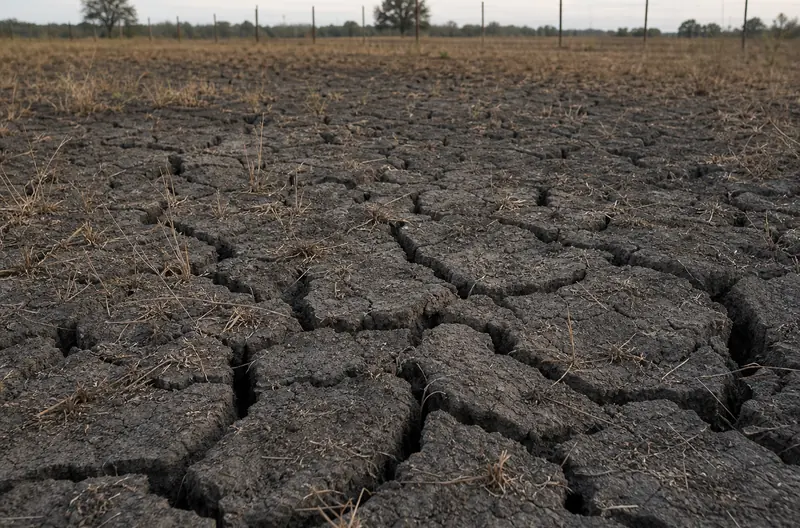
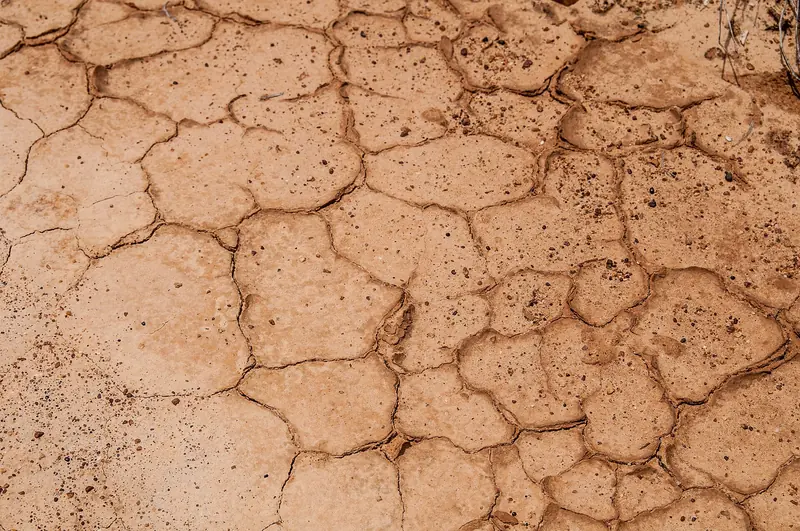
Figure 14-1 gives the idea, and Figure 14-2 shows the same process close up on a different clay. Neither is a local photograph. The local description is the survey's. AgriLife's soils guide explains the surface cracking of this class of soil by its clay mineral.7
14-2 Three soils, three-quarters of the survey
More than three-quarters of the Lamar and Delta survey area falls in three map units, and all three carry a shrink-swell warning.
| Map unit | Share of survey area | What the survey says |
|---|---|---|
| Houston Black-Leson-Heiden | About 32 percent | "clayey prairie soils that crack when dry"; shrink and swell greatly; corrosive; low strength |
| Annona-Freestone-Woodtell | About 23 percent | "forested soils that have a loamy surface layer and a clayey subsoil"; shrink and swell |
| Wilson-Normangee-Crockett | About 22 percent | "prairie soils that have a loamy surface layer and a clayey subsoil"; low strength, shrinking and swelling |
The USDA's description of the Houston Black series gives you numbers. When dry it has cracks from 0.5 to 4 inches wide, and they "remain open for 90 to 150 cumulative days in most years."2 Normangee is described as having "high shrink-swell", cracking when dry.3 Wilson is described as very slowly permeable.4
The survey covers Lamar and Delta only. Do not stretch it to Hopkins, Fannin or the rest. USDA's Web Soil Survey is the place to ask about your own tract.
14-3 The part nobody official has said
Here is where this book has to be careful. No statement was found from the Texas Water Development Board, TCEQ or AgriLife tying drought or clay movement to water line breaks. What follows is ordinary observation, and it is reasoning from the soil facts, not a finding.
A buried pipe is long and fairly stiff. The ground around it moves as moisture changes, and it may not move the same along the whole run. A line crossing from a wetter low spot to a drier rise sits in soil doing different things at the same time. A joint or an old fitting is a natural place for that strain to show. So a dry year followed by a wet one is a time to watch.
TDLR, writing about buildings and not pipes, calls expansive soils "a very common cause of foundation problems." It says high moisture "will heave (swell), causing a building to be lifted", and low moisture lets soils collapse.5 A foundation is not a water line. The mechanism it describes is at least the same ground doing the same thing. Chapter 18 takes up what that means under a slab.
14-4 Corrosion, and why a leak may not show
The survey's word "corrosive" is worth holding on to if you have old metal in the ground. The survey's table of corrosion by pipe type is not covered here, so this book gives no rule for any material. Ask a licensed plumber what they see on old lines in your soil, and see Chapter 16 before choosing what goes back in.
One more fact matters for the next chapter. The USDA says of Houston Black that water "enters the soil rapidly when it is dry and cracked, and very slowly when it is moist."2 This book reads that to mean a leak in cracked ground may go down without ever making a wet spot, at least for a while. That too is reasoning, not an agency finding. It is why a dry yard does not clear your line of suspicion.
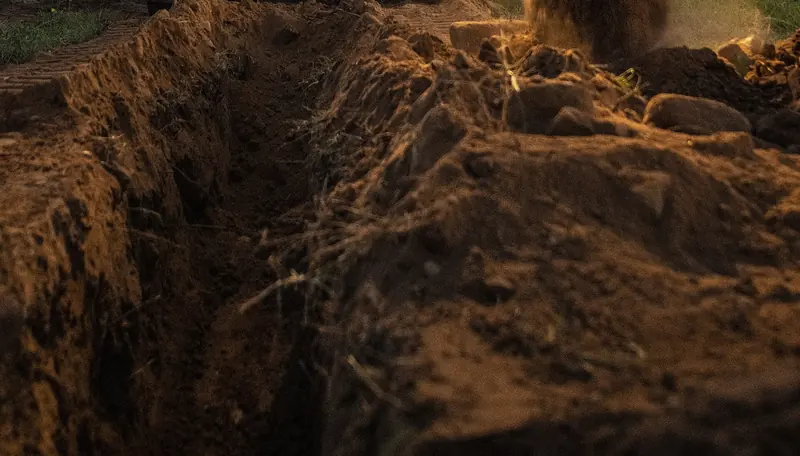
Bedding is the other thing that may be in your favor on a new line. Lamar County WSD's standards call for pipe bedded in washed sand with 6 inches of cushion.6 The rule does not explain why, and it is not a promise against movement. As ordinary practice, it helps limit what sharp clods and rock do to a pipe. Figure 14-3 shows how much soil comes out of even a narrow trench, and how much is going back around the pipe.
Who decides this
- What soil is under my land?
- USDA's Web Soil Survey; the 1979 survey for Lamar and Delta as background
- Do drought or clay break water lines?
- No official source found; treat it as reasoning, not a finding
- Which pipe suits my soil?
- A licensed plumber and your supplier's approved materials list
- Is my foundation moving?
- A qualified foundation professional; see Chapter 18
- What is my line made of?
- Your records, or a careful look at the meter end and where it enters the house
On your own place
- Look up your tract on the Web Soil Survey and write the map unit name on your sketch from Chapter 13.
- In a dry spell, walk the line and note where the cracks are widest.
- Note where the line crosses from low wet ground to higher dry ground. Those are the places to watch.
- Check your water use on your bills for the months after a long dry spell.
- Find out what your line is made of at the visible ends, without digging.
- Call 811 before any digging to look at a pipe, as always.
Notes
- USDA, Soil Survey of Lamar and Delta Counties, Texas (1979), Internet Archive machine-read scan, not the agency's own site. archive.org (read November 4, 2026) ↩
- USDA, Official Series Description, Houston Black. soilseries.sc.egov.usda.gov (read November 4, 2026) ↩
- USDA, Official Series Description, Normangee. soilseries.sc.egov.usda.gov (read November 4, 2026) ↩
- USDA, Official Series Description, Wilson. soilseries.sc.egov.usda.gov (read November 4, 2026) ↩
- Texas Department of Licensing and Regulation, Technical Bulletin 10-01, Industrialized Housing and Buildings. tdlr.texas.gov (read November 4, 2026) ↩
- Lamar County Water Supply District, District Service Rules and Regulations, section E.22, machine-read scan. lamarcountywatersupply.myruralwater.com (read November 4, 2026) ↩
- Texas A&M AgriLife, Know Your Texas Soils. forages.tamu.edu (read November 4, 2026) ↩