Stretch III. The long line
Who owns the line
Who owns the water line between the meter and the house?
Chapter 12 of 34. Sources checked .
In the rules quoted here, the supplier's part ends at the meter and the pipe from there to the house is yours. For a water supply corporation or special utility district, though, the deciding text is that supplier's own tariff or service rules, so read yours.
12-1 Which rule is yours
Chapter 2 sorted out who sells your water, and that answer decides this one. Most people who look this up find a state rule and stop. The rule is real, but it may not be about your supplier.
The Public Utility Commission's rule says: "The customer's responsibility shall begin at the discharge side of the meter or utility's cut-off valve if there are no meters. If the utility's meter or cut-off valve is not on the customer's property, the customer's responsibility will begin at the property line."1 It makes the applicant "responsible for furnishing and laying the necessary service line from the meter to the place of consumption" and for keeping it "in good repair."
Note the word "utility". Water Code 13.002(23) leaves water supply corporations and political subdivisions out of that term.2 Most rural systems in this book's counties are one of those, as the names in Chapter 2 show. So for a WSC or special utility district, the state rule is a useful picture of the usual split, and your tariff or service rules are what govern.
12-2 Four documents, side by side
Here are four such documents. Their words differ even where the practical split looks alike.
| Document | Who it speaks to | What it says |
|---|---|---|
| 16 TAC 24.163 | A "utility" as the Water Code defines it, not a WSC or district | Customer's part begins at the discharge side of the meter |
| Lamar County WSD service rules | Its own customers | Its "ownership and maintenance responsibility of water supply and metering equipment shall end at the meter or other service equipment" |
| Walston Springs WSC tariff, approved March 2014 | Its own members; county not confirmed by this book | Meters and materials to the point of connection are the corporation's "and shall be maintained by the water system only" |
| Texas Rural Water Association sample language, as used by Hilltop WSC in McLennan County | Hilltop's members; not in this book's area | Same ownership sentence, plus a line leak on the member's side is "a potential hazardous condition" |
Lamar County WSD also says "Customer service pipelines shall be installed by the applicant", citing 30 TAC 290.46.3 That text rests on a scan, so check your own copy. The Walston Springs and Hilltop documents come from the corporations' own sites.45 The Hilltop language gives a member "up to five (5) business days" to repair a leak found on inspection, before disconnection. Other tariffs may differ.
For the rest of this book's counties the picture is thinner. North Hopkins WSC's draft bylaws say conditions of service "are established in the Corporation's tariff".6 The PUC's site would not open when checked, so no tariff was seen there. No tariff was found for MJC, Pattonville or Petty WSC. Ask the office for a copy.
12-3 The meter box is theirs
An opened meter box like Figure 12-1 is the place the line changes hands, and you can look but should not work there. Lamar County WSD says "No person, other than the properly authorized agent of the District, shall be permitted to tap or make any connection to the mains" or alter a fixture on the service pipe.3
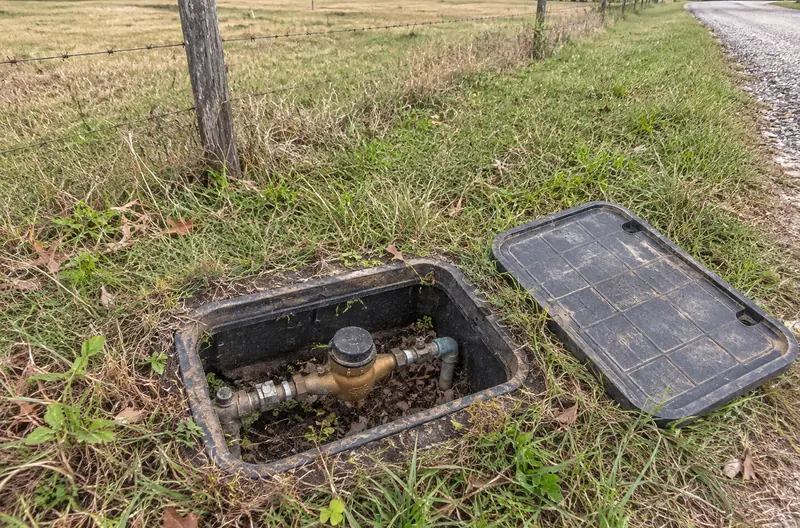
The same rules ask for "a cut-off valve on the Customer's side of the meter", and they prohibit using the District's curb stop for that purpose. Lamar County WSD requires one; check yours. If it is missing, the fix is on your side of the line. Ball valves (Plumbing Supply and More, run by the same team as this book) are one common type, sold at this store. A licensed plumber can tell you what fits your pipe and what your supplier accepts. Chapter 31 covers who may install it.
12-4 Who pays for water that leaks
Water that passes the meter is measured, and the rules bill it. Lamar County WSD says "all water usage registering upon and/or damages occurring to the metering equipment... shall be subject to charges."3 The likely reading is that a leak past the meter shows on your bill, though the rule does not say so in those words.
No leak credit clause appears in any of the three documents looked at closely. Lamar County WSD's posted rules speak of "Bill Adjustment Due To Meter Error", with a meter test on written request and a test fee if the meter passes. If it fails, "a billing adjustment may be made as far back as six (6) months". Back-billing runs further the other way, "up to forty-eight (48) consecutive months" for meter error and similar causes.
Some boards may have a leak policy somewhere else. Do not assume one. Ask in writing, before the leak if you can, and keep the answer. Which paper governs a given dispute may need someone who can read your deed and tariff together.
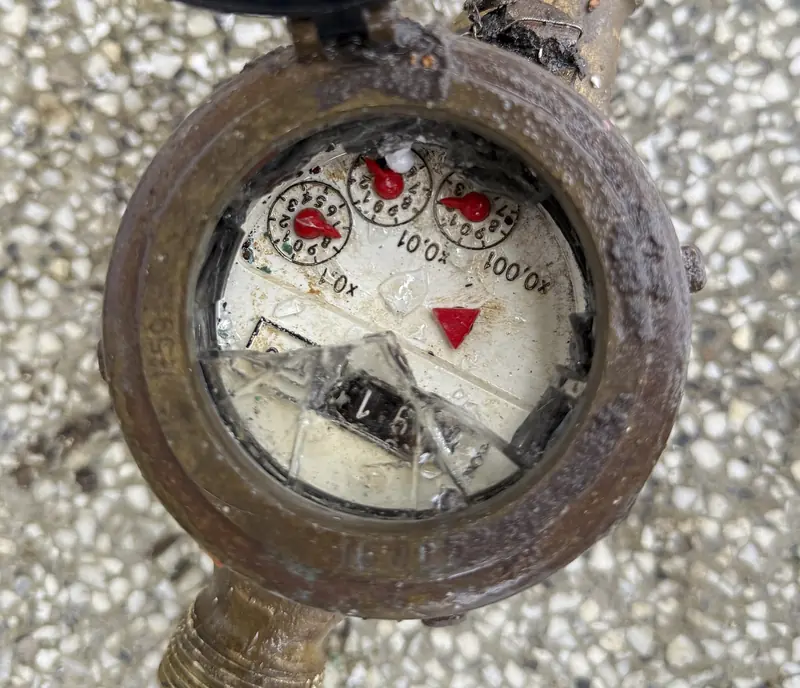
The worn meter in Figure 12-2 is the piece all of this turns on. A meter that reads wrong is a billing matter you may raise. A meter that reads right on a leaking line is the owner's water bill.
12-5 Two more lines that catch people
Lamar County WSD allows "No more than one (1) residential, commercial, or industrial service connection" per meter.3 A second house on the tract, or a barn apartment, may need a meter of its own. That is this book's reading, so ask before you build. Chapter 17 takes up barns.
Moving a meter on the same property is allowed if you grant an easement and pay "the actual cost of relocation plus administrative fees".3
Who decides this
- Where does the owner's responsibility start?
- Your supplier's tariff or service rules
- Does 16 TAC 24.163 bind a WSC?
- Water Code 13.002(23) leaves WSCs and districts out of "utility"; read your tariff
- Who repairs a leak after the meter?
- You, in the documents quoted above; your tariff has the final word
- Is a leak credit available?
- Ask your board in writing; no such clause was found in the documents quoted
- Who may touch the meter and curb stop?
- The supplier's authorized people
On your own place
- Ask your supplier's office for a copy of its tariff or service rules, and read the section on service lines.
- Find your meter box and note whether it sits on your land or in a road right of way.
- Look for a cut-off valve on your side of the meter. Write down what you find.
- Ask in writing whether the board has any leak adjustment policy, and file the reply.
- Read your last 12 bills for a slow climb in use.
- If you plan a second dwelling, ask about the meter rule first.
Notes
- Cornell LII copy of 16 TAC 24.163(a)(2)(B). law.cornell.edu (read November 4, 2026) ↩
- Texas Water Code 13.002(23) and 13.136(c). tcss.legis.texas.gov (read November 4, 2026) ↩
- Lamar County Water Supply District, District Service Rules and Regulations, machine-read scan. lamarcountywatersupply.myruralwater.com (read November 4, 2026) ↩
- Walston Springs WSC, Service Rules and Regulations, approved March 2014. walstonspringswsc.myruralwater.com (read November 4, 2026) ↩
- Hilltop WSC, Tariff. hilltopwatersupply.myruralwater.com (read November 4, 2026) ↩
- North Hopkins WSC, draft bylaws, machine-read scan, pending member approval as read. northhopkinswsc.myruralwater.com (read November 4, 2026) ↩