Stretch III. The long line
Barns, troughs and backflow
How do you run water to a barn or trough safely?
Chapter 17 of 34. Sources checked .
Bring the water in above the rim of the trough, with open air between the outlet and the water, to help keep anything from siphoning back into the drinking supply. Lamar County WSD's rules say this in those terms. Ask your supplier what else it wants at the meter before you trench.
17-1 Why a trough is a public water matter
Chapter 16 ended with an inspector looking for cross-connections. This is where most of them turn up on a working place. A line that ends under water in a trough, with algae and whatever the stock brought in, may draw that water back toward everyone else's drinking water if pressure on the main drops. Low pressure, line breaks and outages are among the reasons for a notice that Chapter 30 lists.
So the state's rule starts from protecting the system. "No water connection from any public drinking water supply system shall be allowed to any residence or establishment where an actual or potential contamination hazard exists unless the public water facilities are protected from contamination." Where that protection is needed at the meter, it takes "the form of an air gap or backflow prevention assembly."1
17-2 The trough rule, word for word
Lamar County WSD says it directly: "All water service connections shall be designed to ensure against back-flow or siphonage into the District's water supply. In particular, livestock water troughs shall be plumbed above the top of the trough with air space between the discharge and the water level in the trough. (30 TAC 290.46)."2
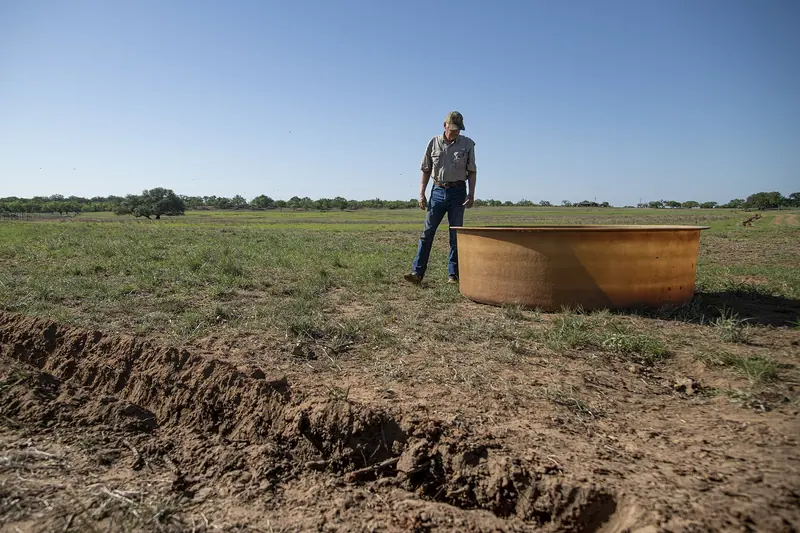
Figure 17-1 shows the kind of big round tank this applies to. A float valve mounted to discharge above the rim fits that wording. A hose dropped over the side and left lying in the water does not, and neither does a float valve that sits submerged. That last sentence is this book's reading of the rule. Ask your supplier if your setup is in doubt, because other systems may word it differently.
| Use | What the rules ask |
|---|---|
| Livestock trough | Plumbed above the top, with air space between discharge and water level |
| Sprinklers | "an approved vacuum breaker" 6 inches above ground |
| Swimming pool makeup | Backflow preventer or air gap |
| Rainwater tank | A "visible air gap" of at least 2 inches |
| Private water system on the same place | Air gap or reduced pressure-zone device at the service connection |
| Any required device | The customer pays |
These rest on a scan of the District's rules, so check your own copy. Yours may differ.
17-3 A well, a pond and a public line on one place
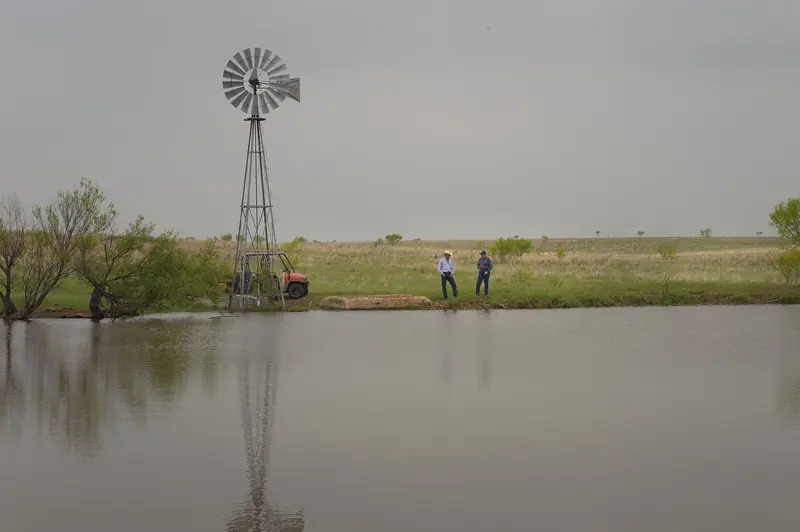
Plenty of places here have more than one source. Figure 17-2 is the picture many people carry of that: windmill, pond, and a line from the road. The rule is short and strict. "No physical connection between the distribution system of a public drinking water supply and that of any other water supply shall be permitted unless the other water supply is of a safe, sanitary quality and the interconnection is approved by the executive director."3
Lamar County WSD puts it more bluntly: "No cross-connection between the water supply and a private water system is permitted." The threat "must be eliminated at the service connection by the installation of an air-gap or a reduced pressure-zone backflow prevention device."2 Cypress Springs SUD's packet asks for much the same, with a service agreement for annual inspection and testing.4 So a valve you only keep shut, between a well and a public line, is not a safe assumption. Ask your supplier in writing before you build anything that joins them, or if you have bought a place where they are already joined. Then get it taken apart by someone licensed.
17-4 Assemblies and who tests them
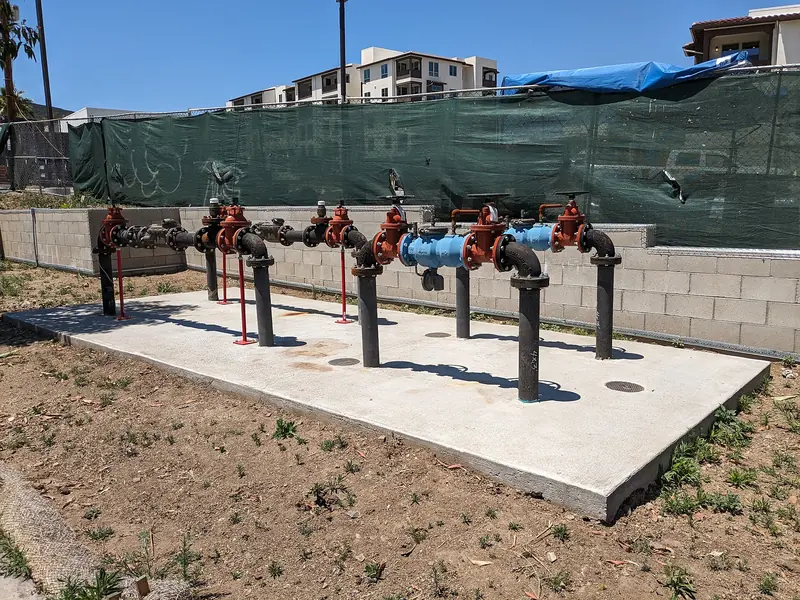
Which assembly goes on a given hazard is set in a state table, 30 TAC 290.47(f). This book could not read that table, which appears as an attached graphic in the copy it used, and it has not seen what it assigns to livestock or wells. Your supplier decides what it will accept. Figure 17-3 shows larger assemblies of the kind you may have seen at a commercial site.
Assemblies "shall be tested upon installation by a licensed backflow prevention assembly tester", and those protecting against health hazards "at least annually."1 Backflow preventers (Plumbing Supply and More, run by the same team as this book) are sold at one place among many, which helps if you want to see what is being talked about. The kind and the install are decisions for your supplier and a licensed person, not something to pick off a page. Where no hazard exists, the rule does not require an assembly.
Then comes the customer service inspection from Chapter 16. It is required on new construction, where the purveyor has reason to suspect a hazard, and after material additions. A new barn line is an addition. The scope is "limited to the identification and prevention of cross-connections, potential contaminant hazards, and illegal lead materials", and a health hazard "shall be considered sufficient grounds for immediate termination of water service."3
17-5 Getting the line there
Everything from Chapter 13 applies. Call 811 before digging, every time. The new line will not be marked afterward either, so add it to your sketch. Chapter 12 covered Lamar County WSD's limit of one connection per meter, and a barn with a dwelling in it is the case to ask about. Livestock and well distances run the other way too: before the reductions the rule allows, a new well is to stand 150 feet from "existing or proposed livestock or poultry yards", so think about both when siting a pen.5
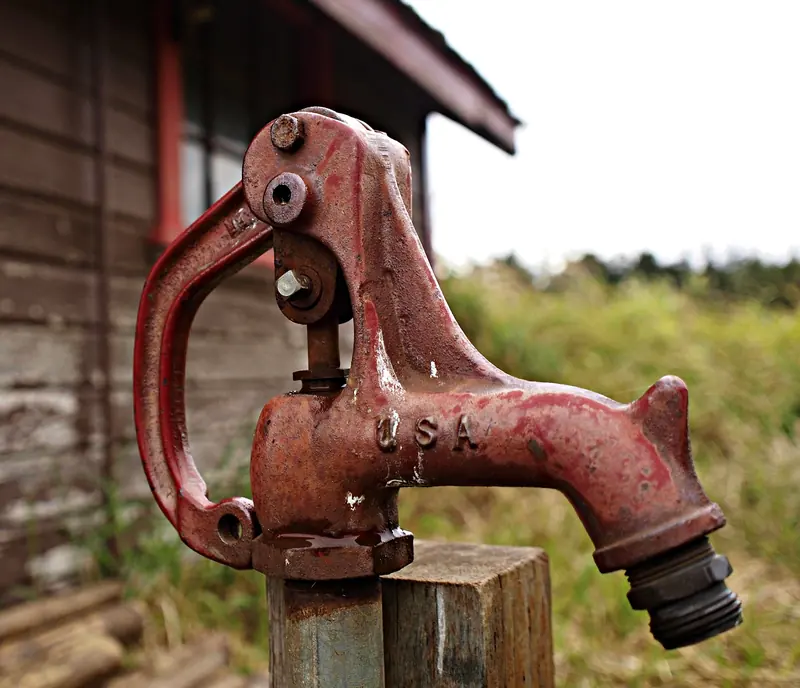
Each outlet in the field needs its own thinking about freezing. A yard hydrant like Figure 17-4 is the common answer, and AgriLife says outdoor water systems should be drained and covered or left to drip slowly in a hard freeze.6 Chapter 28 picks that up. A hose left on a hydrant and lying in a trough is the same hazard as a pipe there, so take it off when you walk away.
Who decides this
- Does a trough need a backflow device?
- Your supplier's rules; an air gap may be what they ask
- Which assembly goes on a connection?
- Your supplier, under 30 TAC 290.47(f)
- Who tests it?
- A licensed backflow prevention assembly tester
- May a well be joined to the public line?
- Not without what the rule requires; ask your supplier and the state
- Who inspects a new barn line?
- A customer service inspector, arranged through your supplier
On your own place
- Go to each trough and look at where the water enters. Check for air between outlet and water at the fullest level.
- Follow every hose on the place to its end, and lift any that lie in water.
- Find out whether any well, pond or tank line touches your public water line anywhere, including at the barn.
- Look for any backflow assembly you have and find its last test date.
- Ask your supplier in writing what it requires for a barn, trough or second source.
- Sketch any new run before you dig, then call 811.
Notes
- Cornell LII copy of 30 TAC 290.44(h). law.cornell.edu (read November 4, 2026) ↩
- Lamar County Water Supply District, District Service Rules and Regulations, section E.20, machine-read scan. lamarcountywatersupply.myruralwater.com (read November 4, 2026) ↩
- Cornell LII copy of 30 TAC 290.46(j) and (k). law.cornell.edu (read November 4, 2026) ↩
- Cypress Springs SUD, Non-Standard Service Application, August 2024. cssudpay.myruralwater.com (read November 4, 2026) ↩
- Cornell LII copy of 16 TAC 76.100(a). law.cornell.edu (read November 4, 2026) ↩
- Texas A&M AgriLife Today, Prepare for Winter Weather (January 2025). agrilifetoday.tamu.edu (read November 4, 2026) ↩