Stretch III. The long line
Telling whether a long line is leaking
How do you tell whether a long line is leaking?
Chapter 15 of 34. Sources checked .
Stop all use of water, then watch the meter. A dial that keeps moving means water is going somewhere. Close your own valve at the house and watch again, and you have narrowed it to the house or the line. The test is ordinary practice.
15-1 Before you test
Chapter 14 gave you a reason to suspect the line, and a reason not to trust a dry yard. This chapter gives you a way to check. No Texas agency or water supplier was found publishing a leak test for homeowners, so the steps below are ordinary practice, kept modest. The rules quoted are real.
There are also limits on what you may touch. Lamar County WSD prohibits a customer's use of its curb stop, and it requires "a cut-off valve on the Customer's side of the meter."1 So your test uses your valves only. Chapter 12 had you find them.
The bills are worth a look first. They cost nothing, and a slow climb across months tells you something a single test may not.
15-2 The meter test
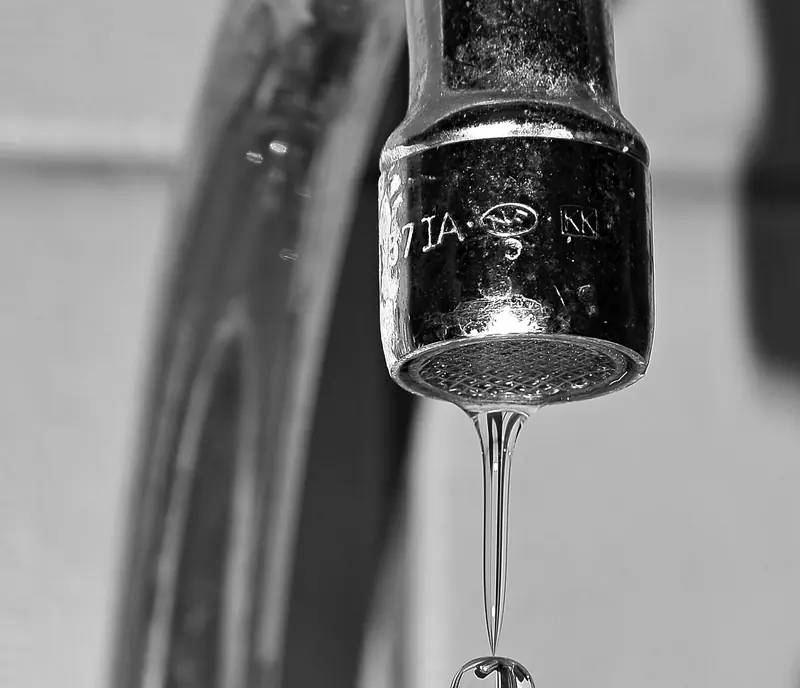
Pick a time when nobody will use water. Stop everything that draws on its own: an ice maker, a softener mid-cycle, an irrigation timer, a float in a stock trough. The drip in Figure 15-1 is a reminder that small uses count, since it will turn the dial too.
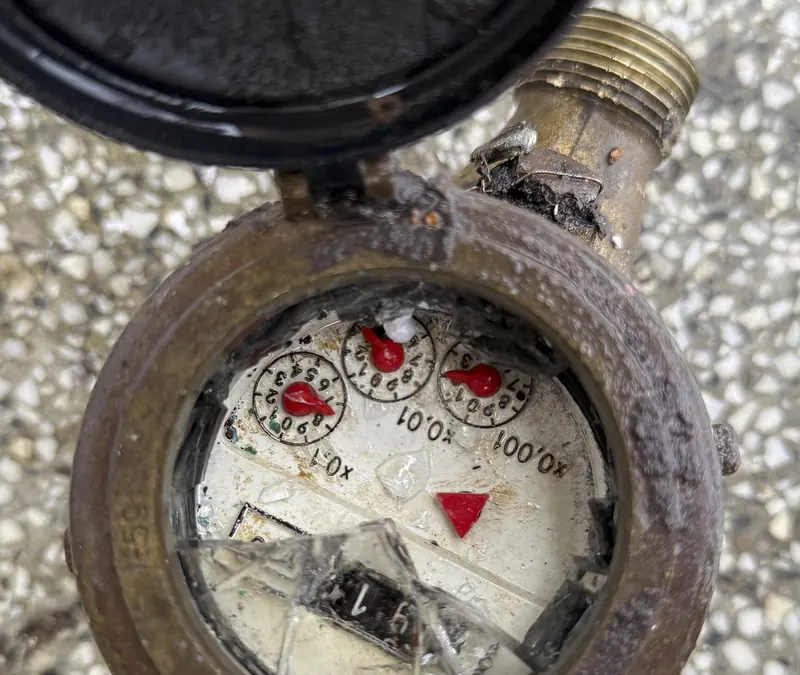
Now find the dial, as in Figure 15-2. Reading it means lifting a lid, and on many rural systems the box is the supplier's. Ask the office whether you may lift the lid, or ask them to read it. Look before you reach in. Note the dial's position and the numbers. Come back after a while. No agency sets a time, and an hour is a modest choice, longer if you can manage it. Many meters also have a small indicator that turns with very low flow; ask your supplier what yours has.
Then use your own valve at the house to split the job.
| Everything off, house valve open | House valve closed | What that points toward |
|---|---|---|
| Dial still | Not needed | No flow large enough to show during your watch |
| Dial moving | Dial stops | Something past that valve, inside the house or under it |
| Dial moving | Dial keeps moving | The line between meter and valve, or anything branching off it |
The third row is the one this book is about. Before you decide the main run is broken, remember what else hangs on it. A barn, a yard hydrant, a trough with a sticking float and a buried branch are all between the meter and the house on many places. Chapter 17 covers those. Close their valves one at a time if you have them. Each one you rule out shortens the search.
A running toilet is one familiar surprise in the second row. Fixing one is a job for the national how-to books, not this one, and ordinary toilet parts (Plumbing Supply and More, run by the same team as this book) are sold at one place among many. A leak that points under a slab belongs to Chapter 18.
15-3 If you are on a well
There is no meter on a private well, so the clue is the pressure gauge and the pump. Chapter 10 explained that the tank holds a reserve so small demands do not start the pump. With all water use stopped, the gauge should hold and the pump should stay off. A gauge that slowly falls and a pump that starts by itself suggests water is leaving somewhere. It may be the line. It may also be equipment at the well. A licensed pump installer can say which.
AgriLife notes that a drop in pressure once water is turned on may indicate a damaged well.2 So do not stop at the line if the answer is not there. Look at the breaker if the pump does not run, and leave the wiring to a licensed person. Keep clear of any wet panel and call your electric provider or a licensed electrician.
15-4 Finding the spot
Knowing the line leaks is not the same as knowing where. Walk it on your sketch from Chapter 13. Look for a wet patch, a strip of greener grass, or a low place that stays soft. On cracked clay, you may find nothing for a while, as Chapter 14 explained.
If the walk finds nothing, this is a good time to pay someone. A licensed plumber may be able to locate a leak by sound or by testing sections. Ask what method they use on your pipe. Do not dig test holes along a line on a guess, and call 811 before any digging. Chapter 13 explained why your own line will still not be marked.
If water is near a septic system, do not open anything to check. Lids stay secure. A wet patch near a tank or a field is a question for a licensed professional, and Chapter 26 has the signs.
15-5 The bill, and what you may ask for
Lamar County WSD says "all water usage registering upon and/or damages occurring to the metering equipment... shall be subject to charges."1 The likely reading is that leaked water that went through the meter shows on your bill, though the rule does not say so in those words. No rule checked promises a leak credit. Ask in writing, and read what your own tariff says.
If you think the meter itself is wrong, that is a different request. The District's rules provide for a meter test on written request, with a test fee if the meter passes the American Water Works Association's accuracy standard. If it does not, "a billing adjustment may be made as far back as six (6) months." Walston Springs WSC and the Texas Rural Water Association's sample tariff word it much the same.34 The sample tariff also calls a line leak on the member's side "a potential hazardous condition" and gives "up to five (5) business days" to fix it before disconnection. If your supplier has language like that, a found leak starts a clock.
Who decides this
- Whose leak is it?
- Past the meter, usually, in the documents read; your tariff decides
- May you lift the meter box lid?
- Your supplier's office; ask first
- Who may close the curb stop?
- The supplier, under Lamar County WSD's rules; check yours
- Who tests the meter?
- Your supplier, on written request; there may be a fee
- Who finds a hidden leak?
- A licensed plumber; ask what method they use on your pipe
- Why does a well pump start by itself?
- A licensed pump installer
On your own place
- Lay out your last 12 water bills and mark any month out of step.
- Find your house valve and work it gently, so it is known to work before you need it.
- List everything on your place that draws water by itself.
- Run the meter test at a quiet hour, and write down both readings with the times.
- If on a well, note the gauge at bedtime and again in the morning with nothing running.
- Walk the line on your sketch, looking for soft spots or strips of green.
- Call 811 before any digging, even a small test hole.
Notes
- Lamar County Water Supply District, District Service Rules and Regulations, machine-read scan. lamarcountywatersupply.myruralwater.com (read November 4, 2026) ↩
- Texas A&M AgriLife, Disinfecting Water Wells by Shock Chlorination, ESC-059 (8-19). twon.tamu.edu (read November 4, 2026) ↩
- Walston Springs WSC, Service Rules and Regulations, approved March 2014. walstonspringswsc.myruralwater.com (read November 4, 2026) ↩
- Hilltop WSC, Tariff, using Texas Rural Water Association sample language; McLennan County, not in this book's area. hilltopwatersupply.myruralwater.com (read November 4, 2026) ↩