Stretch III. The long line
Replacing a long service line
What goes into replacing a long service line?
Chapter 16 of 34. Sources checked .
Five things: settling who may do the work, reading your supplier's standards for pipe and trench, calling 811, keeping clear of septic lines, and passing a customer service inspection before water is restored. Several of those depend on your supplier and on whether the place is your homestead.
16-1 Who may do it
Chapter 15 may have left you with a leak on an old line. Replacing it is plumbing in the eyes of the law. The statute's definition reaches pipe "used outside a building to connect the building to... a supply of water."1 So the licensing rules come first, and they do not read the way people repeat them. Chapter 31 has them in full.
The homestead exemption is quoted there, with what it leaves out; by its words it does not reach a rental or a second property.1
The rule people mean when they say no license is needed in the country is 1301.052. It reads: "A person is not required to be licensed under this chapter to perform plumbing, other than plumbing performed in conjunction with new construction, repair, or remodeling", on a property meeting one of its listed conditions. Replacing a line sounds a lot like repair. What plumbing is left after that exclusion the statute does not explain, and no Texas State Board of Plumbing Examiners page was found that does. Treat that as unsettled, do not lean on it for this job, and ask the Board.
If unsure, a licensed plumber is the safe route, and the Board's lookup confirms a license.2
16-2 What your supplier's standards ask
Your supplier's rules govern how your pipe meets its meter. Lamar County WSD is the example here, taken from a scan, so get your own supplier's current copy.3 Its section E.22 is specific.
| Item | What it asks |
|---|---|
| Distance from wastewater lines | At least 3 feet apart horizontally |
| Same trench | Only with the water line bottom 12 inches above the wastewater line, on a solid shelf 18 inches off, with tight joints tested to 150 PSI |
| At the meter | "A minimum of four feet (4') of type 'L' soft copper pipe" |
| Bedding | Washed sand with 6 inches of cushion |
| Inspection | Request 48 hours ahead; no backfill before inspection |
| Backfill | Within 24 hours after approval |
| Materials named | PVC, brass, copper, cast iron, galvanized malleable iron, galvanized wrought iron, galvanized steel, "or other approved materials" |
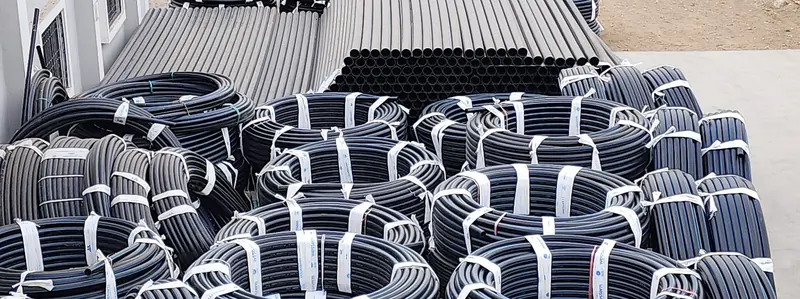
Look at that materials list against Figure 16-1. Poly pipe, shown there, is not named. It may fall under "other approved materials", or it may not. That is a question for the office, in writing, before you buy a coil. PVC is named, and PVC pipe (Plumbing Supply and More, run by the same team as this book) is sold at one place among many. Which pressure class and joint your supplier wants is theirs to say.
The lead limit is stricter than one posted number. The state rule prohibits pipes over 0.25 percent lead, and solder and flux over 0.2 percent.4 Lamar County WSD's posted rule, as scanned, says 8.0 percent. The District says of conflicts with TCEQ rules that "the more stringent rule shall apply", so use the state's figure.
16-3 Digging it
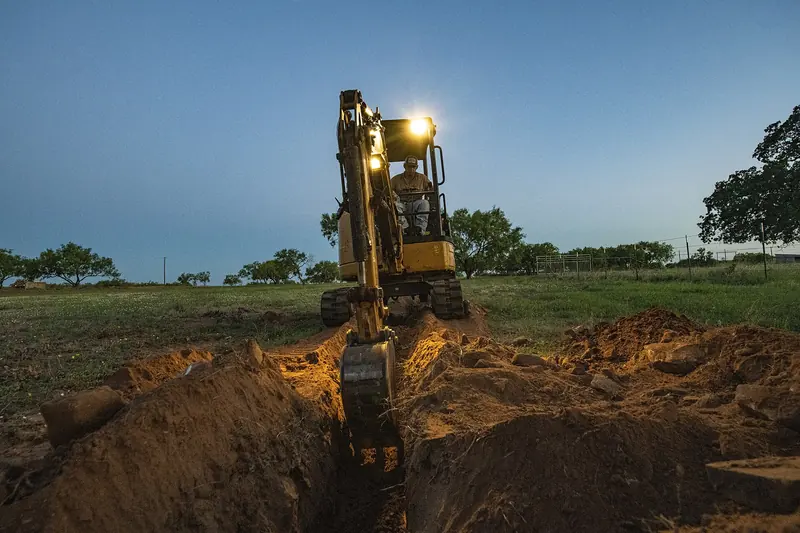
A trench through open pasture, like the one in Figure 16-2, looks simple. Call 811 first, every time, and call your supplier about its main. Remember from Chapter 13 that your own lines stay unmarked, which includes the old line you are replacing and anything branching from it.
Keep the new line away from septic parts. The table below comes from a 2017 compilation of TCEQ's rules, and 30 TAC 285.91 was amended in 2023. Confirm the current table with the authorized agent before you lay a pipe by it.5 Stay outside the tank and field areas, and do not open anything. Never open a tank or lean into one, because gases can kill quickly. Lids stay secure.
| Line | Tank | Soil absorption | Lined ET | Watertight sewer pipe | Spray edge | Drip |
|---|---|---|---|---|---|---|
| Private water line | 10 | 10 | 5 | 10, except at connection to structure | No separation listed | 10 |
| Public water supply line | 10 | 10 | 10 | 10 | 10 | 10 |
Clay deserves thought as well. Chapter 14 gave the soil facts and said what is only inference. Bedding sand, the cushion, and careful backfill are what the standards ask. Ask a licensed plumber what they do on your soil type beyond that.
16-4 Pressure on a long line
The state requires a public system to be designed to keep "a minimum pressure of 35 psi at all points within the distribution network at flow rates of at least 1.5 gallons per minute per connection."6 That is a design rule for the system's network, and it does not promise what reaches your kitchen. No state maximum for a house was found.
A long run changes what you get, and so does a hill. Ask your supplier what pressure to expect at your meter, and have a licensed plumber measure at the house. No agency figure backs a target here. If the pressure at the house turns out high, pressure-reducing valves (Plumbing Supply and More, run by the same team as this book) are a common fix, sold at one place among many. Have a licensed plumber size it and set it. If the line is long and the pressure low, that is a sizing talk to have before the trench is open, not after.
16-5 The inspection and the turn-on
The state rule requires a customer service inspection certificate "prior to providing continuous water service to new construction, on any existing service either when the water purveyor has reason to believe that cross-connections or other potential contaminant hazards exist, or after any material improvement, correction, or addition to the private water distribution facilities."4 A replaced line is a likely case. Ask your supplier when you plan the work, not after the trench is closed.
The inspector, a licensed customer service inspector or a Board plumbing inspector, is looking for cross-connections, not grading your workmanship. A hazard found "shall be considered sufficient grounds for immediate termination of water service", which is the reason to get it right. If the old line is being retired, leave no dead branch tied in. Tell whoever does the work about any well on the place, because the next chapter's rule about wells and public water applies here too.
Who decides this
- Who may do the work on a homestead?
- Section 1301.051 as written; ask the Texas State Board of Plumbing Examiners
- Who may do it on a rental or second place?
- A licensed plumber; the homestead words do not reach it
- Which pipe is approved?
- Your supplier's rules, and the state's lead limits
- Who inspects?
- A licensed customer service inspector or a Board plumbing inspector, arranged through your supplier
- How far from septic parts?
- The current Table X, confirmed with your authorized agent
On your own place
- Get your supplier's current standards and read the section on customer lines.
- Ask in writing whether poly is approved, and what is required at the meter.
- Sketch the new route, away from any septic tank or field, and mark distances.
- Check the license of anyone you hire through the Board's lookup.
- Call 811 before any digging and call your supplier about its main.
- Ask your supplier how to book the inspection, and how many hours' notice it wants.
- Keep pictures of the open trench with a tape in the shot before backfill, for your sketch.
Notes
- Texas Occupations Code ch. 1301, sections 1301.002(7), 1301.051 and 1301.052. tcss.legis.texas.gov (read November 4, 2026) ↩
- Texas State Board of Plumbing Examiners, Find a License/Registration. tsbpe.texas.gov (read November 4, 2026) ↩
- Lamar County Water Supply District, District Service Rules and Regulations, section E.22, machine-read scan. lamarcountywatersupply.myruralwater.com (read November 4, 2026) ↩
- Cornell LII copy of 30 TAC 290.46(i) and (j). law.cornell.edu (read November 4, 2026) ↩
- TCEQ, On-Site Sewage Facilities Rules Compilation, RG-472 (May 2017). tceq.texas.gov (read November 4, 2026) ↩
- Cornell LII copy of 30 TAC 290.44(d). law.cornell.edu (read November 4, 2026) ↩