Stretch IV. In and under the house
Is your water actually hard
Is your water actually hard, and what do you do if it is?
Chapter 20 of 34. Sources checked .
It depends on your source, and for some systems in this region the answer is no. Lamar County Water Supply District's 2023 report gives 56.2 mg/L, soft on the USGS scale, while TWDB describes Trinity water as very hard where the aquifer outcrops, which this book did not establish for any well here. Find your number before you buy anything, then decide.
20-1 The number first
Sellers and neighbors may both tell you the water here is hard. For some taps in this region, the printed figures say otherwise.
The USGS scale reads: "0 to 60 mg/L (milligrams per liter) as calcium carbonate is classified as soft; 61 to 120 mg/L as moderately hard; 121 to 180 mg/L as hard; and more than 180 mg/L as very hard."1 The Texas Well Owner Network uses a stricter low end, where under 17.1 mg/L is soft and 17.1 to 60 is "slightly hard."2 So the same glass can be soft on one chart and slightly hard on the other. This book uses USGS unless it says so. Sellers often speak in grains per gallon. On the Well Owner Network's chart, 1 grain is 17.1 mg/L.
| Source | Report | Hardness | Reads as (USGS) |
|---|---|---|---|
| Lamar County WSD (Pat Mayse Lake, Crook) | 2023 | 56.2 mg/L, about 3.3 grains | Soft |
| Red River County WSC | 2024 | 56.8 mg/L, but see below | Soft |
| North Hopkins WSC (Cooper Lake water) | 2025 | Not stated; calcium 31.1 ppm, magnesium 2.82 | Unknown |
| City of Paris | Not read | Not confirmed | Unknown |
Each of those lines has a limit. The Red River County table carries a note tying one figure to the Lamar County district, and the same system's 2025 report calls its source ground water, so its table may not describe what comes from its wells.3 Paris's site could not be reached when checked, so the city's figure is left blank. It draws on the same lakes as the district, but this book does not assume the two match.4 Chapter 4 explains why hardness may be missing from a report altogether: such lines are not always required.4
20-2 On a well, the aquifer decides
Groundwater varies far more. The Texas Water Development Board calls Blossom water "generally soft" and Nacatoch water "soft." It calls Trinity water "very hard in the outcrop," though this book did not establish that for any well here, and it warns that the upper zone of the Woodbine is "very high in iron."5 Chapter 5 goes through which aquifers lie where. No one can tell you the figure for your well from a map. Chapter 7 sets out how to test it.
20-3 What hardness looks like
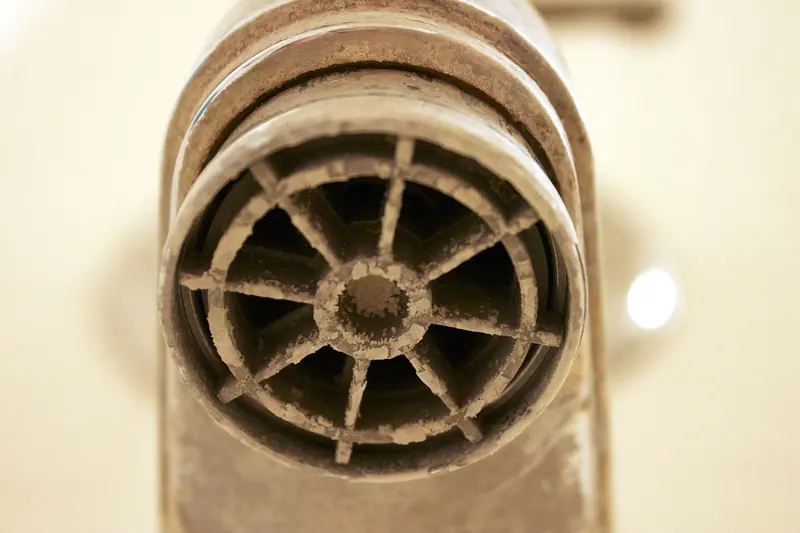
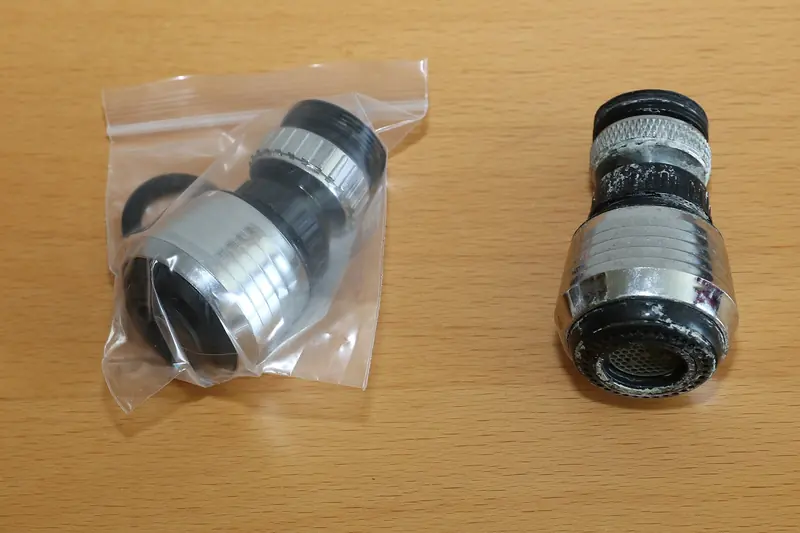
AgriLife says hard water "consumes soap before lather will form," "creates scale in boilers, water heaters and pipes," and "forms white flakes in ice."6 Figure 20-1 shows scale built up on a tub spout, and Figure 20-2 sets a crusted aerator beside a new one. Crust like that is worth noticing, but a little of it does not prove your water is hard by any chart. A test does that.
20-4 If the test says hard
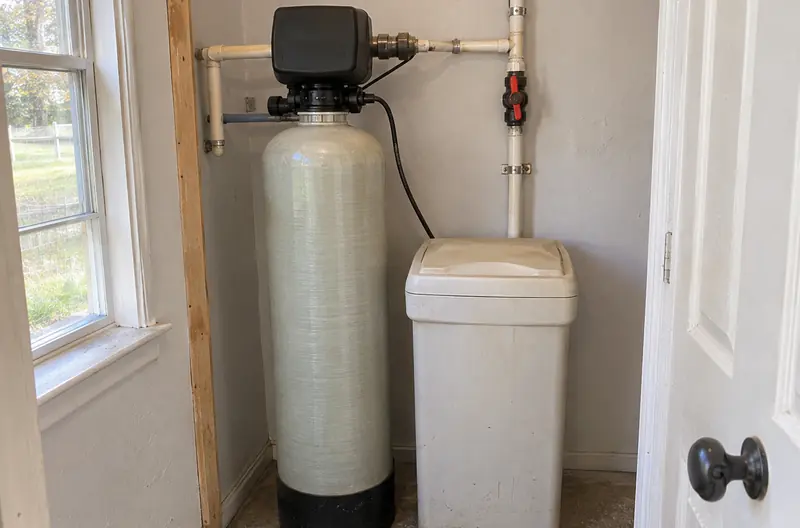
A softener is one answer, and only if your test shows it. AgriLife explains: "Hard water becomes 'soft' after the calcium is replaced with either sodium or potassium salt." It also says softeners "do not remove particles, pathogens, organic chemicals, or radon gas."2 Figure 20-3 shows the usual arrangement, a softener tank and a brine tank. So a softener will not fix a positive bacteria test, and it is a poor answer for a problem you have not measured.
If your well test does show hardness, here is one such unit, a softener sold for well water (SoftPro, run by the same team as this book) and a shop page on softeners and their sizing (Quality Water Treatment, run by the same team as this book), so you can see what the equipment is and how sizing is talked about. Both are simply stores. Particles are a separate matter, and water filters and housings (Plumbing Supply and More, run by the same team as this book) are sold at a third. Take your test results with you, whoever you talk to, and buy for the number you have.
Softened water has costs of its own. "Do not use soft water, especially if it has high sodium levels, to water houseplants, garden vegetables, or yard plants that do not tolerate salinity well," says AgriLife, adding that it "may not be suitable for drinking because it tastes salty."2 The EPA's guidance level for sodium is 20 mg/L, written for people on a 500 mg a day restriction, and EPA says it should "not be extrapolated to the entire population."7 The reports above already show sodium near or over that figure before any softener: 19.6, 18 and 26.8. If you are on a low-sodium diet, ask your doctor about your own number.
20-5 A softener and a septic system
The two have a rule between them. AgriLife warns that "the increased salinity may damage the soils in a septic leach field."2 The Texas rule, 30 TAC 285.37, allows discharge from a softener installed on or after September 1, 2003, into a system where the unit uses "a demand-initiated regeneration (DIR) control device," labeled as such. On a non-standard or proprietary system, which on clay is the usual case, the softener drain must bypass the treatment unit and connect at the pump tank or the pipe after treatment. Discharge must enter "through an airgap or an airgap device."8 Read Chapter 24 and ask your authorized agent what local rules add.
20-6 Who may install one
No plumbing license is needed under Occupations Code 1301.053 for "water treatment installations, exchanges, services, or repairs, other than the treatment of rainwater," though the work is subject to inspection where law requires.9 Health and Safety Code 341.034(e) then says a person who does this "under a contract" in "public or private water systems" must hold a TCEQ water treatment license unless licensed by the plumbing board. TCEQ's page adds: "Private wells that do not meet the definition of public water system" are "not subject to the requirements of this chapter."10 Those two do not sit together neatly, and this book could not settle them. Ask TCEQ if it matters to your job.
Who decides this
- What is the water's hardness?
- Your water supplier's report, or a lab test on a well
- Is a softener worth buying?
- You, after a test shows hardness
- May a softener drain into the septic?
- The rule above, and your local authorized agent
- Must the installer hold a license?
- Ask TCEQ and TSBPE; the wording is unsettled for private wells
- Sodium and your health
- Your doctor
On your own place
- Pull your supplier's latest water report and write down hardness, sodium and the date.
- On a well, send a sample for hardness and iron, following Chapter 7.
- Compare your aerators and shower heads with the pictures here and note any crust.
- If you have a softener, trace its drain line by eye and see where it goes.
- Ask your supplier whether its source changes through the year.
Notes
- U.S. Geological Survey, Hardness of Water. usgs.gov (read November 4, 2026) ↩
- Texas Well Owner Network, Texas A&M AgriLife, Well Owner's Guide to Water Supply. twon.tamu.edu (read November 4, 2026) ↩
- Red River County WSC, Consumer Confidence Report 2024, machine-read scan, and 2025 report. redrivercountywsc.myruralwater.com and redrivercountywsc.myruralwater.com (read November 4, 2026) ↩
- Lamar County Water Supply District, Consumer Confidence Report 2023, and North Hopkins WSC, Consumer Confidence Report 2025. lamarcountywatersupply.myruralwater.com and northhopkinswsc.myruralwater.com (read November 4, 2026) ↩
- Texas Water Development Board, aquifer pages: Blossom, Nacatoch, Trinity, Woodbine. twdb.texas.gov and twdb.texas.gov and twdb.texas.gov and twdb.texas.gov (read November 4, 2026) ↩
- Texas Well Owner Network, Description of Water Analysis Parameters. twon.tamu.edu (read November 4, 2026) ↩
- U.S. EPA, Sodium in Drinking Water support document, February 2003. epa.gov (read November 4, 2026) ↩
- Cornell LII copy of 30 TAC 285.37. law.cornell.edu (read November 4, 2026) ↩
- Texas Occupations Code ch. 1301, section 1301.053. tcss.legis.texas.gov (read November 4, 2026) ↩
- Texas Health and Safety Code section 341.034(e), and TCEQ, Water Treatment Specialist licensing. tcss.legis.texas.gov and tceq.texas.gov (read November 4, 2026) ↩