Stretch I. Where the water comes from
What to find out before you buy
What should you find out about water before you buy land?
Chapter 1 of 34. Sources checked .
Find out who is certified to serve the tract, whether a main already reaches it, what wells are on record, and whether the lot and soil will take a septic system. Most of the answers sit in public records and a utility's written rules. Get them before closing.
1-1 Start with who is certified to serve it
Water reaches a tract here from one of a few directions: a city, a water supply corporation, a special utility district, a municipal utility district, or a well of its own. If the land sits inside a certified service area, the law sounds generous. A retail utility holding a certificate "shall serve every consumer within its certified area and shall render continuous and adequate service."1
That sentence has limits a buyer should know. A water supply corporation or special utility district need not extend service to an applicant in a subdivision if it documents that the developer failed to follow its service extension policy and the applicant bought after notice was given. A "developer" includes anyone who subdivides land or asks for more than two connections on one contiguous tract.1 So a lot split off a larger parcel deserves a direct question to the utility before you sign.
There is a second limit. A certificate holder "shall refuse to serve a customer within its certified area" if it is barred from serving under Local Government Code sections 212.012 or 232.0047.1 This book did not read those two sections, and how they apply to one tract is a question for the utility and your own attorney.
To see who serves an area, start with the Texas Water Development Board's service boundary viewer, which it describes as "a public water system service area mapping application."2 The Public Utility Commission also keeps a viewer of certified boundaries. Its site would not open when this was checked, so that description is not confirmed.3 A map is a starting point. Figure 1-1 shows why road frontage alone settles nothing.

1-2 A main in the ditch is not a connection
Ask the utility whether the tract gets standard service. Lamar County Water Supply District's posted rules define that as "service on an existing pipeline where pipeline or service facility extensions are not required." Extensions are "the sole responsibility of the property owner and/or developer."4
The road ditch carries its own catch. Where a main runs in the right-of-way because a past owner refused an easement, the District's rules say the applicant "shall grant the easements required" and pay what it takes "to cap the existing line in the ROW and construct the appropriate line or lines within that easement."4 An old refusal can become your bill.
A seller's membership may pass with the land, but that is not the same as water. Transfer "does not entitle the transferee to water or sewer service unless each condition for water or sewer service is met."5 Chapter 3 walks through those conditions.
| Question | Where the answer lives | Why it matters |
|---|---|---|
| Who may serve this tract? | Service boundary viewers, then the utility in writing | Decides whose rules apply |
| Is it standard service? | The utility's tariff or service rules | Extensions fall on the owner |
| Any wells on record? | State well report databases | An idle well carries duties |
| Is there a septic permit on file? | The local authorized agent | A permit moves with the land |
| Can this lot take a new system? | Lot history and a licensed site evaluation | Lot size and clay limit choices |
1-3 What a well on the place does and does not tell you
Texas keeps well reports in two places: the Submitted Drillers Reports database for 2003 to the present, and a TCEQ viewer for older wells.6 A missing report proves little, since an owner can ask in writing for a log to be kept confidential.7
Look harder at any well nobody uses. A well "not in use" counts as abandoned unless it fits a listed exception, such as being in good condition with casing, pump and column, or being capped and not deteriorated. Once a landowner or possessor learns of the condition, the well must be plugged or capped "Not later than the 180th day."7 TCEQ's plugging guide adds that the landowner "is also held responsible for injury or pollution related to the abandoned well."8 Buying the land can mean buying that duty. Chapter 11 covers it.
A working well is not a tested one. No Texas rule found for this book makes a seller test a private well, so a test would be your request, and Chapter 7 says what to ask for. Do not assume anything about the water from the neighborhood's reputation, either. Hardness here depends on the source, from soft to whatever your test says. Test before you buy any treatment equipment.
Whether an earlier owner sold or kept back the groundwater rights is a separate question. The sources behind this book do not settle it for any tract, so ask a title company or an attorney before you count on a well.
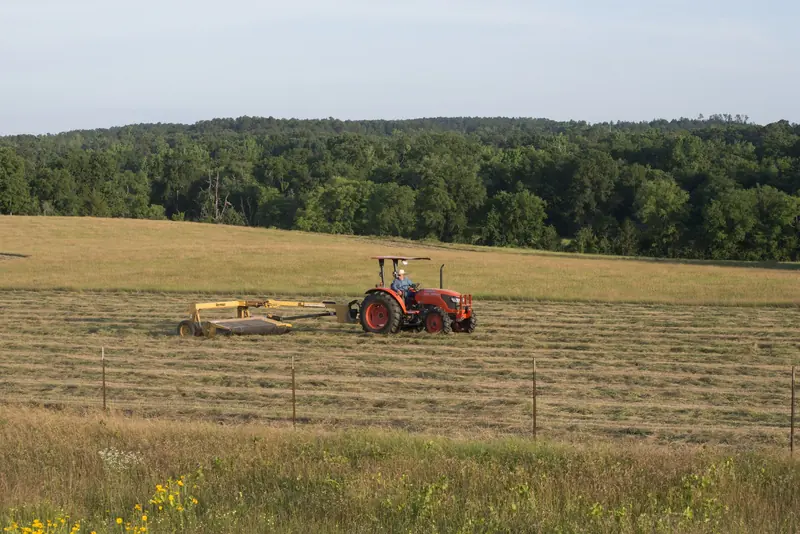
Figure 1-2 shows hay being cut on a good field, which is no evidence of a well, a main, or a septic site. Each of those has its own paper.
1-4 Septic: lot, soil and paper
Lot size rules apply to subdivisions, and the test is about public water, not about whether a well exists. "Subdivisions of single family dwellings platted or created after the effective date of this section, served by a public water supply and using individual OSSFs for sewage disposal, shall have lots of at least 1/2 acre." Those "not served by a public water supply" need "at least one acre."9 Smaller lots subdivided before January 1, 1988 may still use a system, but it "must comply with the requirements set forth in this Chapter."9 A family division into tracts of five acres or more is exempt only from submitting planning materials, not from the standards.9
Then there is the soil. AgriLife puts it flatly: "A standard drain field cannot be used in a clay soil."10 The 1979 survey of Lamar and Delta counties says "Very clayey or wet soils are poorly suited to septic tank absorption fields."11 That usually means a non-standard system, and Chapter 24 explains why. Every tract where a system will be installed needs a site evaluation by a licensed evaluator or engineer.9 Get it done before you count on a house site.
If a system exists, ask the local authorized agent for its permit. "Permits shall be transferred to a new owner automatically upon sale or other legal transfer of an OSSF."9 If there is none, TCEQ says that a grandfathered or ten-acre system "MIGHT" need no permit, and to "Confirm with your local permitting authority."12 Do not open a tank to check on it. Lids stay on, because tanks can hold gases that kill quickly, and inspection work belongs to licensed people.
Who decides this
- Which utility may serve this land?
- The utility itself, in writing, with the state boundary viewers as a first check
- Does a connection need an extension or easement?
- The utility, under its tariff or service rules
- Is there an old well to deal with?
- The Texas Department of Licensing and Regulation, for the rules on abandoned wells
- Is this lot big enough for a septic system?
- The authorized agent for the county, listed in Appendix A
On your own place
- Look up the tract in the state's service boundary viewer and write down every system shown.
- Ask each system, in writing, whether the tract gets standard service and what it would take to connect.
- Search both well report databases for the survey and the neighbors around it.
- Walk the fence lines and old house sites looking for casing, a pump house or a concrete pad. Stay well back from anything uncovered.
- Ask the county's authorized agent whether a septic permit is on file.
- Before anyone digs a soil pit or trench, call 811. Your own buried lines will not be marked, so ask the seller where they run.
Notes
- Texas Water Code ch. 13, sections 13.250, 13.2502 and 13.2501. tcss.legis.texas.gov (read November 4, 2026) ↩
- Texas Water Development Board, Lamar County water planning summary, describing the Water Service Boundary Viewer. twdb.texas.gov (read November 4, 2026) ↩
- Public Utility Commission of Texas, water guidance page. Search listing only; the site blocked direct reading. puc.texas.gov (read November 4, 2026) ↩
- Lamar County Water Supply District, Service Rules and Regulations, machine-read scan. lamarcountywatersupply.myruralwater.com (read November 4, 2026) ↩
- Texas Water Code section 67.016(c). tcss.legis.texas.gov (read November 4, 2026) ↩
- Texas Water Development Board, groundwater data page. twdb.texas.gov (read November 4, 2026) ↩
- Texas Occupations Code sections 1901.251 and 1901.255. tcss.legis.texas.gov (read November 4, 2026) ↩
- TCEQ, Landowner's Guide to Plugging Abandoned Water Wells, RG-347. tceq.texas.gov (read November 4, 2026) ↩
- TCEQ, On-Site Sewage Facility Rules Compilation, RG-472, May 2017, sections 285.3 and 285.4. Some sections have since been amended; check with the authorized agent. tceq.texas.gov (read November 4, 2026) ↩
- Texas A&M AgriLife, L-5227, Septic Tank/Soil Absorption Field. ossf.tamu.edu (read November 4, 2026) ↩
- USDA, Soil Survey of Lamar and Delta Counties, 1979, Internet Archive machine-read scan rather than the agency's copy. archive.org (read November 4, 2026) ↩
- TCEQ, OSSF permits page. tceq.texas.gov (read November 4, 2026) ↩