Stretch VI. Weather
When pipes freeze or burst
What do you do when pipes freeze or burst?
Chapter 29 of 34. Sources checked .
Find the main water valve before you do anything else, because a frozen pipe may already be split. Keep the faucet open and thaw with gentle electric or hot-towel heat, never a flame. If water reaches an electrical panel, keep clear and call the electric provider or a licensed electrician.
29-1 First, the valve
Chapter 28 asked you to find your main shutoff on a mild day. Tonight is why. AgriLife says: "Make sure you know where the main water valve is located outside of your home. The frozen pipe may already be broken, and it will leak when the water is thawed."1
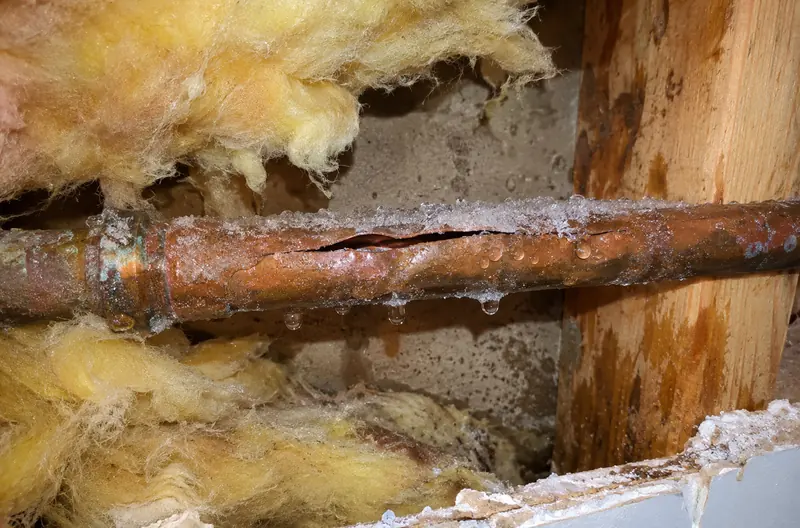
Ice holds a split pipe closed. The leak shows up when the ice melts, and it is often somewhere you were not looking. Figure 29-1 illustrates what that split looks like inside a wall. So do not start thawing until you know you could reach that valve and close it, in the dark, with cold hands. If you could not, thawing can wait until someone who knows the place is with you. A licensed plumber can help if you are unsure where the line runs.
29-2 Thawing without making it worse
Keep the faucet on that line open. AgriLife says "Water will begin to flow as you treat the frozen area."1 The moving water also shows you when you are done.
| You may use | Do not use |
|---|---|
| A heating pad | A blowtorch |
| An electric hair dryer | A kerosene or propane heater |
| A portable space heater | A charcoal stove |
| Towels soaked in hot water | Any other open flame device |
AgriLife's reason for the right-hand column is that those devices "present a serious fire hazard as well as release lethal carbon monoxide fumes into the air."1 Its one condition on the left-hand column is to "Make sure that electrical cords do not come into contact with water."
The space heater needs a word of its own. The state's report on the 2021 storm counted ten deaths from fire, from "house fires or while space heaters were in close proximity to ignitable materials."2 Keep it clear of anything that burns, and keep its cord away from water. In a well house, a crawl space or an attic, the safe answer may be to wait. A pipe in a tight space is a poor reason to crawl in with a cord.
29-3 If it has burst
Close the main. Then open a low tap and a high one to let the pressure and the remaining water out of the house lines (ordinary practice). If the break is on the far side of your main shutoff, between meter and house, the valve on your side may not stop it. Call your supplier, and see Chapter 12 for who owns that stretch of line.
If water is near an electrical panel, a heater or a cord, keep clear of it. Do not wade to a panel to switch it. Call your electric provider or a licensed electrician, and stay out until they tell you it is safe. Water and live wiring together are a bigger danger than the water damage.
On a well, you may also want to stop the pump from running against a burst line. A switch or breaker you can reach from dry ground is as far as this book goes. Pump wiring goes to a licensed person. If the pump or its wiring has been under water, do not turn the pump on, and read Chapter 9.3
Repairing a leak inside the house is plumbing. Chapter 31 sets out who may do it, and Chapter 32 covers permits. Where a city's permit rules apply, the state law's list of permit exceptions begins with "the repairing of leaks," so ask your city what a burst repair needs.4 Once the valve is closed, there is time to hire someone you have checked; Chapter 34 shows how.
29-4 Stay out of the cold, and watch the air
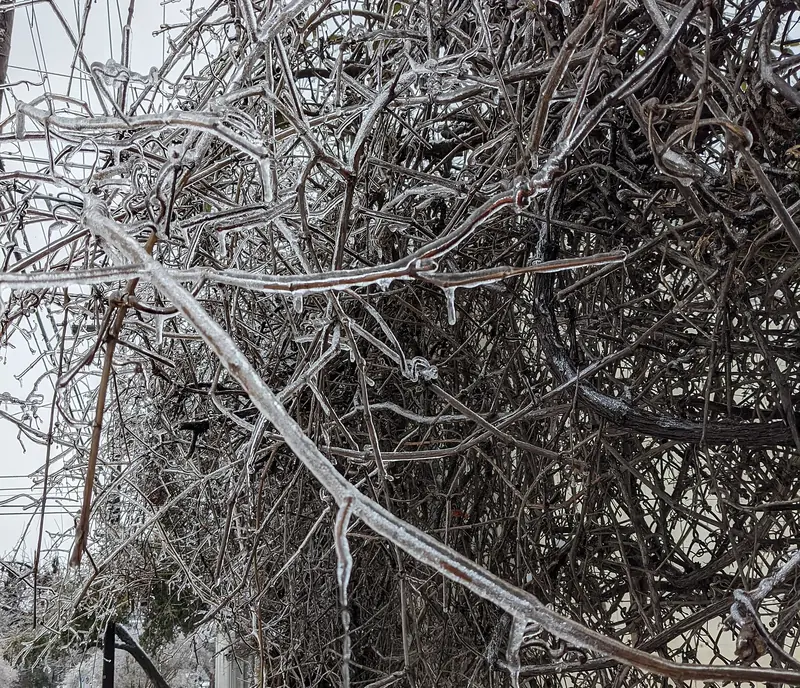
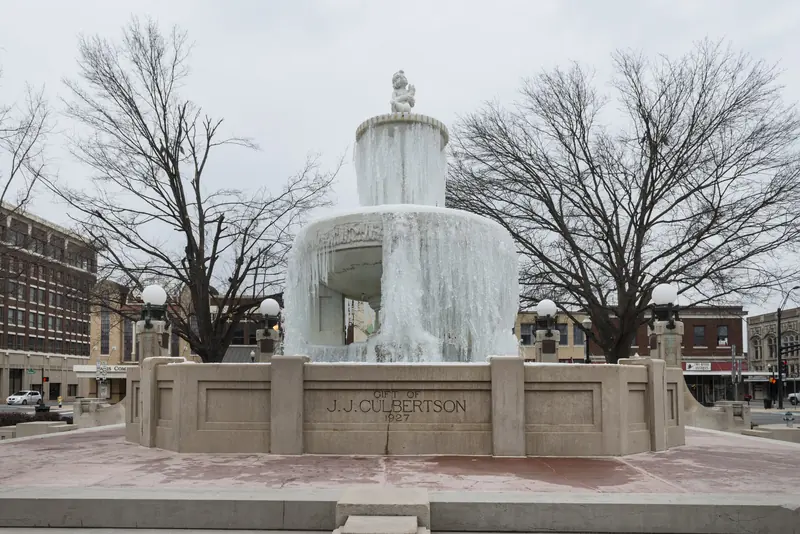
You may recall the line from Chapter 27. The state's report lists "engaging in outdoor repair activity during the storm" among the risk factors for hypothermia.2 A leak at the barn can be closed off at a valve and left. Figure 29-2 shows what footing looked like outdoors in that storm. Going out in it for a line that can wait is the trade to refuse. A freeze that can sheathe the fountain in downtown Paris in thick ice, as in Figure 29-3, is no time for a long walk to a far valve.
Carbon monoxide is the other quiet risk. If a CO alarm sounds, everyone goes outside first, and you call 911 from outside. The Consumer Product Safety Commission says not to look for the source, and not to go back in until responders give permission.5 If you smell gas or propane, Chapter 33 gives the steps. Leave the building first.
Who decides this
- Who repairs a break on the customer's side of the meter?
- You arrange it, under your supplier's rules; see Chapter 12
- Who repairs a main in the road?
- Your water supplier
- Who deals with water near the panel?
- Your electric provider or a licensed electrician
- Who says a house is safe after a CO alarm?
- The emergency responders you called
- Who fixes a burst pipe in the wall?
- A licensed plumber, or you in your own homestead as the statute allows; see Chapter 31
On your own place
- Time yourself getting from the back door to the main shutoff in the dark, with a flashlight.
- Keep a flashlight and any valve key where you can find them without power.
- Check where a heating pad or hair dryer could reach, and whether a safe outlet is near.
- Walk the house and note what sits near your panel, so you know where water would be a hazard.
- Clear stored things away from where a space heater would stand.
Notes
- Texas A&M AgriLife, Winter Storms: Frozen Pipes. texashelp.tamu.edu (read November 4, 2026) ↩
- Texas Department of State Health Services, February 2021 winter storm mortality surveillance report, December 31, 2021. dshs.texas.gov (read November 4, 2026) ↩
- Texas A&M AgriLife, ER-011, Decontaminating flooded wells, 2006. twon.tamu.edu (read November 4, 2026) ↩
- Texas Occupations Code, Chapter 1301, Sec. 1301.551(c). tcss.legis.texas.gov (read November 4, 2026) ↩
- US Consumer Product Safety Commission, carbon monoxide safety guide. cpsc.gov (read November 4, 2026) ↩