Stretch VI. Weather
Getting the place ready for a hard freeze
How do you get a house and outbuildings ready for a hard freeze?
Chapter 28 of 34. Sources checked .
Start early, on a mild day. Find your main shutoff, protect what sits outside or against cold walls, drain what can be drained, and shield the well house from wind. AgriLife treats 20 F as the point where pipes are at real risk, and advises care at any freeze.
28-1 When to worry, and when to start
Chapter 27 was the record. This chapter is the list. Texas A&M AgriLife says "Water pipes have the potential to freeze and burst when the outside temperature reaches 20 °F or below."1 An AgriLife agent adds that you should take precautions any time temperatures dip below freezing.2 So 20 F is the line to take seriously, and 32 F is the line to start paying attention.
The same agency says "It's best to act early," because supplies may run short once a storm is forecast.2 Buy sleeves, covers and heat tape in October. The afternoon before an ice storm is a poor time to look for them.
28-2 Know your shutoff first
Everything else in these chapters assumes you can stop the water. AgriLife's first point on frozen pipes is to know where the main valve is.1 Walk to it now and try it gently, with dry hands, in daylight.
On a public system, the valve you use may not be the one at the meter. Lamar County Water Supply District's posted rules require "a cut-off valve on the Customer's side of the meter" and say that use of the District's curb stop for that purpose "is prohibited."3 Other suppliers' rules may differ, and Chapter 12 explains why yours are the ones to read. On a well, trace the line from the pressure tank to the house and find the valve on it, if one was fitted.
While you are looking, try the small stops under sinks and behind toilets. They let you isolate one fixture if a supply line lets go. Angle stop valves (Plumbing Supply and More, run by the same team as this book) are the usual part, and that link is one place that sells them. If one will not move, have it replaced before cold weather (ordinary practice), and Chapter 31 covers who may do that work. If you are unsure of a valve, ask a licensed plumber to show you.
28-3 What freezes first
AgriLife names the usual places: hose bibs, sprinkler lines, and pipes in crawl spaces, attics, garages and against poorly insulated outside walls. It adds well houses.12 On a place with a long line and outbuildings, that list is longer than it looks.
| Place | What to do |
|---|---|
| Hose bib | Remove the hose. "Close inside valves supplying outdoor hose bibs if possible." Fit an insulated cover. |
| Exposed pipe in a crawl space, attic or garage | Fit a "pipe sleeve" or UL-listed heat tape, and follow the maker's instructions for the tape. |
| Sprinkler lines | Drain them. "Do not put antifreeze in these lines." |
| Well house | "Insulate well houses, wrap pipes and position safe heat sources before cold weather arrives." |
| Pipes in the wind | "Shield pipes from direct wind, which accelerates freezing." |
| Outdoor water systems | "drained and covered or allowed to drip slowly" |
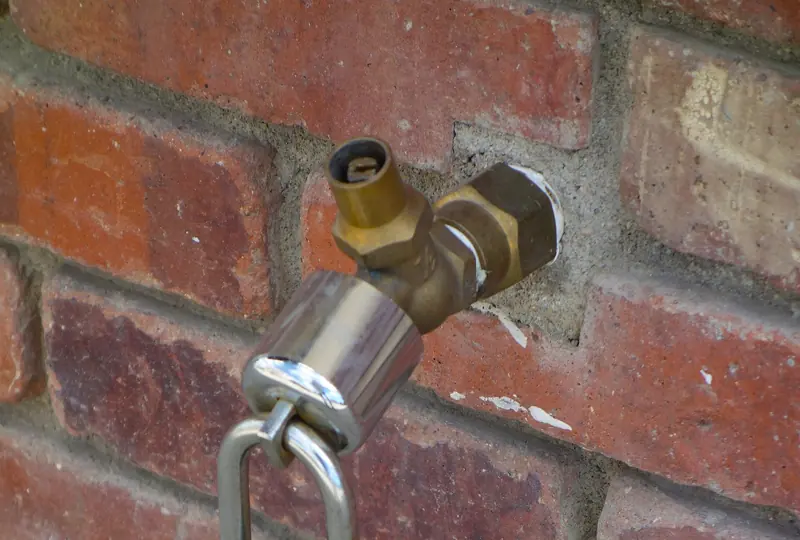
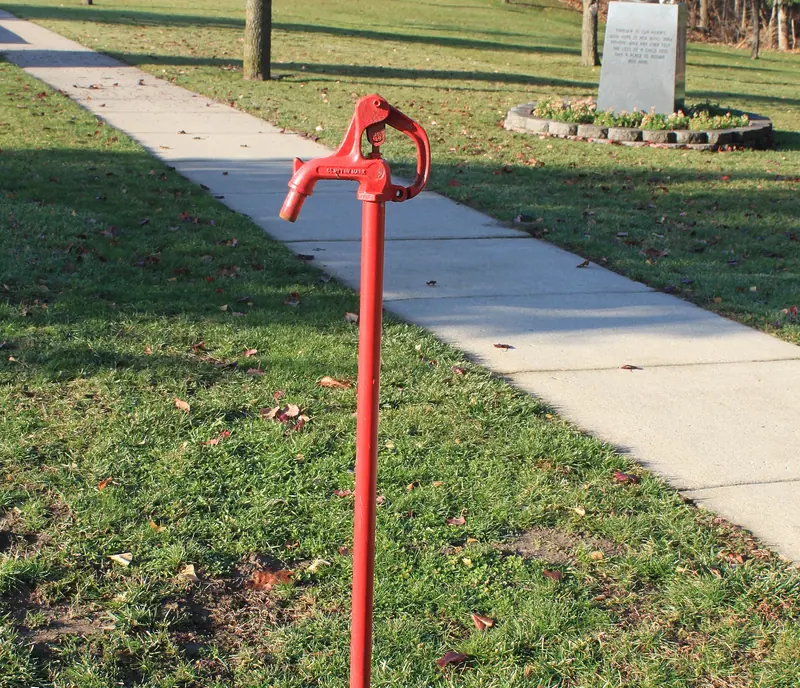
The brass bib in Figure 28-1 is padlocked against theft, not cold, and it shows how little metal stands between the wall and the weather. A frost-free yard hydrant like the one in Figure 28-2 is a different item: it stands in the open on its own line. Treat one as part of your outdoor water system, and check the maker's instructions for how it should drain.
28-4 Well houses, barns and troughs
Two AgriLife warnings apply here. Do not wrap pipes and pressure tanks with empty fertilizer or pesticide bags.4 And any heat source you put in a well house has to be a safe one, set up before the cold arrives.5 Keep any heater away from anything that burns, and use only what the maker allows in that space. Pump wiring and any new circuit go to a licensed person. Your own part stops at a breaker or switch check from dry ground.
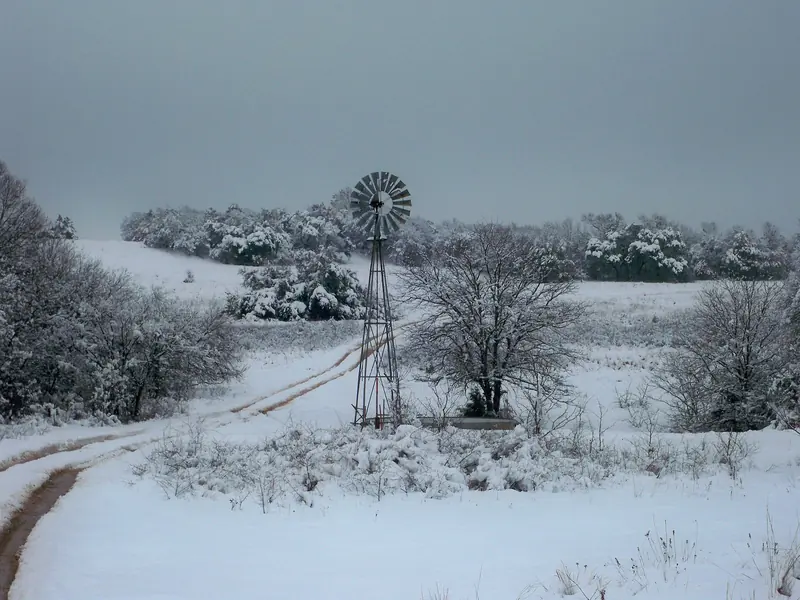
Stock water needs its own plan. The windmill and tank in Figure 28-3 stand in Texas snow, and an open tank like that one is what a frozen line leaves you relying on. Chapter 17 covers how troughs are plumbed. For the freeze, it comes down to knowing which outside lines can be drained or dripped, and how you would water stock if they froze anyway.
28-5 On the cold night
Open kitchen and bathroom cabinet doors. Keep the thermostat steady. If you will be away, set it "no lower than 55 °F."1 The Railroad Commission gives the same cabinet advice for doors on outside walls.6
Dripping is less settled. AgriLife's news service says that leaving water running slightly "does help during prolonged freezing temperatures," though AgriLife's own frozen-pipes sheet does not mention it.21 If your supplier announces a shortage or asks people to cut use, follow that notice. Retail water suppliers must have drought contingency plans, which can include stages for a system outage, and Chapter 2 explains who runs yours.7
Ready.gov says "Only use generators and grills outdoors and away from windows and never heat your home with a gas stovetop or oven."8 Chapter 33 has what to do about a gas or propane smell, and what to do about a carbon monoxide alarm.
Who decides this
- Whose job is the valve on the customer's side of the meter?
- Yours as customer under the rules quoted above; read your own supplier's tariff
- May a customer use the curb stop at the meter?
- Your supplier's rules decide; Lamar County WSD prohibits it
- Should you drip taps during a shortage?
- Your water supplier's notice, if one is out
- Who wires a well house heater circuit?
- A licensed electrician
On your own place
- Try the main shutoff, and show everyone in the house where it is.
- Find any valve inside the house that feeds an outside bib, and label it.
- Disconnect hoses and put covers on bibs before the first forecast freeze.
- Walk the crawl space entrance, attic hatch and garage and list every bare pipe you can see from a safe spot.
- Stand in the well house on a windy day and feel where the gaps are.
- Mark every yard hydrant and trough line on a sketch, with how each one drains.
Notes
- Texas A&M AgriLife, Winter Storms: Frozen Pipes. texashelp.tamu.edu (read November 4, 2026) ↩
- AgriLife Today, Prepare for winter weather, January 16, 2025. agrilifetoday.tamu.edu (read November 4, 2026) ↩
- Lamar County Water Supply District, District Service Rules and Regulations, machine-read copy of the posted scan. lamarcountywatersupply.myruralwater.com (read November 4, 2026) ↩
- Texas Well Owner Network, Well Owner's Guide to Water Supply. twon.tamu.edu (read November 4, 2026) ↩
- AgriLife Today, Protect livestock, plants, pipes and pets from winter weather, January 22, 2026. agrilifetoday.tamu.edu (read November 4, 2026) ↩
- Railroad Commission of Texas, conservation recommendations, February 15, 2021. rrc.texas.gov (read November 4, 2026) ↩
- Cornell LII copy of 30 TAC 288.20, drought contingency plans. law.cornell.edu (read November 4, 2026) ↩
- Ready.gov, Winter Weather. ready.gov (read November 4, 2026) ↩