Stretch VI. Weather
Boil-water notices
What does a boil-water notice ask you to do?
Chapter 30 of 34. Sources checked .
It asks you not to drink or cook with the tap water until you have boiled it. TCEQ says to bring it to a vigorous rolling boil, keep it there at least two minutes, and let it cool. The notice stays in force until your water system rescinds it.
30-1 What the notice means
Chapter 29 dealt with your side of the meter. A boil-water notice comes from the other side. TCEQ says a notice "indicates the water in the distribution system may be unsafe for consumption or may pose an acute health risk."1 May be is the key. Some notices follow a bad test and others follow a condition such as low pressure. You follow it either way, because nobody can tell by looking.
Texas systems have many listed reasons to issue one. They include a bad bacteria result, high turbidity at the plant, pressure "below 20 pounds per square inch", water outages, "Line breaks or repairs", well and storage problems, treatment plant problems, power outages and natural disasters.1 Most of those can follow a freeze, which is how a storm like the one in Chapter 27 produces notices in numbers.
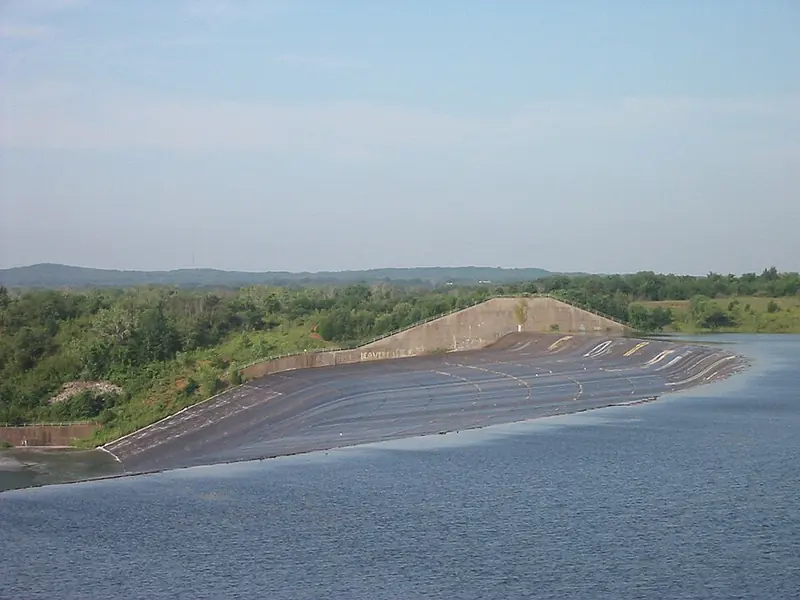
The lake behind Figure 30-1 is not a local source, but surface water is. Lamar County Water Supply District lists Pat Mayse Lake and Lake Crook as its sources, and any lake system depends on a working plant between the lake and your tap.2
30-2 How long to boil
TCEQ's wording is to "bring the water to a vigorous rolling boil and then boil it for at least two minutes. You can consume the water after it cools down."3 The CDC gives one minute, or three above 6,500 feet.4 Nothing in these counties is that high. Where they differ, this book uses TCEQ's two minutes, and if your own notice gives a longer time, use that.
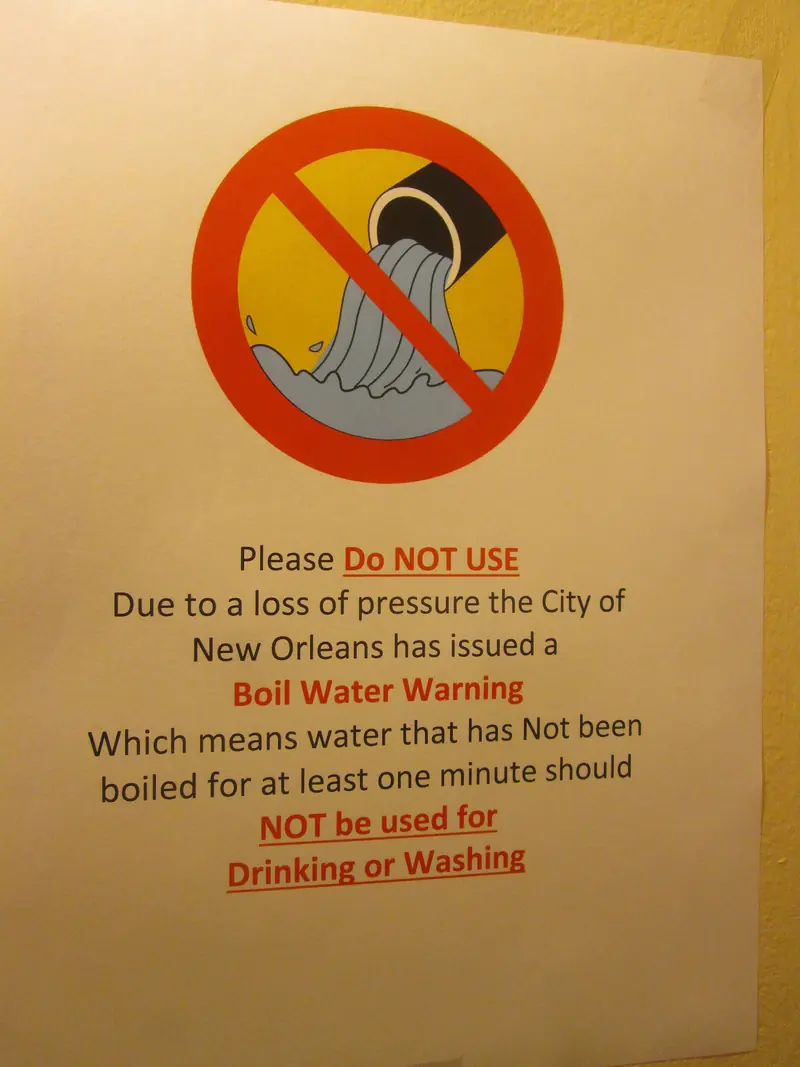
Boiling deals with germs and little else. The CDC says "You cannot make water containing fuel, toxic chemicals, or radioactive materials safe by boiling or disinfecting it."4 If your notice says do not use the water at all, boiling does not get around that.
30-3 Using the water
TCEQ's page goes further than the kettle.1 These are its suggestions, in short form, and a notice from your system overrides them.
| Use | What to do |
|---|---|
| Drinking, coffee, tea, lemonade | Boiled and cooled water |
| Washing produce and food surfaces | Boiled and cooled water, or bottled |
| Cooking | Bring water to a rolling boil for 2 minutes before adding food |
| Baby formula | "Use ready-to-use baby formula, if possible." Otherwise bottled water, then boiled |
| Ice | Throw out ice made with tap water. Make new ice with boiled or bottled water |
| Brushing teeth | Boiled or bottled water |
| Bathing and showering | Do not swallow any. Consider a sponge bath for babies and young children |
| Dishes | A dishwasher with a sanitizing cycle or a 150-degree final rinse is generally safe. By hand, wash and rinse, then soak at least one minute in 1 teaspoon of unscented household bleach per gallon of warm water, and air dry |
| Laundry | As usual |
| Pets | Boiled and cooled water is a good idea |
| Home filters | Boil anyway. Most kitchen filters do not remove bacteria or viruses |
If power is out, boiling may be the hard part. Ready.gov warns against heating a home with a gas stove, and says generators and grills belong outdoors, away from windows.5 Keep a store of bottled water for those days (ordinary practice).
30-4 How it ends
A notice ends when your system says so. Your neighbor's kitchen tap running clear is not the test. TCEQ says "The public water system will issue a 'rescind' notice cancelling the boil water notice."3 Before that, the system must have corrected the problem, flushed the lines until disinfectant levels are above the minimums, returned to normal operation, and "Collected bacteriological samples marked as special and have obtained negative coliform results." The rescind notice then says "the water is now safe to drink without boiling."1
A notice must go out "as soon as possible, but in no case later than 24 hours after the violation or condition occurs."1 That leaves room for hours of drinking from the tap before you hear. Systems may use radio or TV, a newspaper, direct delivery or posting, or electronic alerts, and the rescind goes out the same way.1 So learn now how yours does it.
If you do not know who supplies you, TCEQ points to an old bill or to its online lookup.3 TCEQ's sheet calls that Texas Drinking Water Watch. The old address now says it has been retired in favor of the Drinking Water Viewer, at dwv.tceq.texas.gov, which was blocked when checked.6 Chapter 2 has other ways to find out.
30-5 If you are on a well
A public system's notice is about the public system's water. A private well has no one to issue a notice, or to rescind one. TCEQ says "If you have a private well, you should disinfect it before you use it" after a disaster.3 Flooding has its own rules, and a flooded well is to be treated as contaminated. Do not drink from it until you have followed Chapter 9 and a lab has said it is clear. Any positive result goes to Chapter 8. AgriLife's well instructions say to boil for one minute, in a different document from a different agency.7 Use at least two minutes unless your notice or lab instructions give a longer time.
Who decides this
- Is your water under a notice?
- Your water system, then the notice itself
- When may you drink the tap water again?
- Your water system's rescind notice
- Does a public notice cover a private well?
- No; a private well is the owner's to test, see Chapter 7
- You think the system should have issued a notice
- TCEQ, which receives notice of every boil-water order within 24 hours from the system
On your own place
- Copy the system's name from your last water bill onto the inside of a kitchen cabinet door.
- Ask the office how it delivers notices, and sign up if it has an alert list.
- Set aside a covered, clean container for boiled water.
- Keep ready-to-use formula on the shelf if there is a baby in the house.
- Check whether your dishwasher has a sanitizing cycle.
- Find the fridge's ice maker switch, so you know how to stop it making ice during a notice.
Notes
- Texas Commission on Environmental Quality, Understanding Boil Water Notices. tceq.texas.gov (read November 4, 2026) ↩
- Lamar County Water Supply District, Consumer Confidence Report 2023, machine-read scan. lamarcountywatersupply.myruralwater.com (read November 4, 2026) ↩
- TCEQ, GI-431, June 2024. tceq.texas.gov (read November 4, 2026) ↩
- US Centers for Disease Control and Prevention, water emergency guidance. cdc.gov (read November 4, 2026) ↩
- Ready.gov, Winter Weather. ready.gov (read November 4, 2026) ↩
- TCEQ, decommission notice at the old Drinking Water Watch address. dww2.tceq.texas.gov (read November 4, 2026) ↩
- Texas A&M AgriLife, ESC-059, Disinfecting Water Wells by Shock Chlorination, August 2019. twon.tamu.edu (read November 4, 2026) ↩