Stretch II. Keeping a well
The pump and the pressure tank
How do a well pump and pressure tank work together?
Chapter 10 of 34. Sources checked .
The pump lifts water from the well into a pressurized tank, and the tank holds a reserve so small demands do not start the pump each time. The house draws from that reserve, and the pump runs in longer stretches to refill it.
10-1 Two machines, one job
Chapter 9 warned you off a pump that has been under water. This chapter is about the same equipment on an ordinary day. Texas A&M AgriLife's well guide puts the idea in a sentence. Most home systems have a pressurized tank that stores water for periods of heavy use, and the reserve means small demands do not continually activate the pump.1
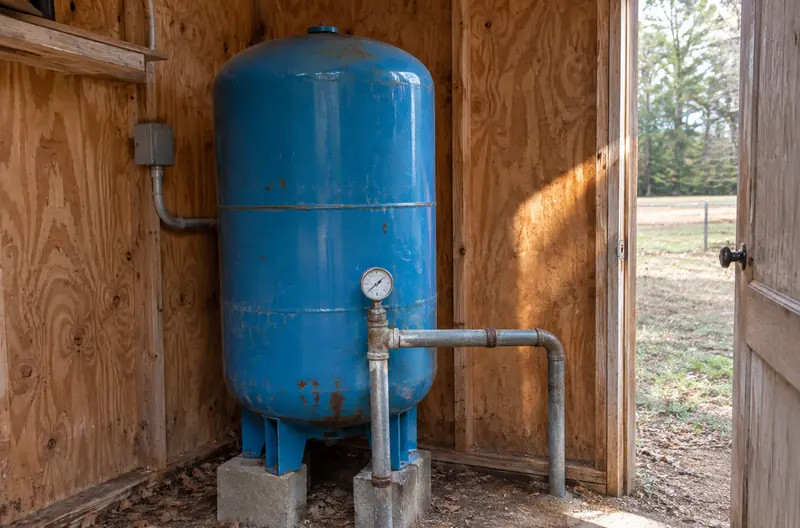
That is the partnership. The pump, often a submersible down in the casing, does the lifting. The tank, shown as an older galvanized type in Figure 10-1 and a newer blue one in Figure 10-2, holds water under pressure so a glass of water does not start a motor far down the casing.
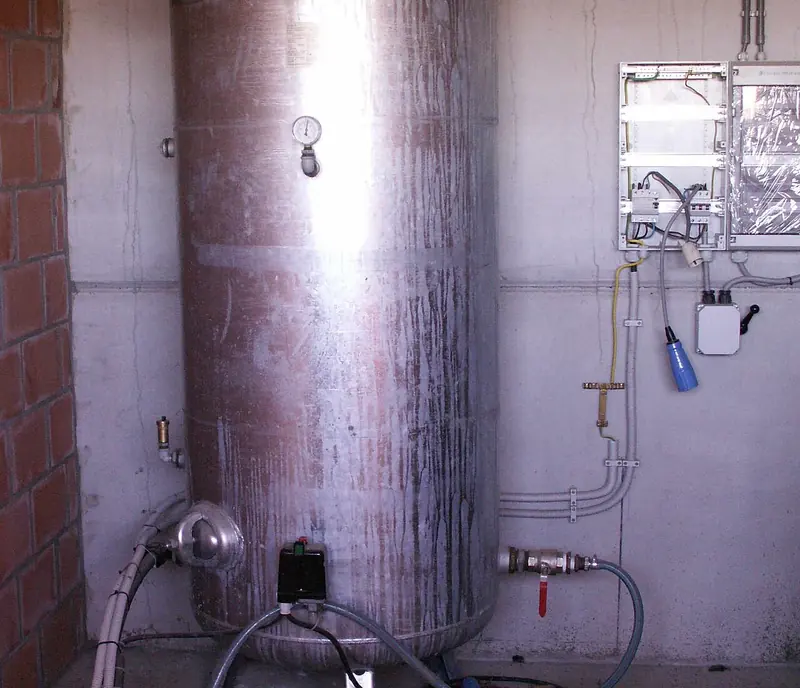
Between them sits a pressure switch, which starts the pump when pressure falls to one setting and stops it at another. No Texas agency source was found for the right settings, for the air charge in a tank, or for how to tell a tank has failed. Those numbers belong to the maker's manual for your equipment and to the person who services it. The description here is ordinary practice, not a rule.
10-2 Why a slow well matters
The tank does its best work on a well with enough water behind it. AgriLife says a pump in a low-yield well is more likely to cycle on and off, which introduces oxygen into the aquifer.1 Your driller's log, from Chapter 6, is the first place to look for what the well was doing when it was finished.
Aquifer matters as well. The Texas Water Development Board describes freshwater saturated thickness averaging 25 feet in the Blossom and about 50 feet in the Nacatoch, against 160 feet in the Woodbine.234 Those are averages over wide areas and say nothing certain about your tract. They do explain why two neighbors on different formations may have very different experiences with the same size of pump.
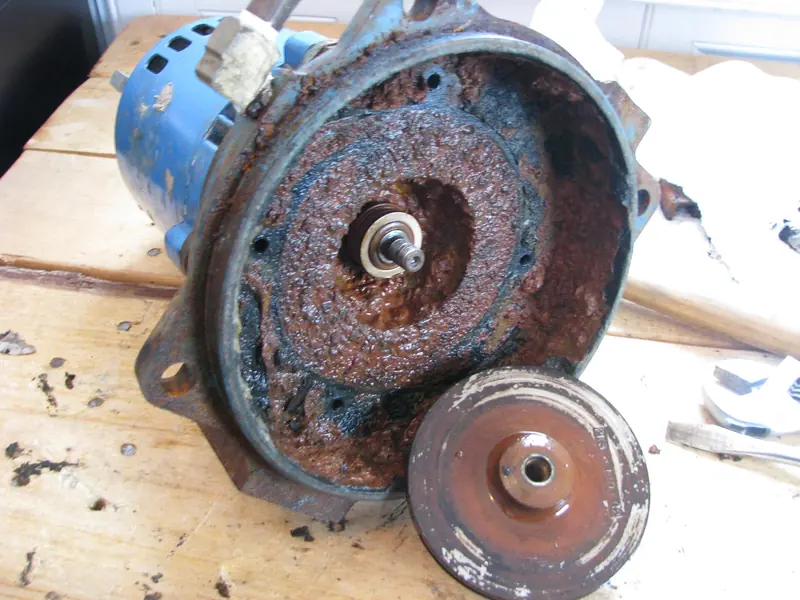
Water chemistry works on the machinery too. Figure 10-3 shows a pump caked in mineral scale. That picture is not from here, and it makes no claim about local wells. It is a reason to look at the test results from Chapter 7 before blaming the motor when a pump is pulled.
10-3 What you may look at, and what you leave alone
AgriLife's guide gives the owner a monthly job. Inspect the wellhead every month for breakage, soil disturbed by burrowing animals, or flooding.1 Another AgriLife sheet says a drop in water pressure once the water is turned on may indicate a damaged well.5 So low pressure is worth noticing and worth a call. It does not by itself tell you which part is at fault.
If the water stops, a breaker or switch check is as far as this book goes. Pump wiring goes to a licensed person. No electrical work beyond that, and if the pump house is wet near the panel, keep clear and call your electric provider or a licensed electrician. Never enter a well pit.
Winter brings one specific warning. AgriLife says not to winterize by wrapping pipes and pressure tanks in empty fertilizer or pesticide bags.1 Chapter 28 has the better way.
| Job | Who | Where it comes from |
|---|---|---|
| Monthly wellhead look, keeping up the pad | The owner | AgriLife well guide |
| Repairing broken casing | A licensed contractor | AgriLife well guide |
| Installing a pump for someone else | A licensed installer | Texas Department of Licensing and Regulation |
| Installing or repairing a pump on your own land for your own use | Left out of the definition of "installer" | Occupations Code 1902.001(5) |
| Pump wiring | A licensed person, whatever the above says about the pump | This book's rule for readers |
10-4 What the license law says
The Texas Department of Licensing and Regulation says that a license is required "to install a pump for a water-related well."6 The carve-out sits in the definition. "Installer" excludes a person who "installs or repairs well pumps and equipment on the person's own property for the person's own use."7 Both conditions apply, own property and own use. It says nothing about wiring. Section 1902.052(b)(1) bars state rules on that work by the owner, by "an employee of a person described by Paragraph (A)," and by "a person who is not hired or compensated and who acts on behalf of a person described by Paragraph (A)." Subsection (b)(2) bars a rule that makes an owner "complete, repair, or retrofit the well to any standard other than a standard in effect at the time the well was originally completed unless the well is found to be a threat to public health and safety or to water quality." Ask TDLR about your own case.7
Plumbing licensing has its own line for this trade. A person holding a "license as a water well pump installer issued under Chapter 1902" is not required to hold a plumbing license under Chapter 1301.8 Chapter 31 covers the plumbing side in full.
If a tank needs replacing, your installer may supply one, and the maker's sizing table is what to ask about. To see what the choices look like before the visit, here are well tanks (Plumbing Supply and More, run by the same team as this book) at one store. Choosing one on your own, without knowing your well's yield and your pump's settings, is the part this book would leave to the person who services it.
Who decides this
- Who may install a pump for pay?
- A licensed pump installer; check with TDLR
- Is a license needed on your own land for your own use?
- The statute leaves that out of "installer"; ask TDLR about your case
- What should the tank and switch be set to?
- The maker's manual and your installer
- Who touches the pump wiring?
- A licensed person
- Why has pressure dropped?
- A licensed installer or driller, after a look at the breaker
On your own place
- Read your tank's label and gauge. Note both, with the date, on the page with your well log.
- Find the manual, or the make and model, for the tank and the pump.
- Listen at a time when nothing is running. A pump that starts with every tap in the house is worth mentioning to your installer.
- Walk to the wellhead and do the monthly check: cap, casing, pad, burrows, standing water.
- Find the breaker for the pump and label it. Do not open the switch box or any wiring.
- Clear stored bags, chemicals and junk from the pump house.
Notes
- Texas A&M AgriLife, Well Owner's Guide to Water Supply, 2024 copy. twon.tamu.edu (read November 4, 2026) ↩
- Texas Water Development Board, Blossom Aquifer. twdb.texas.gov (read November 4, 2026) ↩
- Texas Water Development Board, Nacatoch Aquifer. twdb.texas.gov (read November 4, 2026) ↩
- Texas Water Development Board, Woodbine Aquifer. twdb.texas.gov (read November 4, 2026) ↩
- Texas A&M AgriLife, Disinfecting Water Wells by Shock Chlorination, ESC-059 (8-19). twon.tamu.edu (read November 4, 2026) ↩
- Texas Department of Licensing and Regulation, Water Well Drillers and Pump Installers. tdlr.texas.gov (read November 4, 2026) ↩
- Texas Occupations Code 1902.001(5) and 1902.052. tcss.legis.texas.gov (read November 4, 2026) ↩
- Texas Occupations Code 1301.054. tcss.legis.texas.gov (read November 4, 2026) ↩