Stretch II. Keeping a well
When a well test comes back positive
What do you do when a well test comes back positive?
Chapter 8 of 34. Sources checked .
Stop drinking the water and retest to confirm. Then, following Texas A&M AgriLife's order, find the source and fix it, disinfect the well, and test again. Disinfecting before the cause is fixed skips the step most likely to keep the bacteria from coming back.
8-1 What the result is saying
Chapter 7 was about getting a clean sample. If yours came back positive, read the lab's report for which test it was, because the words matter.
Coliform bacteria are very common, and a positive for coliform alone does not necessarily mean the water has met human or animal waste. AgriLife is firmer on the other two. Fecal coliform or E. coli "definitely indicates contamination" by contact with waste.1 Either way, the next steps start the same.
8-2 Five steps, in the order AgriLife gives them
Texas A&M AgriLife's publication SCSC-PU-146, from May 2023, lists them in this order.1 The order is the useful part.
| Step | What it means on your place |
|---|---|
| 1. Retest to confirm contamination | Same care as the first sample. Bottle from the lab, cold tap. |
| 2. Don't drink the water | Starts now, not after the retest comes back. |
| 3. Find the source and fix the problem | Disinfecting a well with an open path to it treats the symptom. |
| 4. Disinfect the well | Shock chlorination, below. AgriLife advises having a licensed driller or pump installer do it. |
| 5. Retest the water | After the chlorine is flushed. No drinking until the result is in. |
8-3 What to drink in the meantime
AgriLife says to use bottled water for drinking and cooking. If you have none, boil what you use for drinking, cooking and brushing your teeth.1 Boiling is for germs. EPA says it will not reduce nitrate, so a nitrate problem stays a separate question, as Chapter 7 explains.9
Boil times differ by publication. ESC-059 says one minute, an older AgriLife sheet says five, and TCEQ's notices for public systems say a vigorous boil for two minutes.234 This book uses TCEQ's two minutes. Use at least two minutes unless your notice or lab instructions give a longer time.
ESC-059 also says contaminated water should not go to making ice, bathing, or washing clothes and dishes.2 That reaches further than people first expect, and it is one more reason to move through the steps instead of waiting on them.
8-4 Looking for the way in
AgriLife's list of places to check is short: a faulty wellhead or poor construction, a shallow well or one near surface water, an old or abandoned well, a septic system, or another concentrated source.1 Figure 8-1 shows the first place to look, because you can see it without tools.
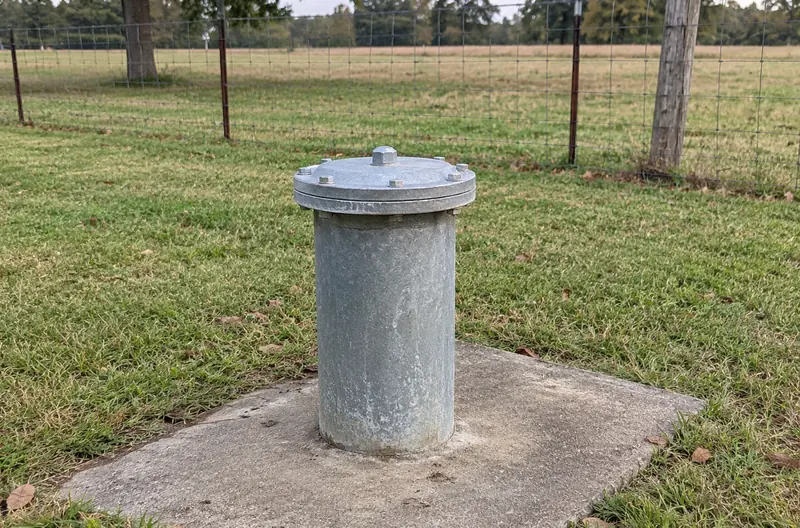
AgriLife's well guide says to look at the wellhead monthly for breakage, soil disturbed by burrowing animals, or flooding. It says the owner can repair and maintain the pad, and a licensed contractor should repair broken casing.5 An old well nearby deserves a walk of its own, and Chapter 11 covers what the law then expects of you.
A septic system is the one you look at from the outside only. Never open a tank, and never lean into or enter a tank or pit, because the gases can kill quickly. Lids stay secure. If you suspect the system, the work goes to licensed people, and Chapter 26 covers the signs that can be read from the yard. TDLR's distances between wells and septic parts are 50 feet from a tank and 100 feet from drain fields or spray areas, so a measurement from the surface tells you how close yours sits.6
8-5 ESC-059's chlorine figures
These figures come from ESC-059, published by Texas A&M AgriLife in August 2019.2 AgriLife's publications differ from one another. ER-011, from 2006, gives different times, and a version on the Texas Help site differs again.37 AgriLife also lists a January 2022 publication of the same title, seen here only as an overview.8 Get the current AgriLife publication or your lab's instructions and follow them as written. Treat this table as a way to see the scale of the job, not as the whole method.
ESC-059 is written for wells with a properly functioning submersible pump only. It says its method will not work with a jet pump or a damaged system. The bleach it calls for is unscented household liquid bleach less than 6 months old. Water depth is total well depth minus the static water level, and if you do not know that level, it says to use the total depth.
| Water depth | 4-inch well | 6-inch well | 8-inch well |
|---|---|---|---|
| 10 feet | 6 cups | 7 cups | 8 cups |
| 50 feet | 8 cups | 10 cups | 14 cups |
| 100 feet | 10 cups | 16 cups | 22 cups |
| 200 feet | 14 cups | 1.5 gallons | 2.5 gallons |
| 400 feet | 22 cups | 2.5 gallons | 4.5 gallons |
The table states no bleach strength, and household bleach is sold at different strengths, so ask the lab or AgriLife before relying on the cups shown.
ESC-059 warns that too much chlorine is harmful and says to follow its table carefully. It carries the bleach in a bucket of bottled water. Softeners and filters go to bypass, and power goes off at the breaker before the well is opened. If your well does not look like the ones it pictures, it says to call a contractor. A breaker reached from dry ground is as far as this book goes with electricity. Any pump wiring goes to a licensed person.
The chlorinated water then circulates through a hose into the casing for 30 minutes. It is drawn to every tap, hot and cold, until you smell bleach, and left in the plumbing for at least 8 hours or overnight. Flushing goes through a hose, kept away from the septic system, landscaping and bodies of water. ESC-059's last word is the one that counts: no drinking until the water has been tested.
SCSC-PU-146 advises hiring a licensed driller or pump installer for this, to cut your exposure to hazardous chemicals and protect the well's parts.1 Chapter 6 covered how to check that license through TDLR's search.
8-6 After a clean result
AgriLife says to retest in 6 months to a year after a negative result, and at least yearly from then on.1 If the positive returns, the source was not found. Go back to step 3, not step 4.
Who decides this
- Who confirms the result?
- The lab, on a second sample
- Who should shock the well?
- AgriLife advises a licensed driller or pump installer; check the license with TDLR
- Who repairs broken casing?
- A licensed contractor, per AgriLife; the owner may keep up the pad
- Who looks at a suspected septic system?
- A licensed professional, through your local authorized agent; see Chapter 22
- Whose instructions govern the chlorination?
- The current AgriLife publication or your lab, as written
On your own place
- Buy bottled water today if a test has just come back positive, and tell everyone in the house.
- Read the lab report and note which test was positive.
- Walk to the wellhead. Check the cap, casing and pad for cracks, gaps, burrows and standing water.
- Walk the place for old wells, and note how close any is to the one you drink from.
- Measure from the wellhead to the septic field, from the surface, without opening anything.
- Find out what pump you have and the total well depth from your log, before you call anyone.
- Set a date for the retest, and another 6 to 12 months after a clean one.
Notes
- Texas A&M AgriLife, What to Do About Coliform Bacteria in Well Water, SCSC-PU-146 (May 2023). twon.tamu.edu (read November 4, 2026) ↩
- Texas A&M AgriLife, Disinfecting Water Wells by Shock Chlorination, ESC-059 (8-19). twon.tamu.edu (read November 4, 2026) ↩
- Texas A&M AgriLife, Decontaminating Flooded Wells, ER-011 (6-06). twon.tamu.edu (read November 4, 2026) ↩
- TCEQ, Understanding Boil Water Notices. tceq.texas.gov (read November 4, 2026) ↩
- Texas A&M AgriLife, Well Owner's Guide to Water Supply, 2024 copy. twon.tamu.edu (read November 4, 2026) ↩
- Texas Department of Licensing and Regulation, Drilling and installing guidance. tdlr.texas.gov (read November 4, 2026) ↩
- Texas A&M, Texas Help, Disinfecting Water Wells by Shock Chlorination. texashelp.tamu.edu (read November 4, 2026) ↩
- Texas A&M AgriLife Extension, Disinfecting Water Wells by Shock Chlorination, overview page only. agrilifeextension.tamu.edu (read November 4, 2026) ↩
- US EPA, Will Boiling My Water Help?, from EPA's nitrate questions for southeast Minnesota groundwater. epa.gov (read November 4, 2026) ↩