Stretch II. Keeping a well
Floodwater over the wellhead
What do you do when floodwater covers a wellhead?
Chapter 9 of 34. Sources checked .
Assume the well is contaminated and do not use the water for drinking, cooking, ice, teeth or bathing. If the pump or wiring went under, do not turn the pump on. A qualified electrician checks it once things are dry, and the well is then flushed, disinfected and tested.
9-1 Assume the worst until a test says otherwise
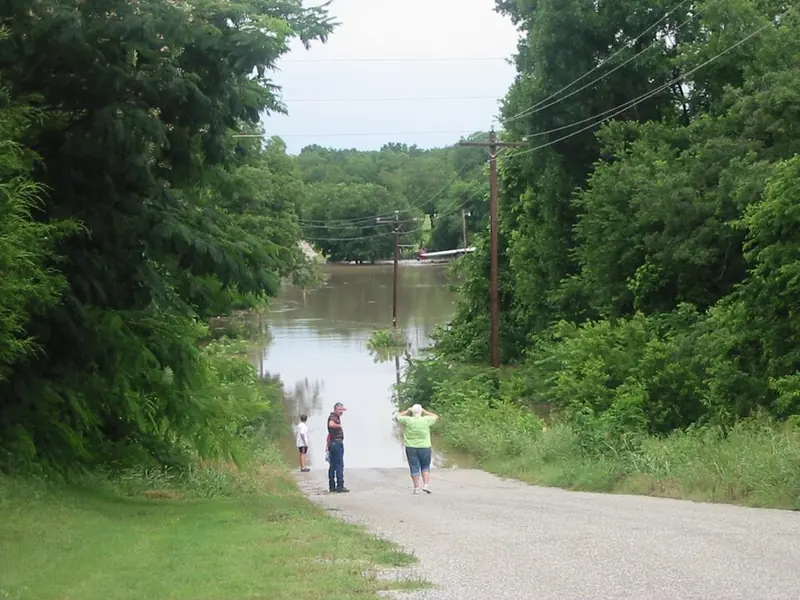
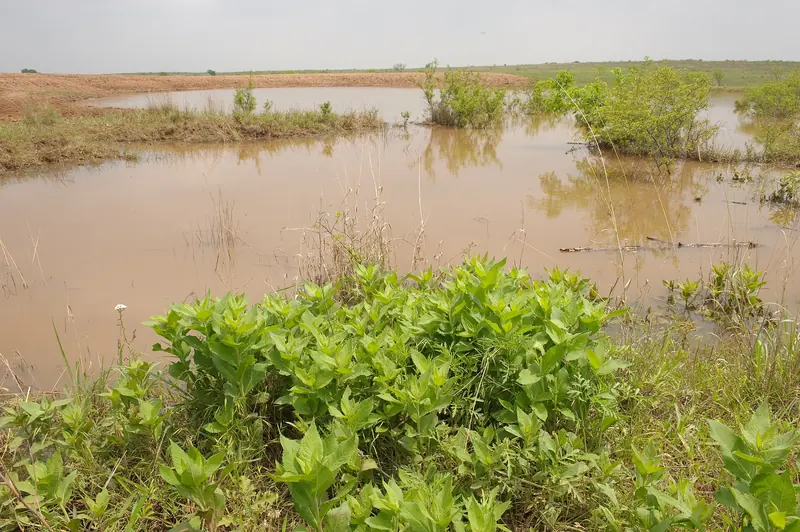
Chapter 8 started from a lab result. A flood skips that step, because you can see for yourself that surface water stood over the casing. Figure 9-1 shows the kind of water that does it, and Figure 9-2 shows what surface water looks like even without a flood. Texas A&M AgriLife's flooded well sheet, ER-011 from 2006, says you should assume a flooded well is contaminated and stay off it for drinking, cooking, making ice, brushing teeth and even bathing until you are satisfied it is not.1
This book looked for flooded well wording from TCEQ and from the Department of State Health Services and did not find a page that lays it out. AgriLife stands in for that here. TCEQ's general disaster sheet, GI-431 from June 2024, does say that a private well should be disinfected before you use it after a disaster, and it sends you to its companion sheet GI-432.2
9-2 Power first
ER-011 is direct. If the pump or electrical system has been under water, do not turn on the pump, because of the risk of shock or damage. Have a qualified electrician check it once it is dry.1
That means a flooded pump house is not the place to start with a switch or a breaker. Water near a panel is a reason to keep clear and call your electric provider or a licensed electrician. Pump wiring goes to a licensed person, and Chapter 10 says more about who does what in there.
Wells in pits get the same answer as everything else below ground. AgriLife says a pit may flood with no water showing at the surface, so assume it has. Have someone licensed look at it. Do not climb in to check.1
9-3 The order of work after the water drops
ER-011 and ESC-059 are different publications from different years, and they do not agree on every time. ESC-059, from August 2019, is the one this book uses for chlorination figures, in Chapter 8.3 ER-011 is the one that speaks to floods directly. AgriLife's publications differ, so follow the current AgriLife or lab instructions as written. This table shows who says what.
| Step | What the publication says | Source |
|---|---|---|
| Keep off the water | No drinking, cooking, ice, tooth brushing or bathing | ER-011 |
| Pump and wiring | If they went under, pump stays off until a qualified electrician has checked it dry | ER-011 |
| Pump out | At least three well volumes from a faucet near the wellhead, and at least 1 hour, for shallow, flooded or unconfined wells | ER-011 |
| Flush the house | Household plumbing, including the water heater | ER-011 |
| Disinfect | Shock chlorination, required before drinking use, in AgriLife's words | AgriLife overview, ESC-059 |
| Test | No drinking until tested | ESC-059 |
AgriLife's overview page is flat about the disinfecting step. A flooded well must be shock chlorinated before it is used as a source of drinking water.4 ESC-059's method applies only to a properly functioning submersible pump, so a pump that went under needs the electrician's answer first. Given the chemicals and the electrical questions, a licensed driller or pump installer is a sensible call here, and AgriLife advises one for shock work generally.5
9-4 What chlorine leaves behind
Floodwater does not carry only bacteria. ER-011 says disinfection does not remove fuels, oils, pesticides, heavy metals or other non-biological contamination.1 CDC says the same about boiling: it will not make water with fuel or toxic chemicals safe.6 So the boil-the-water habit in Chapter 30 has limits after a flood.
If you saw a sheen, smelled fuel, or know of chemicals stored upstream, say so when you order the test. A bacteria test only answers a bacteria question. Ask the lab what else to run, and keep to another water source until you have answers.
9-5 The septic tank next door
A flood that reaches a wellhead may reach a septic system. An EPA release from 2005 recommends against pumping a tank while the ground around it is saturated, because the tank may try to float out of the ground.7 AgriLife also publishes L-5475 on what to do after outages and floods, and it is worth reading before you need it.8 Lids stay secure, and tank work goes to licensed people. Chapter 26 has the signs to look for from the yard.
9-6 Building for the next one
For a well on a site prone to flooding, the state's rule asks for more. It "shall be completed with a watertight sanitary well seal... and a steel sleeve extending a minimum of thirty-six (36) inches above ground level and twenty-four (24) inches below the ground surface."9 AgriLife prints the same text.10 If your well flooded and has none of that, raise it with a licensed driller or pump installer, whom Chapter 6 showed you how to check.
Whether your own tract counts as flood-prone is something to ask a driller about when the well is sited, and to think about again the first time water stands near the casing. Note how high the water came, with a date, while the mark is still there (ordinary practice). It gives the next driller something to work from.
Who decides this
- Is the water safe to drink after a flood?
- Assume not until a test says so; the lab reports the result
- Is it safe to run the pump?
- A qualified electrician, once things are dry, if pump or wiring went under
- Who shocks the well?
- AgriLife's method as written, or a licensed driller or pump installer
- Is there other contamination?
- A lab, told what you saw and smelled; chlorine does not address fuel or pesticides
- What about the septic system?
- A licensed professional and your local authorized agent
On your own place
- Judge how far the top of your casing stands above the highest water you remember.
- Check whether a pit surrounds the wellhead. If one does, look from outside it and stay out.
- Find where the pump's power comes from, so you can tell an electrician, and do not touch it if it has been wet.
- Store a few days of bottled water where a flood would not reach it.
- Look uphill and upstream for stored fuel, pesticides and livestock yards, and write them down for a future test order.
- Keep ER-011 and the current AgriLife chlorination publication printed, in a dry place.
Notes
- Texas A&M AgriLife, Decontaminating Flooded Wells, ER-011 (6-06). twon.tamu.edu (read November 4, 2026) ↩
- TCEQ, GI-431 (June 2024). tceq.texas.gov (read November 4, 2026) ↩
- Texas A&M AgriLife, Disinfecting Water Wells by Shock Chlorination, ESC-059 (8-19). twon.tamu.edu (read November 4, 2026) ↩
- Texas A&M AgriLife Extension, Disinfecting Water Wells by Shock Chlorination, overview page. agrilifeextension.tamu.edu (read November 4, 2026) ↩
- Texas A&M AgriLife, What to Do About Coliform Bacteria in Well Water, SCSC-PU-146 (May 2023). twon.tamu.edu (read November 4, 2026) ↩
- CDC, About Water Emergencies. cdc.gov (read November 4, 2026) ↩
- EPA, archived 2005 news release on septic systems after flooding. epa.gov (read November 4, 2026) ↩
- Texas A&M AgriLife, Responding to Power Outages and Floods, L-5475. ossf.tamu.edu (read November 4, 2026) ↩
- Cornell LII copy of 16 TAC 76.100(a)(3). law.cornell.edu (read November 4, 2026) ↩
- Texas A&M AgriLife, Water Wells in Flood Plains, ERM-014, which cites the rule as (a)(5). twon.tamu.edu (read November 4, 2026) ↩