Stretch II. Keeping a well
Testing a well
How often should you test a well, and for what?
Chapter 7 of 34. Sources checked .
Test at least once a year for nitrate, total dissolved solids, and E. coli or fecal coliform, and test again whenever something changes. No Texas rule was found that makes a private owner do it, so the schedule is yours to keep.
7-1 Nobody is checking but you
Chapter 6 ended with a well drilled and a log on file. From here on, the water is your job. A customer of a water supply corporation gets the yearly report described in Chapter 4. A well owner gets nothing unless the owner asks for it.
Texas A&M's guidance says that private water wells "are not required to meet the national drinking standards."1 Owners can still use those standards as a yardstick. No Texas state rule was found requiring a private owner to test.
The same guidance sets the habit. Test at least once a year.2 At a minimum that yearly test covers nitrate, total dissolved solids, and E. coli or fecal coliform.3
| Test | Why it is there | What to keep in mind |
|---|---|---|
| Nitrate | The limit for public systems is 10 mg/L as nitrogen. "Infants under 6 months old who drink water containing nitrate in excess of the MCL could become seriously ill and, if untreated, may die." | It has no color, smell or taste, so only a test finds it. |
| Total dissolved solids | A general measure of what the water carries. | The Nacatoch runs 1,000 to 3,000 mg/L south of the Mexia-Talco Fault Zone. |
| E. coli or fecal coliform | Points to contact with human or animal waste. | A positive sends you to Chapter 8. |
Nitrate figures come from the state's Well Owner Network publications.45 The fault zone figure comes from the Texas Water Development Board.6
If a test puts nitrate over that limit, do not give that water to an infant, and ask your doctor and the lab what to use instead. Boiling does not fix nitrate. EPA says "Boiling water will NOT reduce nitrate levels," and that it makes the level worse, because some of the water evaporates and the nitrate does not.15
7-2 When once a year is not enough
Four things call for an extra test: a reason to suspect contamination, a change in color, taste or odor, pump or well maintenance, and an illness you cannot explain.3
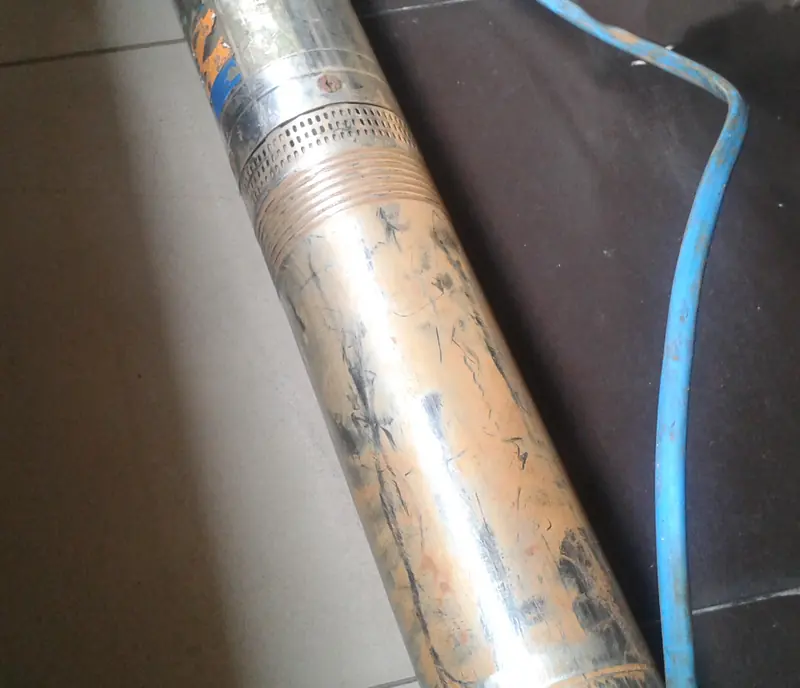
The maintenance one is easy to skip. A pump pulled from the casing, as in Figure 7-1, has been handled, set down somewhere, and lowered back into your drinking water. Test after the work, not at the next yearly date.
7-3 Adding to the list for your aquifer
The yearly three are the floor. What else belongs on the order depends on what you drink from, which Chapter 5 tried to narrow down and your well log may settle.
| Aquifer | Board's description | Worth asking the lab about |
|---|---|---|
| Blossom | Generally soft; in some areas high in sodium, bicarbonate, iron and fluoride | Sodium, iron, fluoride |
| Nacatoch | Alkaline, high in sodium bicarbonate, soft | Sodium, TDS |
| Woodbine | Upper zone tends to run very high in iron | Iron |
| Trinity | Fresh but very hard in the outcrop; dissolved solids rise with depth | Hardness, TDS |
The descriptions come from the Board's aquifer pages.6789 The right-hand column is this book's suggestion, not an agency's. Note what the table does not say. Hard water is not a given here. Two of those four are described as soft, so hardness depends on the source, and a test comes before any purchase.
If your test shows iron, treatment becomes a real question, and an iron filter made for well water (SoftPro, run by the same team as this book) is one kind of equipment sold for it. Without a test result, it is a guess. Chapter 20 deals with hardness and softeners on the same terms.
7-4 Taking a sample that means something
A careless sample tells you about the faucet. AgriLife's sampling sheet, E-126 from 2001, lays out the method, and the steps below follow it.10 Your lab's own instructions come first wherever they differ.
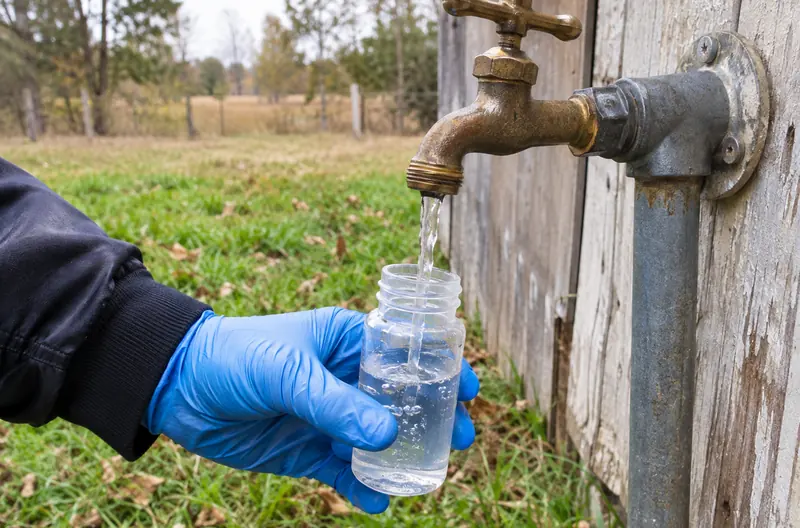
Get a sterile container from the lab. Use a cold faucet with the aerator taken off. Skip any tap that is hot, mixed, leaky, softened or filtered, and do not sample from a hose. Sanitize the tip of the faucet. Run it at full flow for 5 minutes, then cut it back to a stream about the width of a pencil. Fill the lab's bottle without letting it overflow. Figure 7-2 shows where on the spigot this happens, not the container.
Keep the sample cold and get it moving. The sheet says six hours to the lab is best and 30 hours is the outer limit. It also warns that many labs refuse bacteria samples on a Friday, so ask before you fill anything at the end of a week.
7-5 Where the sample goes
TCEQ runs the state's environmental laboratory accreditation program, and AgriLife sends well owners to TCEQ's list of labs.1112 This book has not confirmed which labs near Paris take well samples, so it names none. Call one on the list and ask three things: does it accept private well samples, what bottle does it want, and which days can you bring it in.
An older AgriLife sheet from 2006 says some county health departments and local hospitals may test for bacteria.13 That is worth one phone call to your county. Do not count on it until someone there says yes.
The Texas Well Owner Network holds screenings, "Well Educated" over a half day and "Well Informed" in about an hour, where people bring samples with a form.14 An undated listing, not confirmed, shows one in Mount Pleasant. None was found scheduled in Lamar County for 2025 or 2026, so check their calendar.
Keep each result with your well log (ordinary practice). A slow rise in nitrate only shows if the old numbers are still in the drawer.
Who decides this
- Does the state require testing of a private well?
- No such rule was found; AgriLife recommends yearly testing
- Which lab takes a well sample?
- TCEQ's list of accredited labs; the lab confirms it takes private samples
- Will the county test it?
- Ask your county health department; it varies and is not promised
- What does a positive mean?
- The lab reports it; Chapter 8 gives AgriLife's steps
- Is this nitrate level safe for a baby?
- Your doctor, with the lab result in hand
On your own place
- Dig out your last test result. If it is over a year old, or you have none, order a test.
- Find your well log and write the aquifer name on the same page as your results, if the log gives it.
- Look at the tap you would sample from. Make sure it runs cold, sits ahead of any softener or filter, and lets you take the aerator off.
- Call one lab on TCEQ's list. Ask about bottles, private samples and which days it receives them.
- Write the date of any pump or well work on your calendar, with a test the week after.
- Check the Texas Well Owner Network calendar for a screening within driving distance.
Notes
- Texas Well Owner Network, Texas A&M AgriLife, Drinking Water Problems: Nitrates. twon.tamu.edu (read November 4, 2026) ↩
- Texas A&M AgriLife, What to Do About Coliform Bacteria in Well Water, SCSC-PU-146 (May 2023). twon.tamu.edu (read November 4, 2026) ↩
- Texas A&M AgriLife, Water Well Basics, ESC-013. twon.tamu.edu (read November 4, 2026) ↩
- Texas A&M AgriLife, Drinking Water Standards. twon.tamu.edu (read November 4, 2026) ↩
- Texas A&M AgriLife, Well Owner's Guide to Water Supply, 2024 copy. twon.tamu.edu (read November 4, 2026) ↩
- Texas Water Development Board, Nacatoch Aquifer. twdb.texas.gov (read November 4, 2026) ↩
- Texas Water Development Board, Blossom Aquifer. twdb.texas.gov (read November 4, 2026) ↩
- Texas Water Development Board, Woodbine Aquifer. twdb.texas.gov (read November 4, 2026) ↩
- Texas Water Development Board, Trinity Aquifer. twdb.texas.gov (read November 4, 2026) ↩
- Texas A&M AgriLife, Sampling for Bacteria in Water Wells, E-126 (11/01). twon.tamu.edu (read November 4, 2026) ↩
- TCEQ, Environmental Laboratory Accreditation. tceq.texas.gov (read November 4, 2026) ↩
- Texas A&M AgriLife, Disinfecting Water Wells by Shock Chlorination, ESC-059 (8-19), which gives the address of TCEQ's list, tceq.texas.gov. twon.tamu.edu (read November 4, 2026) ↩
- Texas A&M AgriLife, Decontaminating Flooded Wells, ER-011 (6-06). twon.tamu.edu (read November 4, 2026) ↩
- Texas Well Owner Network, home page. The Mount Pleasant listing comes from a search result only. twon.tamu.edu (read November 4, 2026) ↩
- US EPA, Will Boiling My Water Help?, from EPA's nitrate questions for southeast Minnesota groundwater. The chemistry is not local to Minnesota. epa.gov (read November 4, 2026) ↩