Stretch II. Keeping a well
Old wells and abandoned wells
What must you do about an old well on your land?
Chapter 11 of 34. Sources checked .
If a well on your land counts as abandoned or deteriorated under Texas law, you have 180 days from learning of its condition to have it plugged or capped. You may hire a licensed driller or pump installer, or plug it yourself under the state's rule, and then report it.
11-1 Old places carry old holes
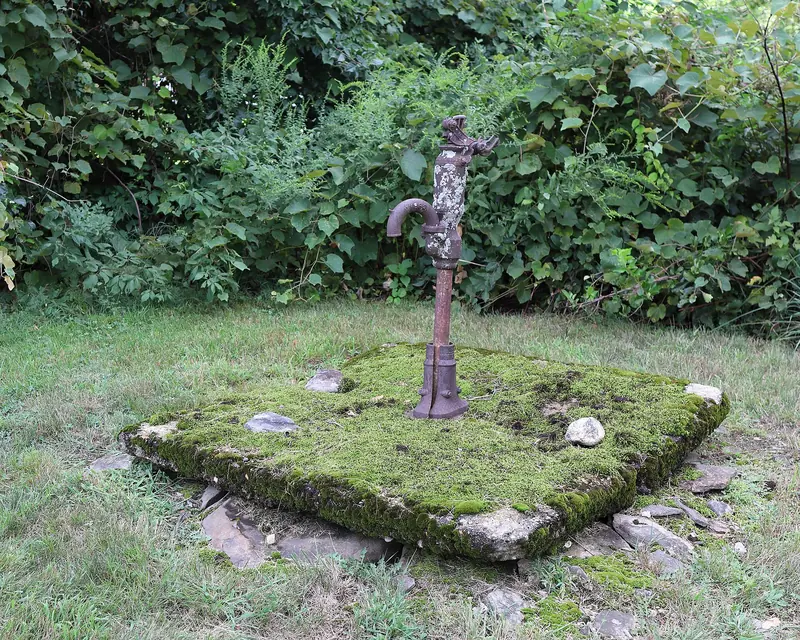
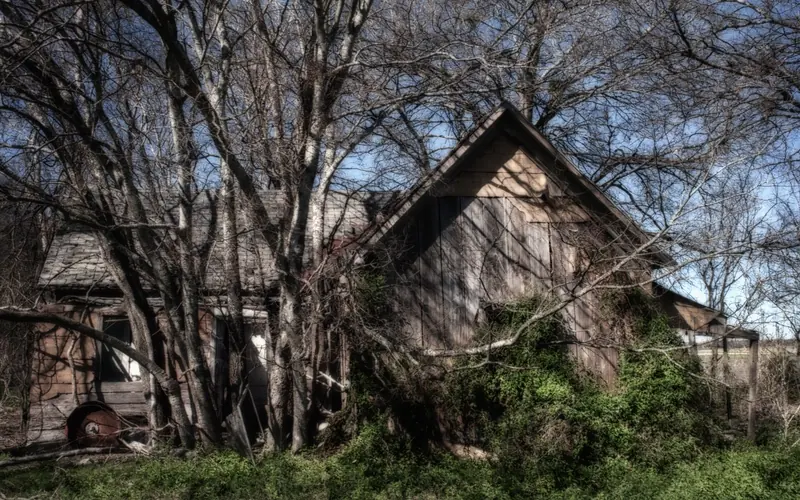
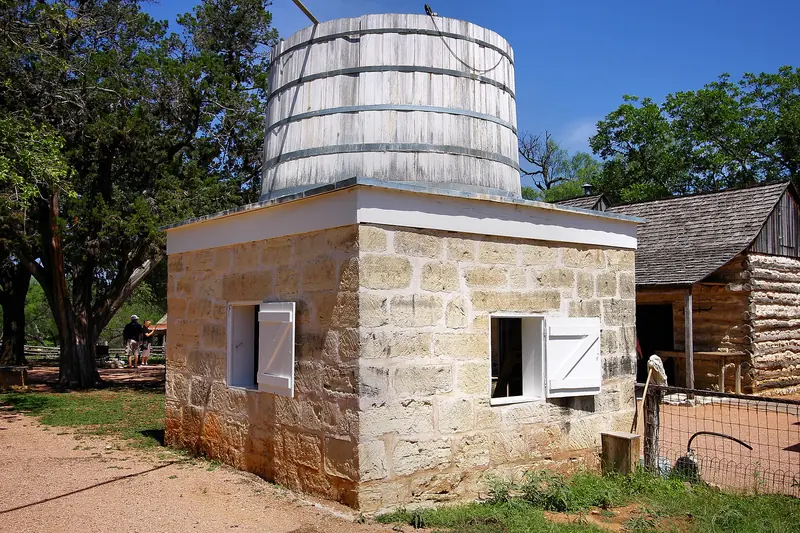
Chapter 10 was about the well you use. This one is about the one you did not know you owned, and it matters on old farmsteads, where the house may be long gone or falling in, as in Figure 11-2. A pitcher pump like the one in Figure 11-1 is an easy clue. A pipe stub in tall grass or a square of old concrete is harder to read. Old water works, like the tank house in Figure 11-3, tell you someone drew water near there. That last point is ordinary observation, and it is worth a slow walk.
Do not lean over an open shaft to look. Keep children and stock back, and never climb into a well or a pit. Texas's own well regulator pictures a horse that fell into an uncovered hand-dug well.1
11-2 When an old well counts as abandoned
Texas law defines the term. An "abandoned well" is "a well that is not in use", and then it lists the ways out. A well is not abandoned if it is not deteriorated and has casing, pump and column in good condition, or is not deteriorated and capped. Nor is it abandoned if it is put to authorized beneficial use, used in the normal course, or the owner is in the Conservation Reserve Program or a similar one. A "deteriorated well" is one that "will cause or is likely to cause pollution of any water in this state."2
TDLR publishes a checklist that asks three questions: is the well in use, does it meet minimum standards, and is it in good condition. A "No" to any of them means abandoned or deteriorated in its reading.3 It is worth printing and walking out with.
11-3 The clock, and who is on it
The statute reads: "Not later than the 180th day after the date a landowner or other person who possesses an abandoned or deteriorated well learns of its condition, the landowner or other person shall have the well plugged or capped under standards and procedures adopted by the commission."2
The clock runs from when you learn of the condition, so finding a shaft on the back of the place may start it. When exactly someone has learned is a legal question. A buyer is in the same spot, which is why Chapter 1 has you walking the land before closing. TCEQ's landowner guide adds that the landowner is held responsible for injury or pollution related to the well.4
An old well is also one of the likely paths for bacteria to reach the well you drink from, in AgriLife's list that Chapter 8 went through.5
11-4 Plugging: what the rule asks
You have two routes, in TDLR's words: a landowner may hire a licensed driller or pump installer, or plug a well on their own property under 16 TAC 76.104 and submit a State of Texas Plugging Report.1 The table below gives the outline. Read the rule itself before anyone starts.
| Part of the job | What the text says |
|---|---|
| Casing and surface | Remove all removable casing and the surface completion |
| Cement method | Pressure fill by tremie pipe with cement from the bottom to land surface |
| Grout method | Bentonite grout of at least 9.1 pounds per gallon, with a cement plug of at least 2 feet |
| Shallow water method | For 100 feet or less of standing water, 3/8 inch or larger granular sodium bentonite, hydrated at frequent intervals, with the top 2 feet in cement |
| Where grout is ruled out | Chlorides above 1,500 ppm, or hydrocarbons present |
| Top of plug | TDLR allows stopping up to 4 feet below ground, called plow depth |
| Disinfecting first | TCEQ's guide: 1 gallon of bleach per 500 gallons of water, unscented, 8 to 10 hours before plugging |
The specifications are in the rule; the note gives the copy used.6 TDLR's page adds the plow depth point.1 The disinfecting figure is from TCEQ's guide RG-347.4 Do not swap it with the chlorination table in Chapter 8, which is for a working well you mean to drink from.
TDLR allows self-plugging, but the methods above call for equipment such as tremie pipe, and the hazard of an open shaft stays yours throughout. If you are unsure, a licensed driller or pump installer is the safer call. Chapter 6 showed how to check a license.
11-5 Capping, reporting and help with the cost
A cover must keep out surface pollutants, carry at least 400 pounds, and not be easy to remove by hand. TDLR's wording about large-diameter wells needs reading on its own page, so read it if yours is a wide hand-dug well.1 A Texas A&M publication calls capping temporary and allows it only for a well in good condition.7 A loose sheet of plywood does not meet that.
Then comes the paperwork. "Not later than the 30th day after the date the well is plugged, a driller, licensed pump installer, or well owner who plugs" the well must report it to the groundwater conservation district, if there is one, and to the executive director.2 TDLR takes the report online with GPS coordinates, and the online route needs a TDLR log-in.18
Whether a district is in the picture depends on the county. Fannin is in Red River Groundwater Conservation District, along with Grayson.9 A Texas Water Development Board report labels Lamar, Red River and Delta "No District".10 A 2019 Board map shows none for Hopkins, Franklin, Titus, Bowie and Morris, and that may have changed. Where no district exists, complaints go through TDLR, which also keeps an abandoned well reporting system.11
As for money, the Texas Groundwater Protection Committee says some areas have plugging assistance, and points to districts, the State Soil and Water Conservation Board and its own map.8 A 2023 index of district programs names none for Red River GCD, Lamar or Fannin.12 This book could not confirm any program in Lamar County, and could not rule one out. Ask before paying.
Who decides this
- Is my old well abandoned in law?
- Occupations Code 1901.255 and TDLR's checklist; ask TDLR if it is close
- Who may plug it?
- A licensed driller or pump installer, or the landowner under 16 TAC 76.104
- Who gets the report?
- The executive director, through TDLR's system, and your groundwater district if there is one
- Is there money to help?
- Ask your district, if any, and the State Soil and Water Conservation Board
- What if a neighbor's well worries me?
- TDLR takes complaints where no district exists
On your own place
- Walk old house sites, barn lots and tree lines for slabs, pipe stubs, pumps and sunken rings. Do it in daylight, with a second person.
- Do not step on old boards, slabs or sunken ground. Flag from several paces back, and have a licensed driller or pump installer fence and cover anything open (ordinary caution).
- Write down the date you found it. That may be the day the 180 days began.
- Print TDLR's determination checklist and answer it for each well.
- Check the state's well report viewers from Chapter 5 for any record of the well.
- Take GPS coordinates from a safe distance, for the report.
- Call a licensed driller or pump installer before the clock runs short, and call 811 before any digging.
Notes
- Texas Department of Licensing and Regulation, Abandoned Wells. tdlr.texas.gov (read November 4, 2026) ↩
- Texas Occupations Code 1901.255. tcss.legis.texas.gov (read November 4, 2026) ↩
- Texas Department of Licensing and Regulation, Abandoned Well Determination Checklist. tdlr.texas.gov (read November 4, 2026) ↩
- TCEQ, Landowner's Guide to Plugging Abandoned Water Wells, RG-347. tceq.texas.gov (read November 4, 2026) ↩
- Texas A&M AgriLife, What to Do About Coliform Bacteria in Well Water, SCSC-PU-146 (May 2023). twon.tamu.edu (read November 4, 2026) ↩
- Cornell LII copy of 16 TAC 76.104. law.cornell.edu (read November 4, 2026) ↩
- Texas A&M AgriLife, Capping of Water Wells for Future Use. twon.tamu.edu (read November 4, 2026) ↩
- Texas Groundwater Protection Committee, Abandoned Well Plugging FAQ. tgpc.texas.gov (read November 4, 2026) ↩
- Red River Groundwater Conservation District, home page. redrivergcd.org (read November 4, 2026) ↩
- Texas Water Development Board, GAM Run 17-029 MAG report (2018). The county map is the Board's GCD map dated November 2019, read by eye, twdb.texas.gov. twdb.texas.gov (read November 4, 2026) ↩
- Texas Department of Licensing and Regulation, abandoned well reporting system. tdlr.texas.gov (read November 4, 2026) ↩
- Texas Groundwater Protection Committee, GCDs with Plugging Programs, 2023 index. tgpc.texas.gov (read November 4, 2026) ↩