Stretch I. Where the water comes from
Who may drill, and what paper follows
Who may drill a well, and what paperwork follows?
Chapter 6 of 34. Sources checked .
A licensed driller, or you on your own property for your own use. Texas requires a license to drill for others, and the owner's carve-out has two conditions. Location and construction rules still reach people having a well drilled. Afterward the driller must send a well log to the state and to you within 60 days.
6-1 The license, and the owner's carve-out
Chapter 5 looked for the water. This chapter is about getting to it lawfully. The rule is short: "A person may not act or offer to act as a driller unless the person holds a license."1 TDLR, the Texas Department of Licensing and Regulation, adds "A license is required to drill a water-related well in Texas and to install a pump for a water-related well."2
The exception sits in the definition itself. A water well driller "does not include a person who: (A) drills, bores, cores, or constructs a water well on the person's own property for the person's own use."1 Both conditions count: your own property, and your own use. It does not reach drilling for a neighbor, and an unlicensed helper is covered only under the direct supervision of a licensed driller.1 The chapter also "does not affect the ownership of or the rights of landowners in groundwater."1
Being outside the license does not mean being outside the rules. TDLR's rule reads: "All well drillers, installers and persons having a well drilled, deepened or altered, and persons in possession of abandoned or deteriorated wells, shall adhere to the provisions of the Code and this chapter prescribing the location of wells and proper drilling, completion, capping, repairing and plugging."3 Whether every construction standard binds an unlicensed owner drilling alone is not settled in anything read for this book. Ask TDLR before you rely on either reading. Nothing here is legal advice on that point.
Pumps run on a parallel track. "Installer" excludes a person who "installs or repairs well pumps and equipment on the person's own property for the person's own use."4 That is a licensing point, not a safety one. Pump wiring goes to a licensed person, whoever owns the land.
6-2 Checking the driller
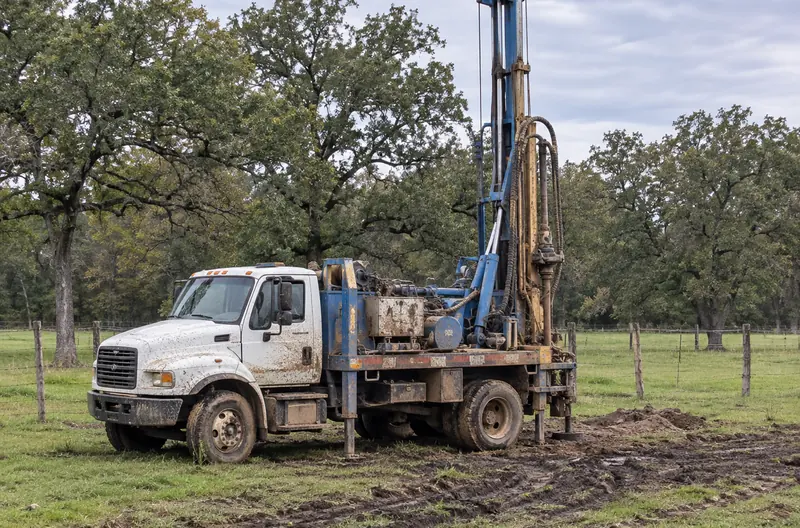
A driller's license number must be marked on rigs like the one in Figure 6-1.1 You can look the name up in TDLR's license search before you sign.2 Ask whether the driller has wells on record near you, and then read those reports, as Chapter 5 described.
Before any machine digs, call 811. Texas law requires notice for mechanized digging, not earlier than the 14th day before and not later than the 48th hour before the work begins, excluding weekends and holidays.5 Know the limit of that call: lines serving only you on your own land are outside the law's marking, so your own lines will not be marked. Water and sewer operators may not get notice either. Tell the driller what you know about your own buried lines. Chapter 13 goes further.
6-3 Where a well may go
Location rules work from the sources of contamination outward. These are from 16 TAC 76.100, and TDLR's guidance matches them in substance.6 7
| From | Distance |
|---|---|
| Livestock or poultry yards, cemeteries, pesticide mixing or loading, privies, existing or proposed | 150 feet |
| Septic absorption field, spray area or dry litter poultry facility, existing or proposed | 100 feet |
| Any water-tight sewage and liquid-waste collection facility, including a septic tank | 50 feet |
| Adjacent property line, if source distances are met | 50 feet |
Those are the rule's figures, and there is a way to shorten them. Source distances "may be decreased to a minimum of fifty (50) feet" if the well is pressure-cemented from 100 feet to the surface with extra annular space, and the same work lets a well "encroach up to five (5) feet of the adjacent property line."6 The property line rule falls away in a district with its own spacing rules, where property restrictions regulate spacing, or where public wastewater is used.6
The septic rules look at the same pair from the other side. TCEQ's 2017 compilation lists wells at 50 feet from a tank and 100 feet from soil absorption, drip or spray. That rule was amended in 2023, so confirm the current table with the authorized agent.8 An AgriLife sheet lists further distances "According to Texas law," including 250 feet from a manure stack or liquid waste disposal system.9 That 250-foot figure was not found in 76.100, so this book does not print it as law. Ask TDLR what binds you.
6-4 Construction, in outline
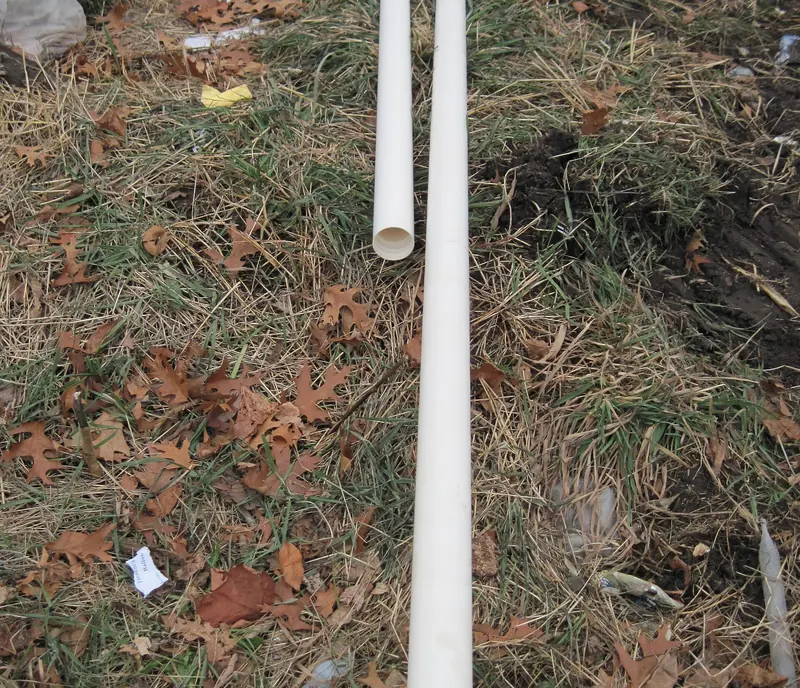
Casing must be "watertight pipe." Plastic casing runs at a minimum of SDR 26, and steel must be new ASTM A-53 Grade or better. The annular space, to at least ten feet, must be 3 inches larger than the casing.6 A test well must be completed or plugged within six months.6 Figure 6-2 shows the sort of plastic casing these rules concern.
Low or flood-prone ground gets a stricter top. Such wells "shall be completed with a watertight sanitary well seal... and a steel sleeve extending a minimum of thirty-six (36) inches above ground level and twenty-four (24) inches below the ground surface."6 A river-bottom tract in Red River County might face that requirement, and Chapter 9 explains the stakes. A well sitting inside a public system's sanitary easement must instead meet public well standards in 30 TAC ch. 290.6
6-5 The paper that follows
The driller records strata, water-bearing strata and casing, and must send a copy "Not later than the 60th day" to TDLR, to TCEQ and to the owner.1 That log is the well's record. An owner can ask for it to be kept confidential, by certified mail to TDLR.1 Keep your copy with the deed, since whoever owns the land next will need it (ordinary practice).
If you decide against a well, or a test hole fails, the duty to plug or cap applies, and Chapter 11 explains it. In Fannin County, ask the Red River GCD first, because a permit or registration may apply.
Who decides this
- Does this driller hold a license?
- TDLR's license search
- May you drill on your own land yourself?
- The statute says yes on two conditions; ask TDLR which construction rules still bind you
- Is a district permit needed?
- The groundwater district, where one exists; Appendix A shows what is known
- What distance to a septic system applies?
- TDLR for the well, and the authorized agent for the septic rule
- Who connects the pump's electricity?
- A licensed person
On your own place
- Pace off the likely well site from the septic field, tank, livestock pens and property lines, and sketch the distances.
- Ask neighbors whether the site floods.
- Look up the driller's name and number with TDLR before signing.
- Mark what you know of your own buried water and power lines for the driller.
- Call 811 ahead of the rig, inside the notice window.
- Note the date the work ends, and expect your well log within 60 days.
Notes
- Texas Occupations Code ch. 1901, sections 1901.001(15), 1901.002, 1901.151, 1901.251 and 1901.252. tcss.legis.texas.gov (read November 4, 2026) ↩
- Texas Department of Licensing and Regulation, Water Well Drillers and Pump Installers. tdlr.texas.gov (read November 4, 2026) ↩
- Cornell LII copy of 16 TAC 76.72. law.cornell.edu (read November 4, 2026) ↩
- Texas Occupations Code sections 1902.001(5) and 1902.052. tcss.legis.texas.gov (read November 4, 2026) ↩
- Texas Utilities Code ch. 251, sections 251.003, 251.151 and 251.153. tcss.legis.texas.gov (read November 4, 2026) ↩
- Cornell LII copy of 16 TAC 76.100. law.cornell.edu (read November 4, 2026) ↩
- Texas Department of Licensing and Regulation, Drilling and Installing a Well. tdlr.texas.gov (read November 4, 2026) ↩
- TCEQ, On-Site Sewage Facility Rules Compilation, RG-472, May 2017, section 285.91 Table X. Amended 2023; confirm the current table. tceq.texas.gov (read November 4, 2026) ↩
- Texas A&M AgriLife, Water Well Basics, ESC-013. twon.tamu.edu (read November 4, 2026) ↩