Stretch I. Where the water comes from
Reading your annual water report
What does your water report actually tell you?
Chapter 4 of 34. Sources checked .
It tells you where your system's water comes from, which regulated contaminants were detected, how those levels compare with the legal limits, and whether any rule was broken. It describes the system's samples for the year, not your own tap on the day you read it. It does not cover a private well at all.
4-1 What the law makes them send
Chapter 2 named the seller and Chapter 3 got you connected. Once you are on, you are owed a report. EPA says "Reports must be sent by your water supplier each year by July 1." Each one lists the source, a summary of contamination risk, regulated contaminants found, health effects of any violation, actions to restore safe water, and notes on nitrate, arsenic and lead.1 Texas's rule says "Each community water system must provide to its customers an annual report," and "detected" means "at any level equal to or greater than the minimum detection level."2
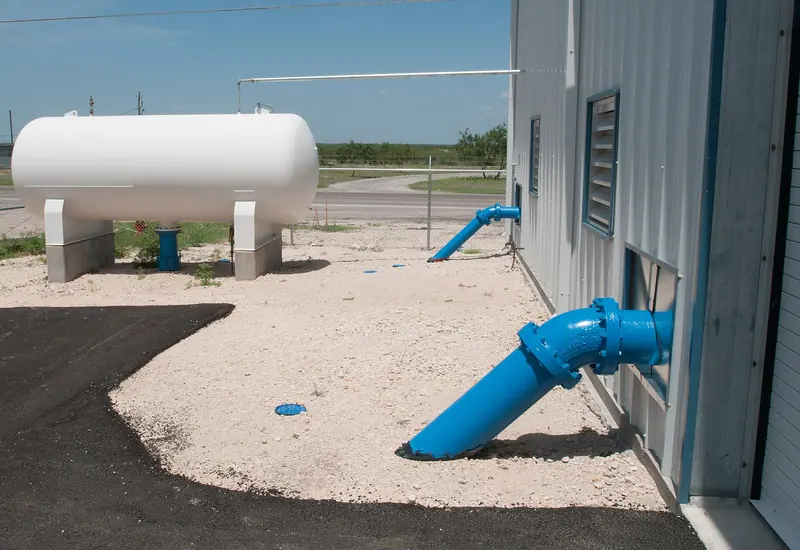
The word "detected" trips people. A line in the table means someone found a measurable amount, which is a different claim from a violation. Compare the number with the limit beside it. Figure 4-1 shows the sort of place those samples begin, and the report covers what happens between there and the taps tested.
4-2 Words in the table
Three terms do most of the work. These are the definitions as a Lamar County report prints them.3
| Term | Definition as printed |
|---|---|
| MCL | "The highest permissible level of a contaminant in drinking water." |
| MCLG | "The level of a contaminant in drinking water below which there is no known or expected health risk." |
| Action Level | "The concentration of a contaminant which, if exceeded, triggers treatment or other requirements" |
| ppm | Milligrams per liter |
4-3 One real report, read through
Lamar County Water Supply District's 2023 report makes a good teacher. It opens "Our Drinking Water Meets or Exceeds All Federal (EPA) Drinking Water Requirements."3 These figures rest on a scan of it, so check your own copy.
| Item | Reported | Limit or level |
|---|---|---|
| Nitrate | 0.252 mg/L | MCL 10 |
| Fluoride | 0.743 mg/L | MCL 4.0 |
| Total trihalomethanes | Average 54.46 ppb | MCL 80 |
| Lead | No sites over the action level | Action level 15 |
| Total coliform | Highest month, 3 positive samples | Level 1 assessment required and completed |
Most of that reads easily: well under the limit, line after line. The coliform row asks for slower reading. Positive samples led to a required assessment, and the report says it was completed. A good headline sentence and a line like that can both be true, which is why you read the table as well as the opening.
Also notice what the report does not say about your own place. Lead results are for the sites sampled. Trihalomethanes are an average for the system. Nothing in the table has tested the long line from your meter to your house. If your own water changes, or you have a reason to worry, a test at your own tap answers a question the report cannot (ordinary practice).
4-4 What may be missing
Some reports add useful lines that are not regulated. The same 2023 report gives hardness 56.2 mg/L, sodium 19.6, total dissolved solids 119 and alkalinity 38.2.3 That hardness is "soft" on the USGS scale, which runs "0 to 60 mg/L" for soft.4 So a claim that all water around here is hard does not hold for this system, and it says nothing about the next one. Hardness depends on the source.
Others leave those lines out, and that is allowed: "These constituents are not causes for health concern. Therefore, secondaries are not required to be reported in this document."3 North Hopkins WSC's 2025 report gives calcium, magnesium and sodium without stating hardness.5 Red River County WSC's 2024 table shows 56.8 mg/L, yet a note in it refers to Lamar County WSD, so that figure may describe purchased water and not its wells.6
For Paris, the city's site could not be reached when checked. A listing of its report names the lakes, but no hardness figure was seen, and this book will not assume it matches the District's. Ask the city for its current report.7
Sodium deserves its own glance. AgriLife says "persons on low sodium diets should consult their physician for levels above 20 ppm."8 EPA's guidance level of 20 mg/L was set for people on a restricted diet and "should not be extrapolated to the entire population."9
4-5 If you want your own numbers
Figure 4-2 is the point where the report stops. If hardness matters to you, you can ask your system for the figure, or measure at the tap. One store sells a hardness, iron and pH field test kit (Quality Water Treatment, run by the same team as this book). By its name, it reads those three things only. Bacteria and nitrate are lab work, explained in Chapter 7. Softeners and filters wait for Chapter 20, and only if your test shows a reason.
Private wells stand apart from all this. AgriLife notes that "private water wells are not required to meet the national drinking standards," though owners can use them as a yardstick.10 Nobody sends you a report. On a well, you become the one who has to commission the numbers.
Who decides this
- Where is this year's report?
- Your water system; EPA also keeps a search tool
- What does a coliform or other line mean for my system?
- Your water system's operator, then TCEQ
- Is a level safe for my diet or my baby?
- Your physician, with the report in hand
- Is my private well covered?
- No system reports on it. See Chapter 7
On your own place
- Lay this year's report and last year's side by side.
- Write down each source named, and whether your system buys from another one.
- Compare every detected line with its limit, and note any that changed.
- Read every sentence about a violation or assessment, even if the opening is reassuring.
- Look for hardness and sodium lines. If they are missing, ask the office for them.
- Note the date on the report. If none has arrived by July, ask for it.
Notes
- US EPA, CCR Information for Consumers. epa.gov (read November 4, 2026) ↩
- Cornell LII copy of 30 TAC 290.271. law.cornell.edu (read November 4, 2026) ↩
- Lamar County Water Supply District, Consumer Confidence Report 2023, machine-read scan. lamarcountywatersupply.myruralwater.com (read November 4, 2026) ↩
- US Geological Survey, Hardness of Water. usgs.gov (read November 4, 2026) ↩
- North Hopkins WSC, 2025 Consumer Confidence Report. northhopkinswsc.myruralwater.com (read November 4, 2026) ↩
- Red River County WSC, 2024 Consumer Confidence Report, machine-read scan. redrivercountywsc.myruralwater.com (read November 4, 2026) ↩
- City of Paris, 2023 Drinking Water Quality Report. Search listing only; the city's site could not be reached. paristexas.gov (read November 4, 2026) ↩
- Texas A&M AgriLife, Description of Water Analysis Parameters. twon.tamu.edu (read November 4, 2026) ↩
- US EPA, Drinking Water Advisory: Consumer Acceptability Advice and Health Effects Analysis on Sodium, February 2003. epa.gov (read November 4, 2026) ↩
- Texas A&M AgriLife, Drinking Water Problems: Nitrates. twon.tamu.edu (read November 4, 2026) ↩