Stretch IV. In and under the house
Plumbing under a house on piers
What goes wrong with plumbing under a pier-and-beam house?
Chapter 19 of 34. Sources checked .
Three things, mostly. Cold reaches pipes in the open air under the floor, old iron drains wear out, and a house that shifts on clay can strain the joints. You can see much of this from the access hatch. Repairs underneath belong to a licensed plumber.
19-1 Why this house is different from a slab
Chapter 18 dealt with pipes you never get to see. A house on piers gives you the opposite problem. The pipes are right there, hung under the floor in moving air, and you can look at them from the hatch.
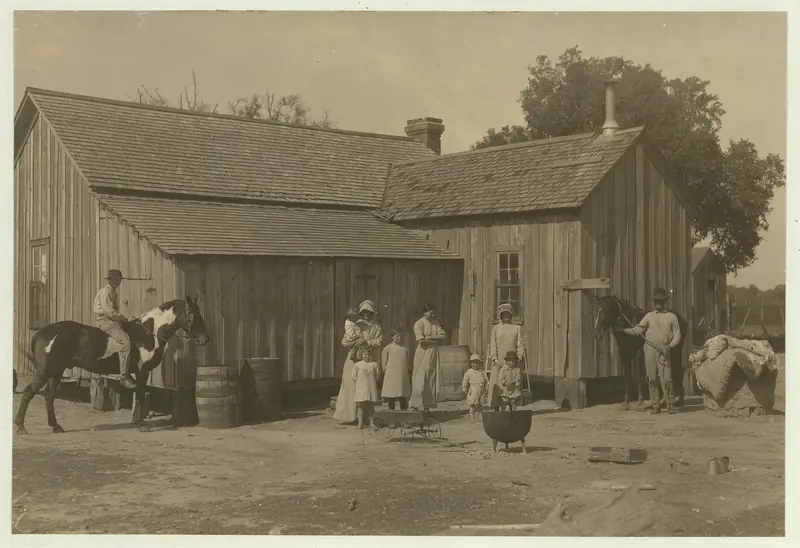
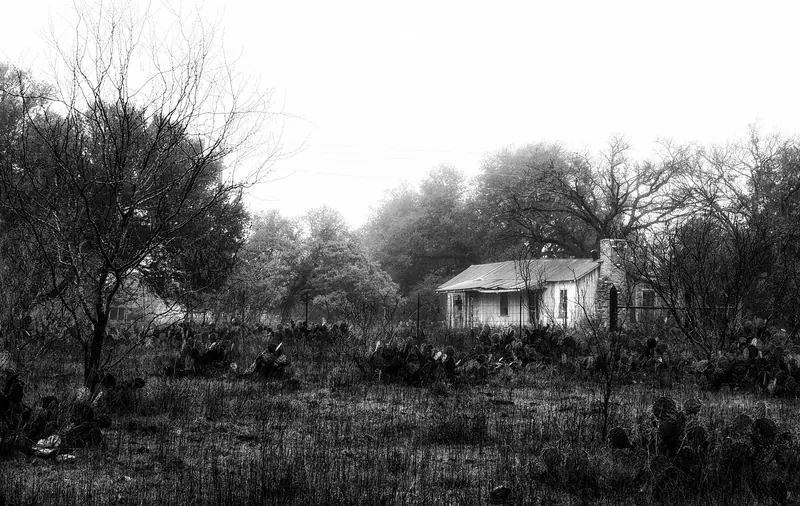
Older country houses were often built up off the ground. Figure 19-1 is a Texas tenant farm from 1913, whose board house appears to sit up on blocks, and Figure 19-2 is a small farmhouse of unstated date, from Central Texas, not this region. Plumbing arrived in many such houses after they were built, so what is under the floor may be several generations of work laid on top of one another. Those two points are ordinary observation.
19-2 Cold comes from below
AgriLife says water pipes "have the potential to freeze and burst when the outside temperature reaches 20 °F or below," and it lists pipes in crawl spaces among the exposed ones.1 On a pier house that is most of the supply line. AgriLife names a pipe sleeve and UL-listed heat tape as protection, and skirting around the house is ordinary practice on top of that. Chapter 28 sets out the rest before the cold, and Chapter 29 covers what to do once it has happened.
Do not crawl under a house in a storm to thaw anything. The state's review of the 2021 storm listed "engaging in outdoor repair activity during the storm" among the risk factors for hypothermia deaths.2 And open flame under a wooden floor is out of the question at any time. AgriLife warns against a "blowtorch, kerosene or propane heater, charcoal stove, or other open flame devices."1
19-3 Drains, slope and old iron
Drain pipes work by gravity. AgriLife describes the line from the house to the system as piping "on a slope to allow gravity to move the waste and water."3 So a drain depends on staying at its pitch, and on a pier house it hangs from a floor that may move.
The clay is the reason it may. The 1979 soil survey of Lamar and Delta counties says of its largest map unit that the soils "shrink and swell greatly with changes in moisture content," and it calls them "corrosive."4 Clay under a pier does the same as clay under a slab. The Texas Department of Licensing and Regulation says that soil with high moisture "will heave (swell), causing a building to be lifted," and low moisture will "collapse."5 No official source was found saying this breaks pipes under a pier house. It is an inference from the soil and the common experience of plumbers, and you should weigh it as that. Chapter 14 takes the same care with the long line.
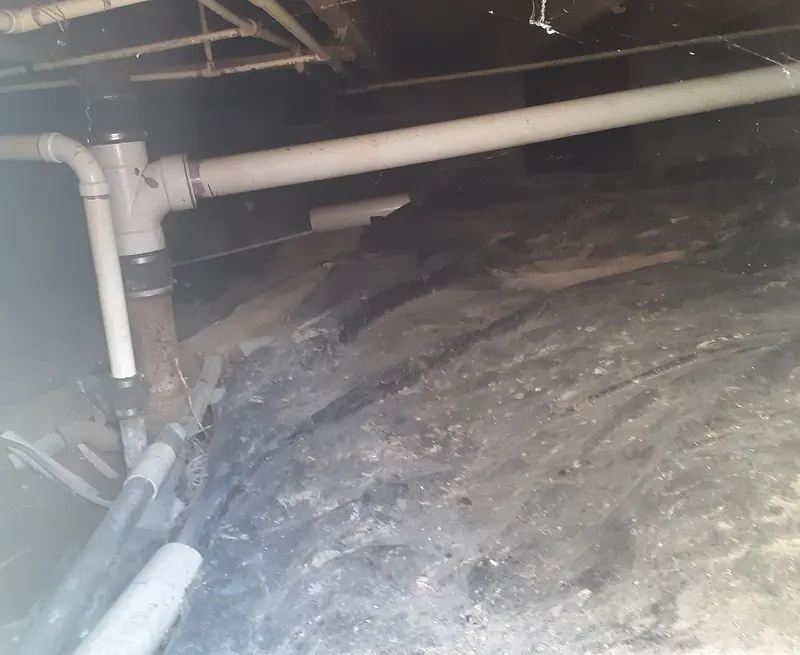
Figure 19-3 is the view you want to learn to read. White plastic drain lines meet an old rusted iron stack, with a plastic sheet over the dirt below. Where iron meets plastic, the joint is often made with a banded coupling, and no-hub fittings (Plumbing Supply and More, run by the same team as this book) are one kind, sold at one place linked here so you can recognize the word. Knowing the name helps you follow what a plumber tells you. It is not a suggestion to do that joint yourself.
19-4 Looking, and stopping at the hatch
Look from the access opening with a good flashlight. That is the job this chapter gives you. What follows is ordinary practice.
| What you see or smell | What it may mean | What to do |
|---|---|---|
| Damp dirt or a wet sheet under one spot | A supply or drain leak | Note the spot, run the meter test, call a licensed plumber |
| Rust stains or weeping on an iron pipe | An old drain wearing through | Photograph from the hatch, call a licensed plumber |
| A sagging run of pipe, or pipe off its hanger | Drain may have lost its slope | Call a licensed plumber |
| Sewage smell, or standing water | A broken drain, or water near wiring | Stay out, call a licensed plumber; for wiring, the electric provider or a licensed electrician |
| Gas or propane smell | A gas leak | Leave the building first. No switches, phones or flames inside. Call 911 and the gas utility or propane supplier from outside, and do not go back in |
The last row outranks everything here. Propane vapors "are heavier than air and may accumulate in low-lying areas," the Railroad Commission says, and a crawlspace is one.6 Chapter 33 has it in full.
Past the hatch, this book stops. It gives no instructions for crawling in, cutting pipe or re-hanging drains. The legal side runs the same way as under a slab. Chapter 31 quotes the homestead exemption and sets out who may do the rest.7 Gas piping counts as plumbing under the statute's definition, and this book's answer is that it goes to a licensed plumber or, for an LP gas system, a licensed LP gas installer.
Who decides this
- Who may repair a drain under the house?
- A licensed plumber; see Chapter 31
- Whose job is gas piping under the floor?
- A licensed person; a gas smell means leave first, with no switches, phones or flames inside, and call 911 and the utility or supplier from outside
- Does a shifting house need more than a plumber?
- A structural engineer or foundation specialist you hire
- Is a permit needed?
- The city inside city limits; see Chapter 32
On your own place
- Clear whatever blocks the hatch, so anyone called out in an emergency reaches it fast.
- On a dry day, shine a light through the hatch and note what you can see: iron, plastic, copper, sheeting.
- Take photographs from the opening, and date them for comparing next year.
- Check that skirting and vents are as you want them before the first hard freeze.
- Find the main shutoff, and note where the long line from Chapter 12 enters the house.
- After a long dry spell and again after heavy rain, note any door that sticks or floor that seems to slope differently.
Notes
- Texas A&M AgriLife, Winter Storms: Frozen Pipes. texashelp.tamu.edu (read November 4, 2026) ↩
- Texas Department of State Health Services, February 2021 Winter Storm mortality report, December 31, 2021. dshs.texas.gov (read November 4, 2026) ↩
- Texas A&M AgriLife, Responding to Power Outages and Floods, L-5475. ossf.tamu.edu (read November 4, 2026) ↩
- USDA Soil Conservation Service, Soil Survey of Lamar and Delta Counties, Texas, 1979, machine-read Internet Archive scan, not the agency's site. archive.org (read November 4, 2026) ↩
- Texas Department of Licensing and Regulation, Industrialized Housing and Buildings Technical Bulletin 10-01. tdlr.texas.gov (read November 4, 2026) ↩
- Railroad Commission of Texas, propane safety sheet. rrc.texas.gov (read November 4, 2026) ↩
- Texas Occupations Code ch. 1301, sections 1301.051 and 1301.002(7). tcss.legis.texas.gov (read November 4, 2026) ↩