Stretch I. Where the water comes from
Getting on a water supply corporation
How do you get on a water supply corporation?
Chapter 3 of 34. Sources checked .
You apply to the corporation, meet the conditions in its tariff, grant any easements it needs, and pay its membership and tap fees. Membership usually follows ownership of the land, but holding one does not by itself turn on the water. If a fee looks wrong, a state appeal exists, with short deadlines that start when you get the quote.
3-1 What membership is
Chapter 2 sorted out who sells the water. If the seller is a water supply corporation, you buy in as a member. A member is someone who holds a membership and is a record owner of fee simple title to property in the served area, or who is granted a membership and receives or will be eligible for service. Votes are even: "a person is entitled to only one vote regardless of the number of memberships the person owns."1
A membership is not freely sold. It may pass by will, or as a free transfer to a relative within the second degree, or back to the corporation. It does move, though, "as part of the conveyance of real estate from which the membership or other right of participation arose."2 A foreclosure buyer who proves the purchase must be reassigned a canceled membership.2
Now the catch that surprises buyers. Transfer "does not entitle the transferee to water or sewer service unless each condition for water or sewer service is met."2 On the good side, those conditions "may not require a personal appearance in the office" if the transferee agrees in writing.2 So a closing that hands you a membership certificate has handed you a place in line. Call the office and ask what remains.
3-2 The tariff decides almost everything
Every corporation "shall file with the utility commission tariffs showing all rates" and rules, and the filing is "for informational purposes only."3 So the state keeps a copy, and the document itself governs you. North Hopkins WSC's draft bylaws say: "All rates, fees, charges, deposits, billing cycles, conditions of service, extension policies, disconnection procedures... are established in the Corporation's tariff."4
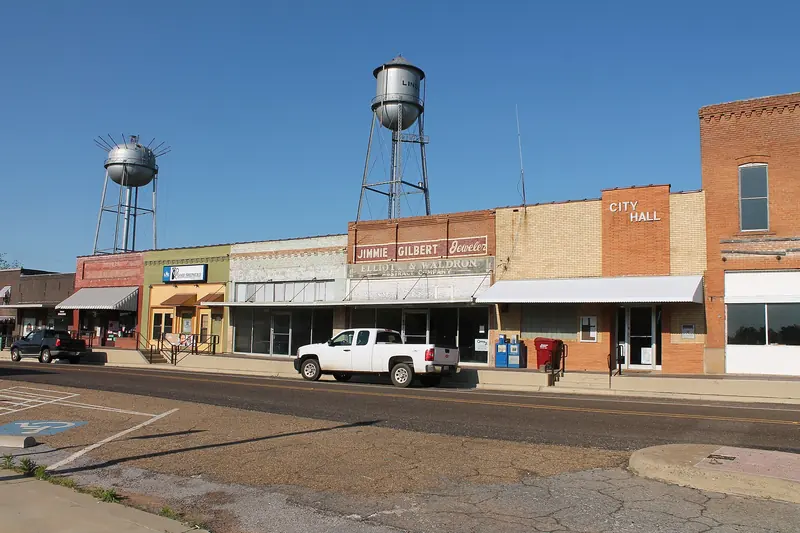
Ask for your corporation's tariff or service rules before you pay anything. The state's site would not open when this was checked, so the examples here come from documents the systems post themselves. Lamar County Water Supply District is a district rather than a corporation, but its posted rules show the same machinery and they are the most local example available. Yours may differ in any line. Figure 3-1 shows two steel water towers over a main street, and neither one says what a tariff requires.
3-3 Standard and non-standard service
Most of the cost turns on one distinction. Lamar County WSD's standard service is "service on an existing pipeline where pipeline or service facility extensions are not required," typically with a 5/8 x 3/4 or 3/4 inch meter. Anything else is non-standard. It aims to set a tap "within ten (10) working days whenever practicable, but not later than fifteen (15) working days," and a cost quote holds for 30 days.5 Those figures are that District's own.
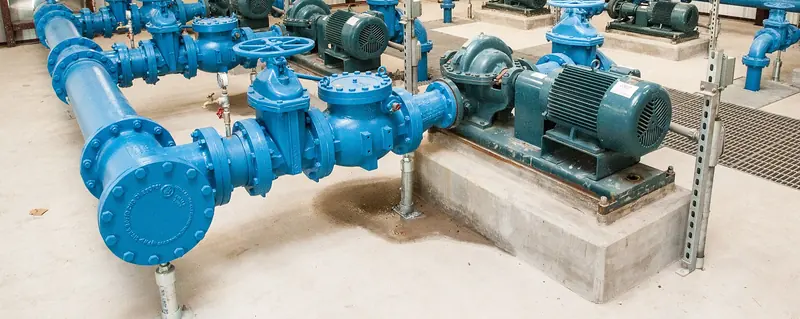
Non-standard is where the larger bills live. Extensions are "the sole responsibility of the property owner and/or developer."5 At Cypress Springs SUD, a single tract may become non-standard because of road bores, extensions, meters over 5/8 x 3/4, or service lines over 3/4 inch and over 100 feet long. Its August 2024 packet asks a $1,000 investigation fee and adds a 10 percent development fee on subdivisions. Check its current fee sheet, since those two charges are written with subdivisions in mind.6 Figure 3-2 gives a sense of what sits behind a tap. A line extension connects you to a real plant somebody has to pay for.
| Item | Standard | Non-standard |
|---|---|---|
| Main | Already at the property | Needs an extension |
| Meter | 5/8 x 3/4 or 3/4 inch | Larger meter |
| Road | No bore | May need a road bore |
| Timing | Lamar County WSD: up to 15 working days | Set by the project |
| Who pays for extension | Not applicable | Owner or developer |
3-4 Easements, inspection and one meter
Expect to be asked for easements. Lamar County WSD lists among its reasons for denial "Failure of the Applicant to provide all required easements and forms and to pay all required fees and charges."5 If a past owner refused an easement and the main went into the road, the applicant "shall grant the easements required" and pay "to cap the existing line in the ROW and construct the appropriate line or lines within that easement."5 Walston Springs WSC's rules use the same words.7
Before continuous service reaches new construction, a customer service inspection certificate "shall be completed."8 It looks for cross-connections and illegal lead materials, and it is not a plumbing inspection. This matters if you also have a well, since the District's rules say "No cross-connection between the water supply and a private water system is permitted."5 Chapter 17 covers that, and Chapter 12 settles who owns the pipe after the meter.
Count your buildings too. The District allows "No more than one (1) residential, commercial, or industrial service connection" per meter.5 A second house may well mean a second meter, so ask before you trench.
3-5 When the answer or the fee is wrong
If refused, "the District must notify the Applicant, in writing, of the basis of its refusal," and you may appeal in writing to its board.5 Check your own system's process, which will sit in its tariff.
The state offers two appeals on money, and they run on different clocks. An applicant may appeal whether "the regular membership fee or tap fee" matches the tariff, starting "not later than the 30th day after the date the water supply or sewer service corporation provides the applicant with the cost of obtaining service." The Public Utility Commission can only order an amount consistent with the tariff.3 Any other amount required to obtain service may be appealed "within 90 days after the date written notice is provided," and the question includes whether it is "reasonably related to the cost of installing on-site and off-site facilities."3 Keep every written quote with its date. Whether a charge fits a particular case is unsettled until someone rules on it.
Who decides this
- What are the fees and conditions?
- The corporation, in its tariff
- Is this tap standard or non-standard?
- The corporation's office, after it looks at the site
- What happens after a refusal?
- The corporation's board, in writing, under its own rules
- Does this fee match the tariff?
- The Public Utility Commission, within the 30 or 90 days above
- Who inspects before service starts?
- A TSBPE-licensed plumbing inspector or water supply protection specialist, or a TCEQ-licensed customer service inspector
On your own place
- Get the tariff or service rules and read the sections on membership, extensions and easements.
- Ask whether the membership on this land is active and what conditions remain for service.
- Mark where the main actually runs, on paper, from what the system tells you.
- Ask for the cost quote in writing and write the date you got it on your calendar, with 30 and 90 days counted out.
- List every building you want served, and ask how many meters that means.
- Call 811 before any trench is cut. Your own line will not be marked.
Notes
- Texas Water Code section 13.002(11). tcss.legis.texas.gov (read November 4, 2026) ↩
- Texas Water Code sections 67.007 and 67.016. tcss.legis.texas.gov (read November 4, 2026) ↩
- Texas Water Code sections 13.136(c), 13.043(g) and 13.043(g-1). tcss.legis.texas.gov (read November 4, 2026) ↩
- North Hopkins WSC, draft bylaws, machine-read scan, pending member approval as read. northhopkinswsc.myruralwater.com (read November 4, 2026) ↩
- Lamar County Water Supply District, Service Rules and Regulations, machine-read scan. lamarcountywatersupply.myruralwater.com (read November 4, 2026) ↩
- Cypress Springs SUD, Non-Standard Service Application, August 2024. cssudpay.myruralwater.com (read November 4, 2026) ↩
- Walston Springs WSC, Service Rules and Regulations, approved March 2014. County not confirmed. walstonspringswsc.myruralwater.com (read November 4, 2026) ↩
- Cornell LII copy of 30 TAC 290.46(j). law.cornell.edu (read November 4, 2026) ↩